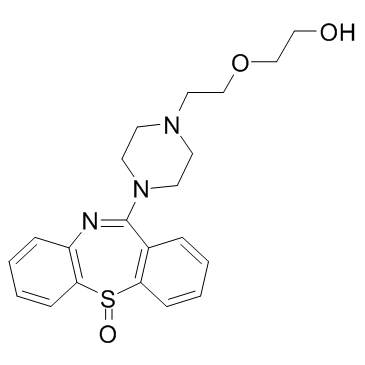
Quetiapine sulfoxide (Quetiapine S-oxide) is a major metabolite of Quetiapinem, which is a second-generation antipsychotic acting as a 5-HT receptor agonist and a dopamine receptor antagonist.
Physicochemical Properties
| Molecular Formula | C21H25N3O3S |
| Molecular Weight | 399.5065 |
| Exact Mass | 399.161 |
| Elemental Analysis | C, 63.14; H, 6.31; N, 10.52; O, 12.01; S, 8.02 |
| CAS # | 329216-63-9 |
| Related CAS # | Quetiapine;111974-69-7;Quetiapine hemifumarate;111974-72-2;Quetiapine sulfoxide dihydrochloride;329218-11-3;Quetiapine sulfoxide hydrochloride;2448341-72-6;Quetiapine Sulfoxide-d8;1330238-38-4 |
| PubChem CID | 10431050 |
| Appearance | Typically exists as solid at room temperature |
| Density | 1.4±0.1 g/cm3 |
| Boiling Point | 611.3±65.0 °C at 760 mmHg |
| Melting Point | -48ºC |
| Flash Point | 323.5±34.3 °C |
| Vapour Pressure | 0.0±1.8 mmHg at 25°C |
| Index of Refraction | 1.675 |
| LogP | -0.51 |
| Hydrogen Bond Donor Count | 1 |
| Hydrogen Bond Acceptor Count | 7 |
| Rotatable Bond Count | 6 |
| Heavy Atom Count | 28 |
| Complexity | 515 |
| Defined Atom Stereocenter Count | 0 |
| SMILES | OCCOCCN(CC1)CCN1C2=NC(C=CC=C3)=C3S(C4=C2C=CC=C4)=O |
| InChi Key | FXJNLPUSSHEDON-UHFFFAOYSA-N |
| InChi Code | InChI=1S/C21H25N3O3S/c25-14-16-27-15-13-23-9-11-24(12-10-23)21-17-5-1-3-7-19(17)28(26)20-8-4-2-6-18(20)22-21/h1-8,25H,9-16H2 |
| Chemical Name | 2-[2-[4-(11-oxobenzo[b][1,4]benzothiazepin-6-yl)piperazin-1-yl]ethoxy]ethanol |
| Synonyms | Quetiapine Sulfoxide; 329216-63-9; Quetiapine S-Oxide; Ethanol, 2-[2-[4-(5-oxidodibenzo[b,f][1,4]thiazepin-11-yl)-1-piperazinyl]ethoxy]-; 2-[2-[4-(11-oxobenzo[b][1,4]benzothiazepin-6-yl)piperazin-1-yl]ethoxy]ethanol; Quetiapine metabolite Quetiapine sulfoxide; 1CW92313VM; 2-(2-(4-(5-Oxidodibenzo(b,f)(1,4)thiazepin-11-yl)piperazin-1-yl)ethoxy)ethanol; |
| HS Tariff Code | 2934.99.9001 |
| Storage |
Powder-20°C 3 years 4°C 2 years In solvent -80°C 6 months -20°C 1 month |
| Shipping Condition | Room temperature (This product is stable at ambient temperature for a few days during ordinary shipping and time spent in Customs) |
Biological Activity
| Targets | Major metabolite of Quetiapine |
| ln Vivo | The estimated Cmax value of quetiapine sulfoxide is 77.3 ± 32.4 ng/mL (mean ± SD). For quetiapine sulfoxide, the calculated AUClast value is 1,286±458 ng·h/mL. The metabolic rate for quetiapine sulfoxide falls with time, averaging 30% after 72 hours following dosage compared to an average of 119% within 2 hours [1]. |
| ADME/Pharmacokinetics |
Metabolism / Metabolites Quetiapine Sulfoxide is a known human metabolite of quetiapine. |
| References |
[1]. Comparison of Capillary and Venous Drug Concentrations After Administration of a Single Dose of Risperidone, Paliperidone, Quetiapine, Olanzapine, or Aripiprazole. Clin Pharmacol Drug Dev. 2016 Nov;5(6):528-537. [2]. Quetiapine and its metabolite norquetiapine: translation from in vitro pharmacology to in vivo efficacy in rodent models. Br J Pharmacol. 2016 Jan;173(1):155-66. |
| Additional Infomation |
Background and purpose: Quetiapine has a range of clinical activity distinct from other atypical antipsychotic drugs, demonstrating efficacy as monotherapy in bipolar depression, major depressive disorder and generalized anxiety disorder. The neuropharmacological mechanisms underlying this clinical profile are not completely understood; however, the major active metabolite, norquetiapine, has been shown to have a distinct in vitro pharmacological profile consistent with a broad therapeutic range and may contribute to the clinical profile of quetiapine.
Experimental approach: We evaluated quetiapine and norquetiapine, using in vitro binding and functional assays of targets known to be associated with antidepressant and anxiolytic drug actions and compared these activities with a representative range of established antipsychotics and antidepressants. To determine how the in vitro pharmacological properties translate into in vivo activity, we used preclinical animal models with translational relevance to established antidepressant-like and anxiolytic-like drug action.
Key results: Norquetiapine had equivalent activity to established antidepressants at the noradrenaline transporter (NET), while quetiapine was inactive. Norquetiapine was active in the mouse forced swimming and rat learned helplessness tests. In in vivo receptor occupancy studies, norquetiapine had significant occupancy at NET at behaviourally relevant doses. Both quetiapine and norquetiapine were agonists at 5-HT1A receptors, and the anxiolytic-like activity of norquetiapine in rat punished responding was blocked by the 5-HT1A antagonist, WAY100635.
Conclusions and implications: Quetiapine and norquetiapine have multiple in vitro pharmacological actions, and results from preclinical studies suggest that activity at NET and 5-HT1A receptors contributes to the antidepressant and anxiolytic effects in patients treated with quetiapine. [1] Risperidone, paliperidone, quetiapine, olanzapine, and aripiprazole are antipsychotic drugs approved for treating various psychiatric disorders, including schizophrenia. The objective of this randomized, parallel-group, open-label study was to compare finger-stick-based capillary with corresponding venous whole-blood and plasma concentrations for these drugs after administration of a single dose to healthy volunteers. All whole-blood and plasma drug concentrations were measured with validated liquid chromatography-tandem mass spectrometry methods. Capillary and venous concentrations (both in plasma and whole blood) were in close agreement, although a time-dependent difference was observed, most obviously for olanzapine and paliperidone, with slightly higher capillary versus venous drug concentrations during the first hours after administering a single dose. The observed difference between capillary and venous plasma drug concentrations is expected not to be relevant in clinical practice, considering the wide window of therapeutic concentrations and the wide range of drug concentrations in the patient population for a given dose. Based on these results, finger-stick-based capillary drug concentrations have been shown to approximate venous drug concentrations.[2] |
Solubility Data
| Solubility (In Vitro) | May dissolve in DMSO (in most cases), if not, try other solvents such as H2O, Ethanol, or DMF with a minute amount of products to avoid loss of samples |
| Solubility (In Vivo) |
Note: Listed below are some common formulations that may be used to formulate products with low water solubility (e.g. < 1 mg/mL), you may test these formulations using a minute amount of products to avoid loss of samples. Injection Formulations (e.g. IP/IV/IM/SC) Injection Formulation 1: DMSO : Tween 80: Saline = 10 : 5 : 85 (i.e. 100 μL DMSO stock solution → 50 μL Tween 80 → 850 μL Saline) *Preparation of saline: Dissolve 0.9 g of sodium chloride in 100 mL ddH ₂ O to obtain a clear solution. Injection Formulation 2: DMSO : PEG300 :Tween 80 : Saline = 10 : 40 : 5 : 45 (i.e. 100 μL DMSO → 400 μLPEG300 → 50 μL Tween 80 → 450 μL Saline) Injection Formulation 3: DMSO : Corn oil = 10 : 90 (i.e. 100 μL DMSO → 900 μL Corn oil) Example: Take the Injection Formulation 3 (DMSO : Corn oil = 10 : 90) as an example, if 1 mL of 2.5 mg/mL working solution is to be prepared, you can take 100 μL 25 mg/mL DMSO stock solution and add to 900 μL corn oil, mix well to obtain a clear or suspension solution (2.5 mg/mL, ready for use in animals). Injection Formulation 4: DMSO : 20% SBE-β-CD in saline = 10 : 90 [i.e. 100 μL DMSO → 900 μL (20% SBE-β-CD in saline)] *Preparation of 20% SBE-β-CD in Saline (4°C,1 week): Dissolve 2 g SBE-β-CD in 10 mL saline to obtain a clear solution. Injection Formulation 5: 2-Hydroxypropyl-β-cyclodextrin : Saline = 50 : 50 (i.e. 500 μL 2-Hydroxypropyl-β-cyclodextrin → 500 μL Saline) Injection Formulation 6: DMSO : PEG300 : castor oil : Saline = 5 : 10 : 20 : 65 (i.e. 50 μL DMSO → 100 μLPEG300 → 200 μL castor oil → 650 μL Saline) Injection Formulation 7: Ethanol : Cremophor : Saline = 10: 10 : 80 (i.e. 100 μL Ethanol → 100 μL Cremophor → 800 μL Saline) Injection Formulation 8: Dissolve in Cremophor/Ethanol (50 : 50), then diluted by Saline Injection Formulation 9: EtOH : Corn oil = 10 : 90 (i.e. 100 μL EtOH → 900 μL Corn oil) Injection Formulation 10: EtOH : PEG300:Tween 80 : Saline = 10 : 40 : 5 : 45 (i.e. 100 μL EtOH → 400 μLPEG300 → 50 μL Tween 80 → 450 μL Saline) Oral Formulations Oral Formulation 1: Suspend in 0.5% CMC Na (carboxymethylcellulose sodium) Oral Formulation 2: Suspend in 0.5% Carboxymethyl cellulose Example: Take the Oral Formulation 1 (Suspend in 0.5% CMC Na) as an example, if 100 mL of 2.5 mg/mL working solution is to be prepared, you can first prepare 0.5% CMC Na solution by measuring 0.5 g CMC Na and dissolve it in 100 mL ddH2O to obtain a clear solution; then add 250 mg of the product to 100 mL 0.5% CMC Na solution, to make the suspension solution (2.5 mg/mL, ready for use in animals). Oral Formulation 3: Dissolved in PEG400 Oral Formulation 4: Suspend in 0.2% Carboxymethyl cellulose Oral Formulation 5: Dissolve in 0.25% Tween 80 and 0.5% Carboxymethyl cellulose Oral Formulation 6: Mixing with food powders Note: Please be aware that the above formulations are for reference only. InvivoChem strongly recommends customers to read literature methods/protocols carefully before determining which formulation you should use for in vivo studies, as different compounds have different solubility properties and have to be formulated differently. (Please use freshly prepared in vivo formulations for optimal results.) |
| Preparing Stock Solutions | 1 mg | 5 mg | 10 mg | |
| 1 mM | 2.5031 mL | 12.5153 mL | 25.0307 mL | |
| 5 mM | 0.5006 mL | 2.5031 mL | 5.0061 mL | |
| 10 mM | 0.2503 mL | 1.2515 mL | 2.5031 mL |