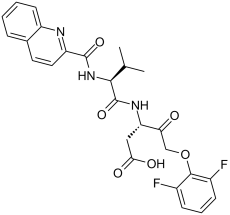
Q-VD-OPh (also known as QVD-OPH; Quinoline-Val-Asp-Difluorophenoxymethylketone) is a novel, potent and irreversible pan-caspase inhibitor with potential anticancer properties. It exhibits inhibitory effects on terminal caspase activation, substrate cleavage, and DNA ladder formation related to apoptosis, with IC50 values for caspases 1, 3, 8, and 9 ranging from 25 to 400 nM. Q-VD-OPh was functional in various cell types and species (human, mouse, and rat) and prevented terminal caspase activation, substrate cleavage, and DNA ladder formation related to apoptosis. It was equally effective at inhibiting the three main apoptotic pathways. The complete suppression of an apoptotic inducer capable of causing significant cell death in less than 4 hours shows the potency of Q-VD-OPh as an apoptotic inhibitor.
Physicochemical Properties
| Molecular Formula | C26H25F2N3O6 | |
| Molecular Weight | 513.49 | |
| Exact Mass | 513.171 | |
| Elemental Analysis | C, 60.82; H, 4.91; F, 7.40; N, 8.18; O, 18.69 | |
| CAS # | 1135695-98-5 | |
| Related CAS # | (R)-Q-VD-OPh | |
| PubChem CID | 24794416 | |
| Appearance | White to off-white solid powder | |
| Density | 1.346±0.06 g/cm3 | |
| Boiling Point | 808.9±65.0 °C at 760 mmHg | |
| Flash Point | 443.0±34.3 °C | |
| Vapour Pressure | 0.0±3.0 mmHg at 25°C | |
| Index of Refraction | 1.591 | |
| LogP | 4.61 | |
| Hydrogen Bond Donor Count | 3 | |
| Hydrogen Bond Acceptor Count | 9 | |
| Rotatable Bond Count | 11 | |
| Heavy Atom Count | 37 | |
| Complexity | 818 | |
| Defined Atom Stereocenter Count | 2 | |
| SMILES | O=C(O)C[C@H](NC([C@@H](NC(C1=NC2=CC=CC=C2C=C1)=O)C(C)C)=O)C(COC3=C(F)C=CC=C3F)=O |
|
| InChi Key | OOBJCYKITXPCNS-REWPJTCUSA-N | |
| InChi Code | InChI=1S/C26H25F2N3O6/c1-14(2)23(31-25(35)19-11-10-15-6-3-4-9-18(15)29-19)26(36)30-20(12-22(33)34)21(32)13-37-24-16(27)7-5-8-17(24)28/h3-11,14,20,23H,12-13H2,1-2H3,(H,30,36)(H,31,35)(H,33,34)/t20-,23-/m0/s1 | |
| Chemical Name | (3S)-5-(2,6-difluorophenoxy)-3-[[(2S)-3-methyl-2-(quinoline-2-carbonylamino)butanoyl]amino]-4-oxopentanoic acid | |
| Synonyms |
|
|
| HS Tariff Code | 2934.99.9001 | |
| Storage |
Powder-20°C 3 years 4°C 2 years In solvent -80°C 6 months -20°C 1 month |
|
| Shipping Condition | Room temperature (This product is stable at ambient temperature for a few days during ordinary shipping and time spent in Customs) |
Biological Activity
| Targets | Caspase-3 (IC50 = 25-400 nM); Caspase-7 (IC50 = 48 nM); Caspase-1 (IC50 = 25-400 nM); Caspase-8 (IC50 = 25-400 nM); Caspase-9 (IC50 = 25-400 nM); Caspase-10 (IC50 = 25-400 nM); Caspase-12 (IC50 = 25-400 nM) |
| ln Vitro | Q-VD-OPh (5-100 μM) potently inhibits Actinomycin D-induced DNA laddering and subsequent apoptosis with minimal toxicity in WEHI 231 cells. The major initiator and effector caspases aren't activated and PARP isn't cleaved by caspases, thanks to Q-VD-OPh. [2] In vitro, Q-VD-OPh guards against apoptosis brought on by virus in cardiac myocytes. [4] |
| ln Vivo | Q-VD-OPh inhibits caspase-1 activity, IL-18 protein expression, and neutrophil infiltration during ischemic ARF in mice. [3] In vivo, Q-VD-OPh inhibits caspase with a significant decrease in caspase-3 activity, protecting against virus-induced myocardial injury. [4] Q-VD-OPh inhibits caspase-7 activation in TgCRND8 mice and limits the pathological alterations brought on by tau, including caspase cleavage. [5] |
| Cell Assay | Caspase inhibitors are added at the indicated concentrations 30 minutes prior to the addition of apoptotic stimuli. Trypan blue exclusion from three random fields with more than 200 cells each determines viability and cell count. Every experiment is run at least three times. |
| Animal Protocol |
C57BL/6 mice ~120 mg/kg Intraperitoneal administration |
| References |
[1]. Apoptosis . 2003 Aug;8(4):345-52. [2]. Apoptosis . 2003 Aug;8(4):345-52 [3]. J Clin Invest . 2002 Oct;110(8):1083-91. [4]. J Virol . 2004 Oct;78(20):11040-50. [6]. Int J Clin Exp Med . 2009 Nov 5;2(4):300-8. |
Solubility Data
| Solubility (In Vitro) |
|
|||
| Solubility (In Vivo) |
Solubility in Formulation 1: ≥ 2.08 mg/mL (4.05 mM) (saturation unknown) in 10% DMSO + 40% PEG300 + 5% Tween80 + 45% Saline (add these co-solvents sequentially from left to right, and one by one), clear solution. For example, if 1 mL of working solution is to be prepared, you can add 100 μL of 20.8 mg/mL clear DMSO stock solution to 400 μL PEG300 and mix evenly; then add 50 μL Tween-80 to the above solution and mix evenly; then add 450 μL normal saline to adjust the volume to 1 mL. Preparation of saline: Dissolve 0.9 g of sodium chloride in 100 mL ddH₂ O to obtain a clear solution. Solubility in Formulation 2: ≥ 2.08 mg/mL (4.05 mM) (saturation unknown) in 10% DMSO + 90% (20% SBE-β-CD in Saline) (add these co-solvents sequentially from left to right, and one by one), clear solution. For example, if 1 mL of working solution is to be prepared, you can add 100 μL of 20.8 mg/mL clear DMSO stock solution to 900 μL of 20% SBE-β-CD physiological saline solution and mix evenly. Preparation of 20% SBE-β-CD in Saline (4°C,1 week): Dissolve 2 g SBE-β-CD in 10 mL saline to obtain a clear solution. Solubility in Formulation 3: ≥ 2.08 mg/mL (4.05 mM) (saturation unknown) in 10% DMSO + 90% Corn Oil (add these co-solvents sequentially from left to right, and one by one), clear solution. For example, if 1 mL of working solution is to be prepared, you can add 100 μL of 20.8 mg/mL clear DMSO stock solution to 900 μL of corn oil and mix evenly. Solubility in Formulation 4: 5%DMSO+40%PEG300+5%Tween80+50%ddH2O: 100mg/ml (Please use freshly prepared in vivo formulations for optimal results.) |
| Preparing Stock Solutions | 1 mg | 5 mg | 10 mg | |
| 1 mM | 1.9475 mL | 9.7373 mL | 19.4746 mL | |
| 5 mM | 0.3895 mL | 1.9475 mL | 3.8949 mL | |
| 10 mM | 0.1947 mL | 0.9737 mL | 1.9475 mL |