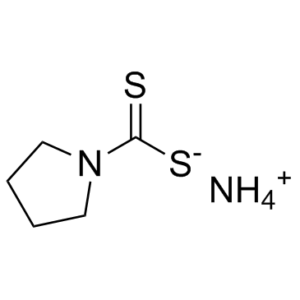
Ammonium pyrrolidine dithiocarbamate (also abbreviated as PDTC) is a potent nuclear factor-κB (NF-κB) inhibitor. It acts by inhibiting IκB phosphorylation, blocking NF-κB translocation to the nucleus, and suppressing the expression of cytokines that are expressed downstream. Pyrrolidinedithiocarbamate induces apoptosis in human acute myelogenous leukemic cells, which affects NF-κB activity, and attenuates bleomycin-induced pulmonary fibrosis in rats. Intestinal epithelial cells' production of IL-8 and NF-B activation are both inhibited by pyrrolidinedithiocarbamate.
Physicochemical Properties
| Molecular Formula | C5H9NS2.H3N | |
| Molecular Weight | 164.29 | |
| Exact Mass | 164.044 | |
| Elemental Analysis | C, 36.56; H, 7.36; N, 17.05; S, 39.03 | |
| CAS # | 5108-96-3 | |
| Related CAS # |
|
|
| PubChem CID | 65351 | |
| Appearance | White to yellow solid powder | |
| Density | 1.264g/cm3 | |
| Boiling Point | 199.7ºC at 760 mmHg | |
| Melting Point | 153-155 °C(lit.) | |
| Flash Point | 74.6ºC | |
| LogP | 1.558 | |
| Hydrogen Bond Donor Count | 1 | |
| Hydrogen Bond Acceptor Count | 2 | |
| Rotatable Bond Count | 0 | |
| Heavy Atom Count | 8 | |
| Complexity | 96.6 | |
| Defined Atom Stereocenter Count | 0 | |
| SMILES | S([H])C(N1C([H])([H])C([H])([H])C([H])([H])C1([H])[H])=S |
|
| InChi Key | MDDIUTVUBYEEEM-UHFFFAOYSA-N | |
| InChi Code | InChI=1S/C5H9NS2.H3N/c7-5(8)6-3-1-2-4-6;/h1-4H2,(H,7,8);1H3 | |
| Chemical Name | azanium;pyrrolidine-1-carbodithioate | |
| Synonyms |
|
|
| HS Tariff Code | 2934.99.9001 | |
| Storage |
Powder-20°C 3 years 4°C 2 years In solvent -80°C 6 months -20°C 1 month Note: Please store this product in a sealed and protected environment, avoid exposure to moisture. |
|
| Shipping Condition | Room temperature (This product is stable at ambient temperature for a few days during ordinary shipping and time spent in Customs) |
Biological Activity
| Targets |
NF-κB
Pyrrolidinedithiocarbamate ammonium (PDTC) targets nuclear factor kappaB (NF-κB) [1] |
| ln Vitro |
Pyrrolidinedithiocarbamate ammonium (Ammonium pyrrolidinedithiocarbamate; 3-1000 μM) pretreatment of cells inhibits IL-8 production in a dose-dependent manner[1]. Additionally, pyrrolidinedithiocarbamate ammonium (100 μM) inhibits IL-8 mRNA accumulation[1]. Because it blocks both NF-κB DNA binding and NF-κB-dependent transcriptional activity, pyrrolidinedithiocarbamate ammonium prevents NF-κB from becoming activated. The production of IL-8 by intestinal epithelial cells is decreased by NF-κB inhibition using pyrrolidinedithiocarbamate ammonium[1]. 1. In the human intestinal epithelial cell line HT-29, pretreatment with Pyrrolidinedithiocarbamate ammonium (PDTC) at concentrations ranging from 3 μM to 1000 μM dose-dependently attenuated IL-1β-induced IL-8 production. At a concentration of 100 μM, PDTC suppressed the accumulation of IL-8 mRNA. Additionally, PDTC inhibited NF-κB activation by suppressing both NF-κB DNA binding activity and NF-κB-dependent transcriptional activity [1] |
| ln Vivo |
Intestinal shortening is suppressed, and the DAI score is lower in the DSS+pyrrolidinedithiocarbamate ammonium-treated group II. The group II treated with DSS and pyrrolidinedithiocarbamate ammonium has significantly lower levels of activated NF-κB level and IL-1β and TNF-α. According to these findings, pyrrolidinedithiocarbamate ammonium can significantly reduce colitis by suppressing the expression of inflammatory cytokines (IL-1β and TNF-α), but it can also delay the healing of mucosal tissue defects (erosions or ulcers) brought on by inflammation. For the treatment of ulcerative colitis, pyrrolidinedithiocarbamate ammonium is helpful[2]. In Sprague-Dawley rats with Bacillus calmette Guérin (BCG)-induced immunological liver injury (BCG pretreatment dose: 125 mg/kg), administration of Pyrrolidinedithiocarbamate ammonium (PDTC) at doses of 50 mg/kg, 100 mg/kg, and 200 mg/kg dose-dependently reversed BCG-induced hepatic injury. BCG pretreatment significantly increased liver weight (by 70%, p < 0.01), spleen weight (by 248%, p < 0.01), serum alanine transaminase (ALT) levels (by 200%, p < 0.01), serum aspartate aminotransferase (AST) levels (by 75.8%, p < 0.01), and the expression of NF-κB (by 228%, p < 0.01) and iNOS (by 303%, p < 0.01), while decreasing CYP2E1 content and metabolic activity (p < 0.05). PDTC (ED50: 76 mg/kg) dose-dependently inhibited the down-regulation of CYP2E1 (p < 0.05) in rat liver tissue with immunological liver injury [2] |
| Cell Assay |
The human colon cancer cell line HT-29 is obtained, and cells are grown in a modified McCoy's 5A medium supplemented with 10% fetal bovine serum. HT-29 cells in 96-well plates are stimulated with 20 ng/mL of IL-1β for 18 hours in order to examine the impact of pyrrolidinedithiocarbamate ammonium on IL-8 production. Thirty minutes before IL-1β stimulation, the cells are given different concentrations (3–1000 μM) of pyrrolidinedithiocarbamate or its vehicle (culture medium). Solid-phase enzyme-linked immunosorbent assay is used to measure the amount of IL-8 in the supernatant[1]. 1. HT-29 human intestinal epithelial cells were pretreated with Pyrrolidinedithiocarbamate ammonium (PDTC) at concentrations of 3 μM, 10 μM, 30 μM, 100 μM, 300 μM, and 1000 μM, followed by stimulation with IL-1β to induce IL-8 production. IL-8 protein production was measured using a suitable immunoassay method, and IL-8 mRNA levels were detected by reverse transcriptase polymerase chain reaction (RT-PCR). NF-κB DNA binding activity was assessed using a DNA-binding assay, and NF-κB-dependent transcriptional activity was evaluated with a reporter gene assay [1] |
| Animal Protocol |
Mice receive intraperitoneal injections of pyrrolidinedithiocarbamate at doses of 100 and 50 mg/kg. The DSS-treated control group, DSS+pyrrolidinedithiocarbamate-treated groupI (low-dose group), DSS+pyrrolidinedithiocarbamate-treated groupII (high-dose group), and DSS-untreated group (normal group) are all given to mice. Intestinal length, histological score, levels of activated NF-κB and inflammatory cytokines (IL-1β and TNF-α) in tissue, as well as the disease activity index score (DAI score) are all measured in each group[2]. Sprague-Dawley rats were used to establish a model of immunological liver injury by pretreatment with Bacillus calmette Guérin (BCG) at a dose of 125 mg/kg. Pyrrolidinedithiocarbamate ammonium (PDTC) was administered to the rats at doses of 50 mg/kg, 100 mg/kg, and 200 mg/kg (administration route not specified). The degree of hepatic injury was evaluated by measuring biochemical parameters (serum ALT and AST levels), hepatic tissue pathological changes, and physiological parameters (liver and spleen weights). Immunohistochemical assay was used to detect the protein localization of liver NF-κB, and western blot analysis was performed to detect the protein expression of NF-κB, IκBα, iNOS, and CYP2E1. ELISA assay was used to detect the content of CYP2E1 in rat liver homogenate, and high-performance liquid chromatography (HPLC) assay was employed to evaluate the enzyme kinetics of the CYP2E1 probe drug chlorzoxazone [2] |
| References |
[1]. Pyrrolidinedithiocarbamate inhibits NF-kappaB activation and IL-8 production in intestinal epithelial cells. Immunol Lett. 2003 Jan 2;85(1):41-6. [2]. Effect of ammonium pyrrolidine dithiocarbamate (PDTC) on NF-κB activation and CYP2E1 content of rats with immunological liver injury. Pharm Biol. 2014 Nov;52(11):1460-1466. |
| Additional Infomation |
Pyrrolidine dithiocarbamate is a member of the class of dithiocarbamic acids that is the N-dithiocarboxy derivative of pyrrolidine. It has a role as an anticonvulsant, a neuroprotective agent, a radical scavenger, an antineoplastic agent, a NF-kappaB inhibitor and a geroprotector. It is a member of pyrrolidines and a member of dithiocarbamic acids. 1. Pyrrolidinedithiocarbamate ammonium (PDTC) is a pharmacological inhibitor of NF-κB. IL-8 produced by intestinal epithelial cells is implicated in the inflammatory process of colitis during inflammatory bowel disease and multiple organ failure following shock and trauma, and NF-κB is a central regulator of IL-8 gene expression [1] 2. Pyrrolidinedithiocarbamate ammonium (PDTC) is a potent inhibitor of NF-κB. NF-κB plays an essential role in the regulation of genes involved in the pathogenesis of immunological liver injury. PDTC inhibits the down-regulation of CYP2E1 and iNOS in rat liver tissue with immunological liver injury, suggesting that NF-κB may be involved in the regulation of CYP2E1 through iNOS [2] |
Solubility Data
| Solubility (In Vitro) |
|
|||
| Solubility (In Vivo) |
Solubility in Formulation 1: 24 mg/mL (146.08 mM) in PBS (add these co-solvents sequentially from left to right, and one by one), clear solution; with sonication. (Please use freshly prepared in vivo formulations for optimal results.) |
| Preparing Stock Solutions | 1 mg | 5 mg | 10 mg | |
| 1 mM | 6.0868 mL | 30.4340 mL | 60.8680 mL | |
| 5 mM | 1.2174 mL | 6.0868 mL | 12.1736 mL | |
| 10 mM | 0.6087 mL | 3.0434 mL | 6.0868 mL |