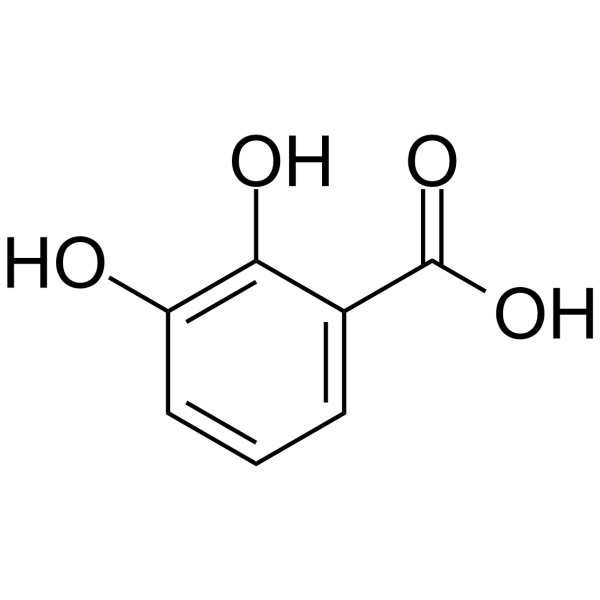
Physicochemical Properties
| Molecular Formula | C7H6O4 |
| Molecular Weight | 154.12014 |
| Exact Mass | 154.026 |
| CAS # | 303-38-8 |
| Related CAS # | 875-28-5 (hydrochloride salt) |
| PubChem CID | 19 |
| Appearance | Off-white to light brown solid powder |
| Density | 1.6±0.1 g/cm3 |
| Boiling Point | 362.5±32.0 °C at 760 mmHg |
| Melting Point | 204-206 °C(lit.) |
| Flash Point | 187.2±21.6 °C |
| Vapour Pressure | 0.0±0.9 mmHg at 25°C |
| Index of Refraction | 1.671 |
| LogP | 1.8 |
| Hydrogen Bond Donor Count | 3 |
| Hydrogen Bond Acceptor Count | 4 |
| Rotatable Bond Count | 1 |
| Heavy Atom Count | 11 |
| Complexity | 157 |
| Defined Atom Stereocenter Count | 0 |
| InChi Key | GLDQAMYCGOIJDV-UHFFFAOYSA-N |
| InChi Code | InChI=1S/C7H6O4/c8-5-3-1-2-4(6(5)9)7(10)11/h1-3,8-9H,(H,10,11) |
| Chemical Name | 2,3-dihydroxybenzoic acid |
| HS Tariff Code | 2934.99.9001 |
| Storage |
Powder-20°C 3 years 4°C 2 years In solvent -80°C 6 months -20°C 1 month |
| Shipping Condition | Room temperature (This product is stable at ambient temperature for a few days during ordinary shipping and time spent in Customs) |
Biological Activity
| ln Vitro | Aspirin consumption raises the levels of pyrocatechuic acid (2,3-dihydroxybenzoic acid), a typical human benzoic acid metabolite that is present in plasma [1]. |
| Enzyme Assay | For detection of Pyrocatechuic acid in human urine and plasma: Collect urine and plasma samples from subjects after oral aspirin administration; acidify samples with dilute acid to stabilize Pyrocatechuic acid; extract the compound using organic solvent; separate the extract via high-performance liquid chromatography (HPLC) with a reverse-phase column; detect and quantify Pyrocatechuic acid via ultraviolet (UV) detection at a wavelength of 290 nm; confirm the identity of the compound by comparing retention time with a standard reference[1] |
| ADME/Pharmacokinetics |
Pyrocatechuic acid (also known as 2,3-dihydroxybenzoic acid) is an endogenous metabolite of aspirin in humans; it is formed by the oxidative metabolism of aspirin's primary metabolite, salicylic acid[1] Pyrocatechuic acid is primarily excreted in human urine; after oral administration of aspirin, it accounts for approximately 1-3% of the total urinary metabolites of aspirin[1] The formation of Pyrocatechuic acid involves hydroxylative metabolism of salicylic acid in the liver, with no significant accumulation in systemic circulation[1] |
| References |
[1]. 2,3-Dihydroxybenzoic acid is a product of human aspirin metabolism. Biochem Pharmacol. 1988 Jan 15;37(2):271-80. |
| Additional Infomation |
2,3-dihydroxybenzoic acid is a dihydroxybenzoic acid that is benzoic acid substituted by hydroxy groups at positions 2 and 3. It occurs naturally in Phyllanthus acidus and in the aquatic fern Salvinia molesta. It has a role as a human xenobiotic metabolite and a plant metabolite. It is functionally related to a benzoic acid. It is a conjugate acid of a 2,3-dihydroxybenzoate. 2-Pyrocatechuic acid is a metabolite found in or produced by Escherichia coli (strain K12, MG1655). 2,3-Dihydroxybenzoic acid is a metabolite found in or produced by Escherichia coli (strain K12, MG1655). 2,3-Dihydroxybenzoic acid has been reported in Grosmannia huntii, Streptomyces, and other organisms with data available. See also: 2,3-Dihydroxybenzoate (annotation moved to). Pyrocatechuic acid is the chemical synonym of 2,3-dihydroxybenzoic acid, a monohydroxybenzoic acid derivative[1] It is a minor but significant metabolite of aspirin, distinguishing itself from other major metabolites (e.g., salicyluric acid, glucuronide conjugates) by its dihydroxy substitution pattern[1] The metabolic pathway leading to Pyrocatechuic acid reflects the oxidative biotransformation capacity of the human liver for aromatic compounds[1] |
Solubility Data
| Solubility (In Vitro) |
DMSO : ~100 mg/mL (~648.85 mM) H2O : < 0.1 mg/mL |
| Solubility (In Vivo) |
Solubility in Formulation 1: ≥ 2.5 mg/mL (16.22 mM) (saturation unknown) in 10% DMSO + 40% PEG300 + 5% Tween80 + 45% Saline (add these co-solvents sequentially from left to right, and one by one), clear solution. For example, if 1 mL of working solution is to be prepared, you can add 100 μL of 25.0 mg/mL clear DMSO stock solution to 400 μL PEG300 and mix evenly; then add 50 μL Tween-80 to the above solution and mix evenly; then add 450 μL normal saline to adjust the volume to 1 mL. Preparation of saline: Dissolve 0.9 g of sodium chloride in 100 mL ddH₂ O to obtain a clear solution. Solubility in Formulation 2: ≥ 2.5 mg/mL (16.22 mM) (saturation unknown) in 10% DMSO + 90% Corn Oil (add these co-solvents sequentially from left to right, and one by one), clear solution. For example, if 1 mL of working solution is to be prepared, you can add 100 μL of 25.0 mg/mL clear DMSO stock solution to 900 μL of corn oil and mix evenly. (Please use freshly prepared in vivo formulations for optimal results.) |
| Preparing Stock Solutions | 1 mg | 5 mg | 10 mg | |
| 1 mM | 6.4885 mL | 32.4423 mL | 64.8845 mL | |
| 5 mM | 1.2977 mL | 6.4885 mL | 12.9769 mL | |
| 10 mM | 0.6488 mL | 3.2442 mL | 6.4885 mL |