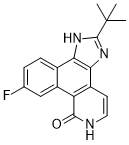
Pyridone 6 (also known as P6, CMP 6, compound 6 or JAK Inhibitor I) is a pan-JAK (Janus-activated kinase) inhibitor with potential anti-AD and anticancer activity. It potently inhibits the JAK kinase family, with IC50s of 1 nM for JAK2 and TYK2, 5 nM for JAK3, and 15 nM for JAK1, while displaying significantly weaker affinities (130 nM to >10 mM) for other protein tyrosine kinases. Pyridone 6 (P6) delayed the onset and reduced the magnitude of skin disease in an AD-like skin-disease model of NC/Nga mice. P6 reduced IFN-γ and IL-13, whereas it enhanced IL-17 and IL-22 expression. In vitro, P6 also inhibited both Th1 and Th2 development, whereas it promoted Th17 differentiation from naive T cells when present within a certain range of concentrations. This was probably because P6 strongly inhibited STAT1, STAT5, and STAT6 phosphorylation, whereas STAT3 phosphorylation was less efficiently suppressed by P6 at the same concentration. Furthermore, IL-22 protects keratinocytes from apoptosis induced by IFN-γ, and administration of IL-17 and IL-22 partially ameliorated skin diseases in NC/Nga mice. These results suggested that the JAK inhibitor P6 is therapeutic for AD by modulating the balance of Th2 and Th17.
Physicochemical Properties
| Molecular Formula | C18H16FN3O | |
| Molecular Weight | 309.34 | |
| Exact Mass | 309.127 | |
| Elemental Analysis | C, 69.89; H, 5.21; F, 6.14; N, 13.58; O, 5.17 | |
| CAS # | 457081-03-7 | |
| Related CAS # |
|
|
| PubChem CID | 5494425 | |
| Appearance | Light brown to brown solid powder | |
| Density | 1.3±0.1 g/cm3 | |
| Boiling Point | 646.5±55.0 °C at 760 mmHg | |
| Flash Point | 344.8±31.5 °C | |
| Vapour Pressure | 0.0±1.9 mmHg at 25°C | |
| Index of Refraction | 1.681 | |
| LogP | 3 | |
| Hydrogen Bond Donor Count | 2 | |
| Hydrogen Bond Acceptor Count | 3 | |
| Rotatable Bond Count | 1 | |
| Heavy Atom Count | 23 | |
| Complexity | 529 | |
| Defined Atom Stereocenter Count | 0 | |
| SMILES | FC1=CC2=C(C(NC=C3)=O)C3=C(N=C(C(C)(C)C)N4)C4=C2C=C1 |
|
| InChi Key | VNDWQCSOSCCWIP-UHFFFAOYSA-N | |
| InChi Code | InChI=1S/C18H16FN3O/c1-18(2,3)17-21-14-10-5-4-9(19)8-12(10)13-11(15(14)22-17)6-7-20-16(13)23/h4-8H,1-3H3,(H,20,23)(H,21,22) | |
| Chemical Name | 2-(1,1-dimethylethyl)-9-fluoro-1,6-dihydro-7H-benz[h]imidazo[4,5-f]isoquinolin-7-one | |
| Synonyms |
|
|
| HS Tariff Code | 2934.99.9001 | |
| Storage |
Powder-20°C 3 years 4°C 2 years In solvent -80°C 6 months -20°C 1 month |
|
| Shipping Condition | Room temperature (This product is stable at ambient temperature for a few days during ordinary shipping and time spent in Customs) |
Biological Activity
| Targets | JAK2: 1 nM (IC50); Tyk2: 1 nM (IC50); JAK3: 5 nM (IC50); Murine JAK1: 15 nM (IC50); CDK2: 3.3 μM (IC50); cAMP-dependent kinase: 7.1 μM (IC50); Csk: 2.1 μM (IC50): Hck: 7.7 μM (IC50); Fyn T: 0.5 μM (IC50); p38: 11 μM (IC50); MAPK: 1.78 μM (IC50); Mek: 0.16 μM (IC50); IκB Kinase 2: 0.3 μM (IC50); KDR: 1.4 μM (IC50); Flt-1: 1.52 μ(IC50); Flt-4: 0.69 μM (IC50); FGFR: 1.48 μM (IC50); FGFR2: 0.94 μM (IC50); Tek: 24 μM (IC50); PDGFR: 1.49 μM (IC50); PKC(α): 1.2 μM (IC50) | ||
| ln Vitro | In tests, Pyridone 6 is found to be an inhibitor of 21 additional protein kinases; its IC50 values range from 130 nM to >10 μM. Pyridone 6 suppresses CTLL cell proliferation stimulated by IL2 at an IC50 of 0.1 μM and IL4 at an IC50 of 0.052 μM[1]. It is demonstrated that pyridinone 6 (P6) interacts with each JAK's ATP-binding cleft to inhibit kinase. For each of these cytokines, Pyridone 6 has an IC50 of 3 nM; this is similar to the IC50s of Pyridone 6 that have been reported for JAK2, Tyk2, and JAK3. When present within a specific range of concentrations, pyridonone 6 enhances Th17 development while weakly inhibiting Th2 and modestly inhibiting Th1. Pyridone 6 increases the expression of IL-17 and IL-22 while decreasing IFN-γ and IL-13. Additionally, pyridone 6 suppresses the growth of Th1 and Th2 cells while, at specific concentrations, promoting the differentiation of Th17 from naive T cells[2]. | ||
| ln Vivo | Pyridone 6 (P6) in an AD-like skin disease model of NC/Nga mice postpones the onset and lessens the severity of skin disease. In NC/Nga mice, P6-nano significantly reduces atopic dermatitis (AD), having an impact similar to that of the widely used medication betamethasone ointment, which also functioned as a positive control. On the other hand, it appeared that empty polylactic acid with glycolic acid (PLGA) nanoparticles (C-nano) had no effect[2]. | ||
| Enzyme Assay | Jak3 is a protein tyrosine kinase that is associated with the shared gamma chain of receptors for cytokines IL2, IL4, IL7, IL9, and IL13. We have discovered that a pyridone-containing tetracycle (6) may be prepared from trisubstituted imidazole (5) in high yield by irradiation with >350 nm light. Compound 6 inhibits Jak3 with K(I)=5 nM; it also inhibits Jak family members Tyk2 and Jak2 with IC(50)=1 nM and murine Jak1with IC(50)=15 nM. Compound 6 was tested as an inhibitor of 21 other protein kinases; it inhibited these kinases with IC(50)s ranging from 130 nM to >10 microM.[1] | ||
| Cell Assay | Compound 6 also blocks IL2 and IL4 dependent proliferation of CTLL cells and inhibits the phosphorylation of STAT5 (an in vivo substrate of the Jak family) as measured by Western blotting. [1] Naive CD4+ T cells are treated with various concentrations of Pyridone 6 (10 and 30 nM) in RPMI 1640 medium 1 h before the appropriate cytokines are added to create each Th-differentiating condition. Immunoblotting is performed using antiphospho-STAT protein Abs or anti-total STAT protein Abs. [2] | ||
| Animal Protocol |
|
||
| References |
[1]. Photochemical preparation of a pyridone containing tetracycle: a Jak protein kinase inhibitor. Bioorg Med Chem Lett. 2002 Apr 22;12(8):1219-23. [2]. Pyridone 6, a pan-JAK inhibitor, ameliorates allergic skin inflammation of NC/Nga mice via suppression of Th2 and enhancement of Th17. J Immunol. 2011 Nov 1;187(9):4611-20. |
||
| Additional Infomation | 2-tert-butyl-9-fluoro-1,6-dihydrobenzo[h]imidazo[4,5-f]isoquinolin-7-one is an organic heterotetracyclic compound that is 1,6-dihydrobenzo[h]imidazo[4,5-f]isoquinolin-7-one bearing additional tert-butyl and fluoro substituents at positions 2 and 9 respectively. It has a role as an EC 2.7.10.2 (non-specific protein-tyrosine kinase) inhibitor. It is an organic heterotetracyclic compound and an organofluorine compound. |
Solubility Data
| Solubility (In Vitro) |
|
|||
| Solubility (In Vivo) |
Solubility in Formulation 1: ≥ 2.5 mg/mL (8.08 mM) (saturation unknown) in 10% DMSO + 40% PEG300 + 5% Tween80 + 45% Saline (add these co-solvents sequentially from left to right, and one by one), clear solution. For example, if 1 mL of working solution is to be prepared, you can add 100 μL of 25.0 mg/mL clear DMSO stock solution to 400 μL PEG300 and mix evenly; then add 50 μL Tween-80 to the above solution and mix evenly; then add 450 μL normal saline to adjust the volume to 1 mL. Preparation of saline: Dissolve 0.9 g of sodium chloride in 100 mL ddH₂ O to obtain a clear solution. Solubility in Formulation 2: 2.5 mg/mL (8.08 mM) in 10% DMSO + 90% (20% SBE-β-CD in Saline) (add these co-solvents sequentially from left to right, and one by one), suspension solution; with ultrasonication. For example, if 1 mL of working solution is to be prepared, you can add 100 μL of 25.0 mg/mL clear DMSO stock solution to 900 μL of 20% SBE-β-CD physiological saline solution and mix evenly. Preparation of 20% SBE-β-CD in Saline (4°C,1 week): Dissolve 2 g SBE-β-CD in 10 mL saline to obtain a clear solution. Solubility in Formulation 3: ≥ 2.5 mg/mL (8.08 mM) (saturation unknown) in 10% DMSO + 90% Corn Oil (add these co-solvents sequentially from left to right, and one by one), clear solution. For example, if 1 mL of working solution is to be prepared, you can add 100 μL of 25.0 mg/mL clear DMSO stock solution to 900 μL of corn oil and mix evenly.. Solubility in Formulation 4: Solubility in Formulation 1: ≥ 2.5 mg/mL (8.1 mM) (saturation unknown) in 10% DMSO + 40% PEG300 + 5% Tween80 + + 45% Saline (add these co-solvents sequentially from left to right, and one by one), clear solution. For example, if 1 mL of working solution is to be prepared, you can take 100 μL of 25 mg/mL DMSO stock solution and add to 400 μL of PEG300, mix well (clear solution); Then add 50 μL of Tween 80 to the above solution, mix well (clear solution); Finally, add 450 μL of saline to the above solution, mix well (clear solution). Preparation of saline: Dissolve 0.9 g of sodium chloride in 100 mL ddH ₂ O to obtain a clear solution. Solubility in Formulation 2: ≥ 2.5 mg/mL (8.1 mM) (saturation unknown) in 10% DMSO + 90% (20% SBE-β-CD in saline) (add these co-solvents sequentially from left to right, and one by one), suspension solution. For example, if 1 mL of working solution is to be prepared, you can take 100 μL of 25 mg/mL DMSO stock solution and add to 900 μL of 20% SBE-β-CD in saline, mix well. Preparation of 20% SBE-β-CD in Saline (4°C,1 week): Dissolve 2 g SBE-β-CD in 10 mL saline to obtain a clear solution. Solubility in Formulation 3: ≥ 2.5 mg/mL (8.1 mM) (saturation unknown) in 10% DMSO + 90% Corn oil (add these co-solvents sequentially from left to right, and one by one), clear solution. For example, if 1 mL of working solution is to be prepared, you can take 100 μL of 25 mg/mL DMSO stock solution and add to 900 μL of corn oil, mix well (clear solution). (Please use freshly prepared in vivo formulations for optimal results.) |
| Preparing Stock Solutions | 1 mg | 5 mg | 10 mg | |
| 1 mM | 3.2327 mL | 16.1634 mL | 32.3269 mL | |
| 5 mM | 0.6465 mL | 3.2327 mL | 6.4654 mL | |
| 10 mM | 0.3233 mL | 1.6163 mL | 3.2327 mL |