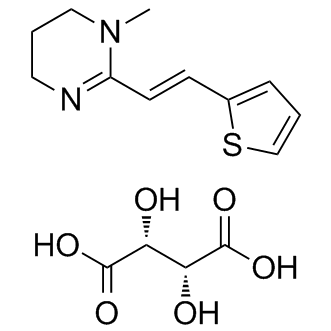
Pyrantel tartrate, the tartrate salt of pyrantel, is a potent antinematodal and anthelmintic agent with a broad spectrum of activities. It has been used to study allosteric modulation of the neuronal nicotinic acetylcholine receptors (nAChRs).
Physicochemical Properties
| Molecular Formula | C11H14N2S.C4H6O6 |
| Molecular Weight | 356.3941 |
| Exact Mass | 356.104 |
| CAS # | 33401-94-4 |
| Related CAS # | Pyrantel pamoate;22204-24-6;Pyrantel;15686-83-6 |
| PubChem CID | 6434144 |
| Appearance | Light yellow to yellow solid powder |
| Boiling Point | 324.4ºC at 760 mmHg |
| Melting Point | 148-150ºC |
| Flash Point | 150ºC |
| Hydrogen Bond Donor Count | 4 |
| Hydrogen Bond Acceptor Count | 8 |
| Rotatable Bond Count | 5 |
| Heavy Atom Count | 24 |
| Complexity | 382 |
| Defined Atom Stereocenter Count | 2 |
| SMILES | CN1CCCN=C1/C=C/C2=CC=CS2.[C@@H]([C@H](C(=O)O)O)(C(=O)O)O |
| InChi Key | VWRCYAZJKNPEQR-NIEARKAZSA-N |
| InChi Code | InChI=1S/C11H14N2S.C4H6O6/c1-13-8-3-7-12-11(13)6-5-10-4-2-9-14-10;5-1(3(7)8)2(6)4(9)10/h2,4-6,9H,3,7-8H2,1H3;1-2,5-6H,(H,7,8)(H,9,10)/b6-5+;/t;1-,2-/m.1/s1 |
| Chemical Name | (2R,3R)-2,3-dihydroxybutanedioic acid;1-methyl-2-[(E)-2-thiophen-2-ylethenyl]-5,6-dihydro-4H-pyrimidine |
| HS Tariff Code | 2934.99.9001 |
| Storage |
Powder-20°C 3 years 4°C 2 years In solvent -80°C 6 months -20°C 1 month Note: Please store this product in a sealed and protected environment, avoid exposure to moisture. |
| Shipping Condition | Room temperature (This product is stable at ambient temperature for a few days during ordinary shipping and time spent in Customs) |
Biological Activity
| ln Vitro | For 72 hours, pyrantel tartrate (10 nM–10 µM) demonstrated strong anti-A antibodies. suum and anti-N (0-168.2 M; 72 h). Activities of American Nus [1][2]. |
| ln Vivo | In hamsters infected with Vibrio ceylonali, pyrantel tartrate (10 mg/kg; po; single dose) can reduce the number of worms, reducing the worm burden by 87.2% and deworming rate to 63.4% [2]. |
| Cell Assay |
Cell viability assay [2] Cell Types: Nepenthes americana Tested Concentrations: 0-168.2 M (0-100 µg/mL) Incubation Duration: 72 hrs (hours) Experimental Results: Inhibitory effect on third-stage larvae and adults of Nepenthes americana, IC50 The values are 2.0 and 7.6 mg/ml respectively. |
| Animal Protocol |
Animal/Disease Models: Male Syrian golden hamster (3 weeks old; A. ceylanicum infection) [2]. Doses: 10 mg/kg Route of Administration: Oral; single. Experimental Results: The worm load reduction rate and deworming rate were 87.2% and 63.4% respectively. |
| References |
[1]. Oxantel is an N-type (methyridine and nicotine) agonist not an L-type (levamisole and pyrantel) agonist: classification of cholinergic anthelmintics in Ascaris. Int J Parasitol. 2004 Aug;34(9):1083-90. [2]. In vitro and in vivo efficacy of Monepantel (AAD 1566) against laboratory models of human intestinal nematode infections. PLoS Negl Trop Dis. 2011 Dec;5(12):e1457. |
| Additional Infomation |
Broad spectrum anthelmintic for livestock. See also: Pyrantel (has active moiety); Carbadox; Pyrantel Tartrate (component of); Pyrantel Tartrate; Tylosin Phosphate (component of) ... View More ... |
Solubility Data
| Solubility (In Vitro) | DMSO : ≥ 34 mg/mL (~95.40 mM) |
| Solubility (In Vivo) |
Solubility in Formulation 1: ≥ 2.08 mg/mL (5.84 mM) (saturation unknown) in 10% DMSO + 40% PEG300 + 5% Tween80 + 45% Saline (add these co-solvents sequentially from left to right, and one by one), clear solution. For example, if 1 mL of working solution is to be prepared, you can add 100 μL of 20.8 mg/mL clear DMSO stock solution to 400 μL PEG300 and mix evenly; then add 50 μL Tween-80 to the above solution and mix evenly; then add 450 μL normal saline to adjust the volume to 1 mL. Preparation of saline: Dissolve 0.9 g of sodium chloride in 100 mL ddH₂ O to obtain a clear solution. Solubility in Formulation 2: ≥ 2.08 mg/mL (5.84 mM) (saturation unknown) in 10% DMSO + 90% (20% SBE-β-CD in Saline) (add these co-solvents sequentially from left to right, and one by one), clear solution. For example, if 1 mL of working solution is to be prepared, you can add 100 μL of 20.8 mg/mL clear DMSO stock solution to 900 μL of 20% SBE-β-CD physiological saline solution and mix evenly. Preparation of 20% SBE-β-CD in Saline (4°C,1 week): Dissolve 2 g SBE-β-CD in 10 mL saline to obtain a clear solution. Solubility in Formulation 3: ≥ 2.08 mg/mL (5.84 mM) (saturation unknown) in 10% DMSO + 90% Corn Oil (add these co-solvents sequentially from left to right, and one by one), clear solution. For example, if 1 mL of working solution is to be prepared, you can add 100 μL of 20.8 mg/mL clear DMSO stock solution to 900 μL of corn oil and mix evenly. (Please use freshly prepared in vivo formulations for optimal results.) |
| Preparing Stock Solutions | 1 mg | 5 mg | 10 mg | |
| 1 mM | 2.8059 mL | 14.0296 mL | 28.0591 mL | |
| 5 mM | 0.5612 mL | 2.8059 mL | 5.6118 mL | |
| 10 mM | 0.2806 mL | 1.4030 mL | 2.8059 mL |