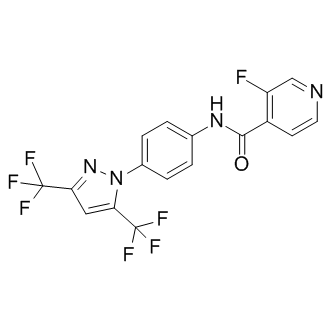
Physicochemical Properties
| Molecular Formula | C17H9F7N4O |
| Molecular Weight | 418.27 |
| Exact Mass | 418.066 |
| Elemental Analysis | C, 48.82; H, 2.17; F, 31.79; N, 13.40; O, 3.82 |
| CAS # | 245747-08-4 |
| PubChem CID | 10598093 |
| Appearance | Light yellow to yellow solid powder |
| Density | 1.5±0.1 g/cm3 |
| Boiling Point | 368.4±42.0 °C at 760 mmHg |
| Flash Point | 176.6±27.9 °C |
| Vapour Pressure | 0.0±0.8 mmHg at 25°C |
| Index of Refraction | 1.551 |
| LogP | 3.1 |
| Hydrogen Bond Donor Count | 1 |
| Hydrogen Bond Acceptor Count | 10 |
| Rotatable Bond Count | 3 |
| Heavy Atom Count | 29 |
| Complexity | 577 |
| Defined Atom Stereocenter Count | 0 |
| InChi Key | XZIQSOZOLJJMFN-UHFFFAOYSA-N |
| InChi Code | InChI=1S/C17H9F7N4O/c18-12-8-25-6-5-11(12)15(29)26-9-1-3-10(4-2-9)28-14(17(22,23)24)7-13(27-28)16(19,20)21/h1-8H,(H,26,29) |
| Chemical Name | N-[4-[3,5-bis(trifluoromethyl)pyrazol-1-yl]phenyl]-3-fluoropyridine-4-carboxamide |
| Synonyms | Pyr 6; Pyr-6; N-(4-(3,5-Bis(trifluoromethyl)-1H-pyrazol-1-yl)phenyl)-3-fluoroisonicotinamide; CHEMBL101896; N-[4-[3,5-bis(trifluoromethyl)pyrazol-1-yl]phenyl]-3-fluoropyridine-4-carboxamide; N-{4-[3,5-bis(trifluoromethyl)-1h-pyrazol-1-yl]phenyl}-3-fluoroisonicotinamide; N-{4-[3,5-bis(trifluoromethyl)pyrazol-1-yl]phenyl}-3-fluoropyridine-4-carboxamide; XZIQSOZOLJJMFN-UHFFFAOYSA-N; Pyr6 |
| HS Tariff Code | 2934.99.9001 |
| Storage |
Powder-20°C 3 years 4°C 2 years In solvent -80°C 6 months -20°C 1 month |
| Shipping Condition | Room temperature (This product is stable at ambient temperature for a few days during ordinary shipping and time spent in Customs) |
Biological Activity
| Targets | TRPC3 (IC50 = 0.49 uM) |
| ln Vitro |
Pyr3, a previously suggested selective inhibitor of TRPC3, inhibited Orai1- and TRPC3-mediated Ca2+ entry and currents as well as mast cell activation with similar potency. By contrast, Pyr6 exhibited a 37-fold higher potency to inhibit Orai1-mediated Ca2+ entry as compared with TRPC3-mediated Ca2+ entry and potently suppressed mast cell activation. The novel pyrazole Pyr10 displayed substantial selectivity for TRPC3-mediated responses (18-fold) and the selective block of TRPC3 channels by Pyr10 barely affected mast cell activation[1]. The pyrazole derivatives Pyr6 and Pyr10 are able to distinguish between TRPC and Orai-mediated Ca2+ entry and may serve as useful tools for the analysis of cellular functions of the underlying Ca2+ channels[1]. |
| Enzyme Assay | For characterization of Pyr6 and Pyr10 selectivity for TRPC channels, n-terminally GFP-tagged murine TRPC6, n-terminally YFP-tagged TRPC5 (Schindl et al., 2008) and c-terminally YFP-tagged TRPC4beta (Graziani et al., 2010) were used. |
| Cell Assay | Electrophysiology[1] Patch pipettes were pulled from borosilicate glass capillaries (resistance 3–5 MΩ). Currents were recorded at room temperature using a List EPC7 patch-clamp amplifier. Signals were low-pass filtered at 3 and 10 kHz and digitized with 5 kHz. For HEK293 cells, voltage-clamp protocols (voltage ramps from −130 to +80 mV, holding potential 0 mV) were controlled by pClamp software. Extracellular solution (ECS) contained (in mM) 140 NaCl, 2 CaCl2, 2 MgCl2, 10 glucose, pH adjusted to 7.4 with NaOH. The pipette solution (ICS) contained (in mM) 120 caesium methanesulphonate, 20 CsCl, 15 HEPES, 5 MgCl2, 3 EGTA, pH adjusted to 7.3 with CsOH. To activate the TRPC3 channel, current cells were challenged with 100 μM carbachol or 100 μM 1-oleoyl-2-acetyl-sn-glycerol (OAG). For RBL-2H3 cells CRAC measurement, standard protocols and buffers were modified from Derler et al. (2009). In brief voltage ramps from −90 to +90 mV over 1 s (holding potential +30 mV) were applied and controlled by pClamp software. ECS contained (in mM) 130 NaCl, 5 CsCl, 1 MgCl2, 10 HEPES, 10 glucose, 20 CaCl2 at pH 7.4. ICS was comprised of 3.5 MgCl2, 145 caesium methanesulphonate, 8 NaCl, 10 HEPES, 20 EGTA at pH 7.2. Experiments in HEK-293 cells expressing STIM1 and Orai1 to reconstitute the CRAC pore were done as in Muik et al. (2008). ECS contained (in mM) 145 NaCl, 5 CsCl, 1 MgCl2, 10 HEPES, 10 Glucose, 10 CaCl2 at pH 7.4. ICS was comprised of 3.5 MgCl2, 145 caesium methanesulphonate, 8 NaCl, 10 HEPES, 20 EGTA at pH 7.2. For measuring the sodium currents in divalent-free conditions, protocols and buffers from Bergsmann et al. (2011) were used. If not mentioned otherwise for the experiments, cells were pre-incubated for 3 min and measured in the presence of either 3 μM Pyr2, Pyr3, Pyr6 or Pyr10. |
| References |
[1]. Novel pyrazole compounds for pharmacological discrimination between receptor-operated and store-operated Ca(2+) entry pathways. Br J Pharmacol. 2012 Dec;167(8):1712-22. |
| Additional Infomation |
The observed selectivity of Pyr6 and Pyr10 suggests that these compounds may be useful to identify and analyse TRPC- and Orai-mediated conductances in native tissues. Our results obtained in RBL-2H3 mast cells and STIM1/Orai1-expressing HEK293 cells were in line with the concept that store-operated Ca2+ entry in these two cell systems occurs via the same channels, which are characterized by sensitivity to Pyr6 being clearly higher than to Pyr10. By contrast, TRPC3 homomeric pore structures are highly sensitive to Pyr10 but weakly sensitive to Pyr6. Importantly, a test for inhibitory effects of Pyr6 and Pyr10 on homomeric channels of other TRPC isoforms such as TRPC4, 5 and 6, revealed a low potency (IC50 > 10 μM) at these channels, indicating that Pyr10 exhibits a significant TRPC subtype selectivity (Supporting Information Fig. S3).[1] We suggest a pyrazole sensitivity of Pyr6 > Pyr10 as a characteristic of Orai1-mediated Ca2+ entry. As RBL-2H3 cells express TRPC genes including TRPC3 (Ma et al., 2008), our results may be taken as an indication that TRPC3 does not contribute to store-operated Ca2+ entry in mast cells. Nonetheless, we cannot exclude contribution of a TRPC3 containing channel complex in local Ca2+ signalling events that are not detectable as global cellular Ca2+ changes but could be pivotal for certain downstream signalling processes as recently reported for cardiac TRPC3s (Poteser et al., 2011). Our finding of NFAT translocation being highly sensitivity to Pyr6 but not to Pyr10 is in line with the concept that in RBL-2H3 cells, NFAT is mainly controlled via the CRAC/Orai Ca2+ entry pathway, as recently suggested by Kar et al. (2011). It is of note that pyrazole structures have initially been recognized as effective inhibitors of NFAT signalling via an ill-defined mechanism downstream of Ca2+ signalling (Djuric et al., 2000; Trevillyan et al., 2001). Here we report that the inhibitory effects of Pyr6 and Pyr10 correlate well with their efficacy as CRAC/Orai1 inhibitors. The observation that Pyr6 was more potent than Pyr10 as a suppressant of mast cell degranulation corroborates the view that Orai channels represent the main source of Ca2+ for exocytosis in RBL-2H3 cells (Ma et al., 2008). Consistent with previous reports, Pyr6 was found to be highly effective as an inhibitor of immune cell transcriptional activation and cytokine production (Ishikawa et al., 2003; Birsan et al., 2004; Shirakawa et al., 2010; Law et al., 2011), underscoring the potential value of this chemical structure for the development of potent immune modulators (Chen et al., 2002; Zitt et al., 2004).[1] |
Solubility Data
| Solubility (In Vitro) | DMSO : ≥ 100 mg/mL (~239.08 mM) |
| Solubility (In Vivo) |
Solubility in Formulation 1: ≥ 10 mg/mL (23.91 mM) (saturation unknown) in 10% DMSO + 40% PEG300 + 5% Tween80 + 45% Saline (add these co-solvents sequentially from left to right, and one by one), clear solution. For example, if 1 mL of working solution is to be prepared, you can add 100 μL of 100.0 mg/mL clear DMSO stock solution to 400 μL PEG300 and mix evenly; then add 50 μL Tween-80 to the above solution and mix evenly; then add 450 μL normal saline to adjust the volume to 1 mL. Preparation of saline: Dissolve 0.9 g of sodium chloride in 100 mL ddH₂ O to obtain a clear solution. Solubility in Formulation 2: ≥ 10 mg/mL (23.91 mM) (saturation unknown) in 10% DMSO + 90% (20% SBE-β-CD in Saline) (add these co-solvents sequentially from left to right, and one by one), clear solution. For example, if 1 mL of working solution is to be prepared, you can add 100 μL of 100.0 mg/mL clear DMSO stock solution to 900 μL of 20% SBE-β-CD physiological saline solution and mix evenly. Preparation of 20% SBE-β-CD in Saline (4°C,1 week): Dissolve 2 g SBE-β-CD in 10 mL saline to obtain a clear solution. Solubility in Formulation 3: ≥ 10 mg/mL (23.91 mM) (saturation unknown) in 10% DMSO + 90% Corn Oil (add these co-solvents sequentially from left to right, and one by one), clear solution. For example, if 1 mL of working solution is to be prepared, you can add 100 μL of 100.0 mg/mL clear DMSO stock solution to 900 μL of corn oil and mix evenly. (Please use freshly prepared in vivo formulations for optimal results.) |
| Preparing Stock Solutions | 1 mg | 5 mg | 10 mg | |
| 1 mM | 2.3908 mL | 11.9540 mL | 23.9080 mL | |
| 5 mM | 0.4782 mL | 2.3908 mL | 4.7816 mL | |
| 10 mM | 0.2391 mL | 1.1954 mL | 2.3908 mL |