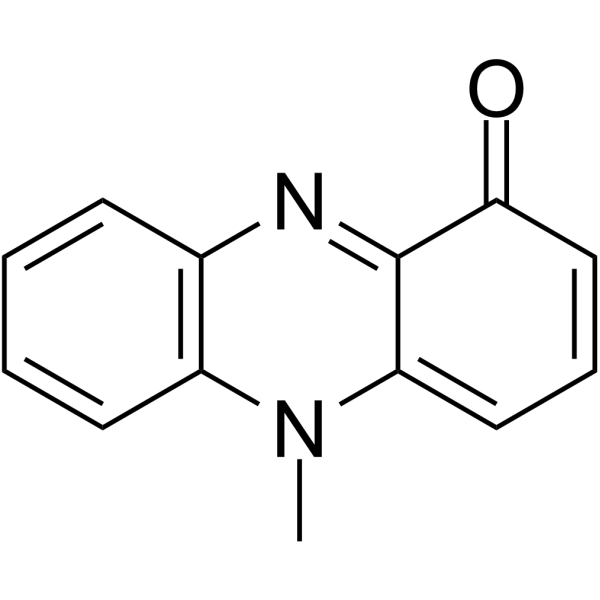
Physicochemical Properties
| Molecular Formula | C13H10N2O |
| Molecular Weight | 210.2313 |
| Exact Mass | 210.079 |
| CAS # | 85-66-5 |
| PubChem CID | 6817 |
| Appearance | Blue to dark blue solid powder |
| Density | 1.24g/cm3 |
| Boiling Point | 403.3ºC at 760 mmHg |
| Flash Point | 197.7ºC |
| Index of Refraction | 1.665 |
| LogP | 2.356 |
| Hydrogen Bond Donor Count | 0 |
| Hydrogen Bond Acceptor Count | 3 |
| Rotatable Bond Count | 0 |
| Heavy Atom Count | 16 |
| Complexity | 420 |
| Defined Atom Stereocenter Count | 0 |
| InChi Key | YNCMLFHHXWETLD-UHFFFAOYSA-N |
| InChi Code | InChI=1S/C13H10N2O/c1-15-10-6-3-2-5-9(10)14-13-11(15)7-4-8-12(13)16/h2-8H,1H3 |
| Chemical Name | 5-methylphenazin-1-one |
| HS Tariff Code | 2934.99.9001 |
| Storage |
Powder-20°C 3 years 4°C 2 years In solvent -80°C 6 months -20°C 1 month Note: Please store this product in a sealed and protected environment (e.g. under nitrogen), avoid exposure to moisture and light. |
| Shipping Condition | Room temperature (This product is stable at ambient temperature for a few days during ordinary shipping and time spent in Customs) |
Biological Activity
| References |
[1]. Pyocyanin Restricts Social Cheating in Pseudomonas aeruginosa. Front Microbiol. 2018 Jun 27;9:1348. [2]. Anti-inflammatory potential of pyocyanin in LPS-stimulated murine macrophages. Immunopharmacol Immunotoxicol. 2019 Feb;41(1):102-108. [3]. Antibacterial, antibiofilm, and anti-quorum sensing activities of pyocyanin against methicillin-resistant Staphylococcus aureus: in vitro and in vivo study. BMC Microbiol. 2023 Apr 24;23(1):116. [4]. Pyocyanin induces systemic oxidative stress, inflammation and behavioral changes in vivo. Toxicol Mech Methods. 2018 Jul;28(6):410-414. |
| Additional Infomation | Antibiotic pigment produced by Pseudomonas aeruginosa. |
Solubility Data
| Solubility (In Vitro) | DMSO : ~9.09 mg/mL (~43.24 mM) |
| Solubility (In Vivo) |
Solubility in Formulation 1: ≥ 0.91 mg/mL (4.33 mM) (saturation unknown) in 10% DMSO + 40% PEG300 + 5% Tween80 + 45% Saline (add these co-solvents sequentially from left to right, and one by one), clear solution. For example, if 1 mL of working solution is to be prepared, you can add 100 μL of 9.1 mg/mL clear DMSO stock solution to 400 μL PEG300 and mix evenly; then add 50 μL Tween-80 to the above solution and mix evenly; then add 450 μL normal saline to adjust the volume to 1 mL. Preparation of saline: Dissolve 0.9 g of sodium chloride in 100 mL ddH₂ O to obtain a clear solution. Solubility in Formulation 2: ≥ 0.91 mg/mL (4.33 mM) (saturation unknown) in 10% DMSO + 90% (20% SBE-β-CD in Saline) (add these co-solvents sequentially from left to right, and one by one), clear solution. For example, if 1 mL of working solution is to be prepared, you can add 100 μL of 9.1 mg/mL clear DMSO stock solution to 900 μL of 20% SBE-β-CD physiological saline solution and mix evenly. Preparation of 20% SBE-β-CD in Saline (4°C,1 week): Dissolve 2 g SBE-β-CD in 10 mL saline to obtain a clear solution. (Please use freshly prepared in vivo formulations for optimal results.) |
| Preparing Stock Solutions | 1 mg | 5 mg | 10 mg | |
| 1 mM | 4.7567 mL | 23.7835 mL | 47.5670 mL | |
| 5 mM | 0.9513 mL | 4.7567 mL | 9.5134 mL | |
| 10 mM | 0.4757 mL | 2.3783 mL | 4.7567 mL |