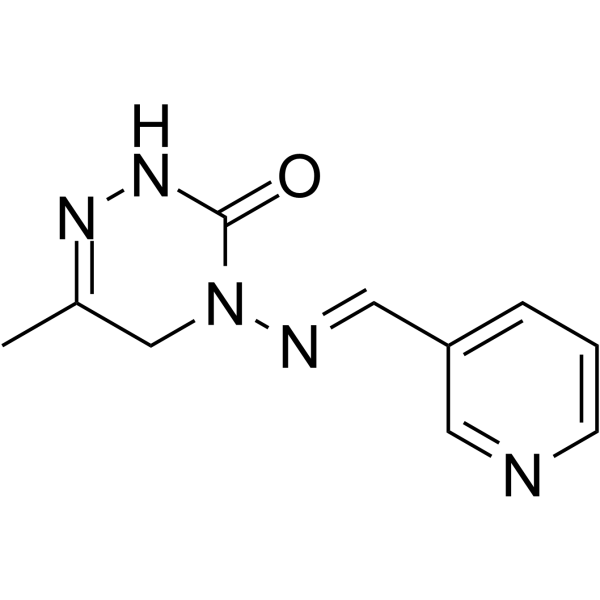
Physicochemical Properties
| Molecular Formula | C10H11N5O |
| Molecular Weight | 217.22724 |
| Exact Mass | 217.096 |
| CAS # | 123312-89-0 |
| PubChem CID | 9576037 |
| Appearance | Colorless crystals |
| Density | 1.3±0.1 g/cm3 |
| Boiling Point | 401.1±37.0 °C at 760 mmHg |
| Melting Point | 217ºC |
| Flash Point | 196.4±26.5 °C |
| Vapour Pressure | 0.0±1.0 mmHg at 25°C |
| Index of Refraction | 1.665 |
| LogP | -0.5 |
| Hydrogen Bond Donor Count | 1 |
| Hydrogen Bond Acceptor Count | 4 |
| Rotatable Bond Count | 2 |
| Heavy Atom Count | 16 |
| Complexity | 325 |
| Defined Atom Stereocenter Count | 0 |
| SMILES | O=C1NN=C(C)CN1/N=C/C2=CC=CN=C2 |
| InChi Key | QHMTXANCGGJZRX-WUXMJOGZSA-N |
| InChi Code | InChI=1S/C10H11N5O/c1-8-7-15(10(16)14-13-8)12-6-9-3-2-4-11-5-9/h2-6H,7H2,1H3,(H,14,16)/b12-6+ |
| Chemical Name | 6-methyl-4-[(E)-pyridin-3-ylmethylideneamino]-2,5-dihydro-1,2,4-triazin-3-one |
| HS Tariff Code | 2934.99.9001 |
| Storage |
Powder-20°C 3 years 4°C 2 years In solvent -80°C 6 months -20°C 1 month |
| Shipping Condition | Room temperature (This product is stable at ambient temperature for a few days during ordinary shipping and time spent in Customs) |
Biological Activity
| ln Vivo | Pymetrozine is a fast-acting, selective inhibitor of aphid feeding. field research using electronic feeding behavior monitoring. The novel insecticide pyromethazine, a pyridyl azomethine molecule, exhibits selective action against Homoptera insects. Aphids are not stricken upon touch, but instead seem to starve to death, which is how it operates. This indicates that feeding behavior is impacted by pymetrozine. The current study aimed to clarify the intricate process by which pymetrozine impedes phloem nutrition and the precise point at which this interference occurs. Using electropenetration mapping (EPG), the effects of varied applications of pymetrozine on the various stages of xstylet penetration and individual aphid feeding activity were investigated. Pymetrozine does not appear to have any deterring or antifeedant effects based on preliminary selection studies. Application topically (150 ng/mg fresh weight) prevents the plant from absorbing the probe. Less than 30 ng/mg of injection is needed to provide the same impact. Aphids start feeding properly once pymetrozine is given via a root absorption device or plant spray. Eventually, though, they remove their probes from the phloem and continue to travel normally. Aphids ultimately recovered and started eating again at low levels. Large doses, however, have the potential to permanently interfere with feeding and hinder xstylet reinsertion. Aphid motility is expected to remain unaffected until the hemolymph concentration reaches 1 mM pymetrozine. Aphids treated with pymetrozine that eventually quit feeding displayed a disrupted EPG salivary/uptake pattern [2]. |
| ADME/Pharmacokinetics |
Absorption, Distribution and Excretion A metabolism study in rats,...using radiolabeled pymetrozine, exposed animals orally or iv in groups of five animals/sex to evaluate absorption and excretion. Within the first 24 hr post-dosing, the urine from all orally-dosed groups contained from 52.0%-73.5% of the administered radioactivity. The iv treated rats also had comparable 24-hr urine levels which were 63.6% and 68.3% of the administered dose in males and females, respectively. At study termination (7 days post-dosing), the recovered radioactivity in urine (56.3-80.3%), expired air (0.2-1.4%), tissues (0.3-3.8%), feces (15.4-38.9%), and cage washes (0.2-0.7%) accounted for a total recovery of 91-100.7% of the administered dose in all groups. A metabolism study in female rats...using...pymetrozine /labeled on either the triazine or the pyridine moiety/, exposed animals orally to a single low dose (0.5 mg/kg) or high dose (100 mg/kg). Irrespective of the label site, the time to max blood concns (tmax) were attained at 1 hr ... and at 8 hours... following low and high oral dosing, respectively. ... the peak blood levels were dependent on the dose but independent of the labeling site... . At all times... and irrespective of the dose or labeling site, tissue residue levels (ppm) were highest in the kidneys and liver. ... Of all tissues (with the exception of the GI tract), the skeletal muscle had the highest percent of the administered dose (both labels) accounting for 7-8% of the low dose at 1 hr and for 19-21% of the high dose at 8 hours. The calculated half life ... (t 1/2) for the triazine.residue depletion from all the tissues ranged from 2.9-4.8 hrs (low dose) and from 1.9-3.5 hrs (high dose) and and for the pyridine .../residue/ depletion from 31.7-110.3 hrs (low dose) and from 2.5-13.9 hr (high dose). Absorption was lower at the high dose representing nearly 82% of the administered dose for both radiolabels. Irrespective of the labeling site, the biliary excretion was higher at the low dose than at the high dose. The total 48-hr excretion, including cage wash, was higher for the triazine label (low dose/high dose: 103%/95%) than the pyridine label (low dose/high dose: 85%/81%). .../Thus,/ the /metabolite from the/ pyridine /residue/ is more persistent than /the metabolite from/ the triazine /moiety/. A dermal absorption study in male rats ...using 98.1-99.5% radiolabeled pymetrozine, exposed 24 male animals ... at dose levels of 0.084, 0.503, or 4.69 mg/rat (0.0067, 0.0402, or 0.375 mg/sq cm). After blood collection, four rats/dose were killed for assessment of dermal absorption after 0.5, 1, 2, 4, 10, and 24 hours of exposure. Urine and feces were also collected at the time of killing. After 24 hours of exposure, dermal absorption ... was minimal (0.05%, 0.01%, and <0.005% for the low, mid, and high dose groups, respectively). For all dose groups, the majority of the dose (81.4-100.0%) was not absorbed and was recovered in the skin wash. For all dose groups, adsorption to skin from the test site (0.18-8.84%) accounted for the next largest proportion of the dose and only trace amounts (< or =0.05%) of radioactivity were excreted in the urine and feces. Within each dose group, radioactivity remaining in/on the skin after washing did not seem to incr with the duration of exposure; likewise, absorption (measured as amount excreted plus amount retained in the body) did not seem to incr over time. Metabolism / Metabolites A metabolism study in rats ...using radiolabeled pymetrozine, exposed animals orally or iv in groups of 5 animals/sex to evaluate absorption and excretion. ...The relatively high urinary level of unchanged test material suggests metabolic saturation at the high dose of 100 mg/kg. Biological Half-Life Calculated half-life /in rat/: 1-2 hrs at 0.5 mg/kg dose (both labels) and from 2-11 hrs (100 mg/kg dose). /from table/ |
| References |
[1]. I D BEDFORD, et al. The effect of Pymetrozine, a feeding inhibitor of Homoptera, in preventing transmission of cauliflower mosaic caulimovirus by the aphid species Myzus persicae (Sulzer). Annals of Applied Biology. 1998 Jun; 132(3): 453-462 [2]. Paul Harrewijn, et al. Pymetrozine, a Fast-Acting and Selective Inhibitor of Aphid Feeding. In-situ Studies with Electronic Monitoring of Feeding Behaviour. Pest Management Science. 1997 Feb;49(2):130-140. |
| Additional Infomation |
Pymetrozine can cause cancer according to The Environmental Protection Agency (EPA). Pymetrozine is a member of the class of 1,2,4-triazines that is 4,5-dihydro-1,2,4-triazin-3(2H)-one substituted by a methyl group at position 6 and a (pyridin-3-ylmethylidene)amino group at position 4. It has a role as an antifeedant, an environmental contaminant, a xenobiotic and a TRPV channel modulator. It is a member of 1,2,4-triazines and a member of pyridines. Pymetrozine is a neuroactive insecticide that selectively affects chordotonal mechanoreceptors. Physiologically, it appears to act by preventing these insects from inserting their stylus into the plant tissue. It controls many strains of aphids on potatoes and in a range of vegetable brassica crops. Pymetrozine has been determined to be of low acute toxicity to humans, birds, aquatic organisms, mammals, and bees. |
Solubility Data
| Solubility (In Vitro) |
DMSO : ~33.33 mg/mL (~153.43 mM) H2O : < 0.1 mg/mL |
| Solubility (In Vivo) |
Solubility in Formulation 1: ≥ 2.5 mg/mL (11.51 mM) (saturation unknown) in 10% DMSO + 40% PEG300 + 5% Tween80 + 45% Saline (add these co-solvents sequentially from left to right, and one by one), clear solution. For example, if 1 mL of working solution is to be prepared, you can add 100 μL of 25.0 mg/mL clear DMSO stock solution to 400 μL PEG300 and mix evenly; then add 50 μL Tween-80 to the above solution and mix evenly; then add 450 μL normal saline to adjust the volume to 1 mL. Preparation of saline: Dissolve 0.9 g of sodium chloride in 100 mL ddH₂ O to obtain a clear solution. Solubility in Formulation 2: ≥ 2.5 mg/mL (11.51 mM) (saturation unknown) in 10% DMSO + 90% Corn Oil (add these co-solvents sequentially from left to right, and one by one), clear solution. For example, if 1 mL of working solution is to be prepared, you can add 100 μL of 25.0 mg/mL clear DMSO stock solution to 900 μL of corn oil and mix evenly. (Please use freshly prepared in vivo formulations for optimal results.) |
| Preparing Stock Solutions | 1 mg | 5 mg | 10 mg | |
| 1 mM | 4.6034 mL | 23.0171 mL | 46.0342 mL | |
| 5 mM | 0.9207 mL | 4.6034 mL | 9.2068 mL | |
| 10 mM | 0.4603 mL | 2.3017 mL | 4.6034 mL |