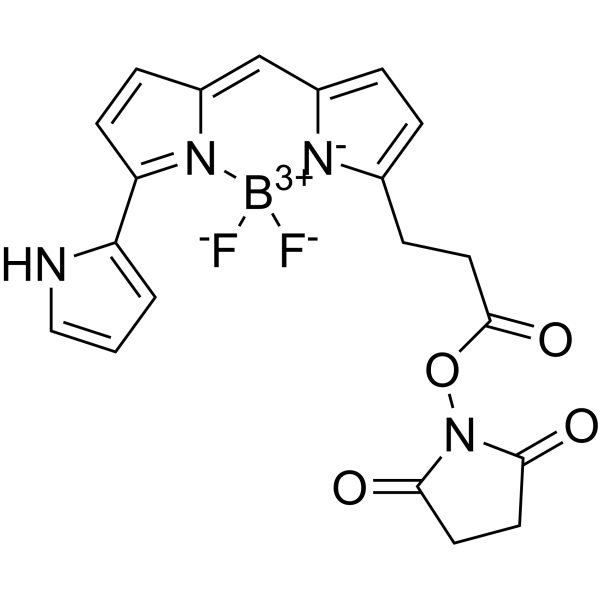
Physicochemical Properties
| Molecular Formula | C??H??BF?N?O? |
| Molecular Weight | 426.18 |
| Exact Mass | 426.131 |
| CAS # | 201998-61-0 |
| PubChem CID | 138115341 |
| Appearance | Brown to black solid powder |
| Hydrogen Bond Donor Count | 1 |
| Hydrogen Bond Acceptor Count | 7 |
| Rotatable Bond Count | 6 |
| Heavy Atom Count | 31 |
| Complexity | 918 |
| Defined Atom Stereocenter Count | 0 |
| SMILES | [F-][B+3]1([N-]2C(=CC=C2C=C2C=CC(C3NC=CC=3)=N12)CCC(=O)ON1C(CCC1=O)=O)[F-] |
| InChi Key | CRGDXALGAHKHRS-UHFFFAOYSA-N |
| InChi Code | InChI=1S/C20H17BF2N4O4/c22-21(23)25-13(6-10-20(30)31-27-18(28)8-9-19(27)29)3-4-14(25)12-15-5-7-17(26(15)21)16-2-1-11-24-16/h1-5,7,11-12,24H,6,8-10H2 |
| Chemical Name | (2,5-dioxopyrrolidin-1-yl) 3-[2,2-difluoro-12-(1H-pyrrol-2-yl)-3-aza-1-azonia-2-boranuidatricyclo[7.3.0.03,7]dodeca-1(12),4,6,8,10-pentaen-4-yl]propanoate |
| Synonyms | PyBODIPYNHS ester; Py BODIPY NHS ester |
| HS Tariff Code | 2934.99.9001 |
| Storage |
Powder-20°C 3 years 4°C 2 years In solvent -80°C 6 months -20°C 1 month Note: Please store this product in a sealed and protected environment (e.g. under nitrogen), avoid exposure to moisture and light. |
| Shipping Condition | Room temperature (This product is stable at ambient temperature for a few days during ordinary shipping and time spent in Customs) |
Biological Activity
| ln Vitro | 1. Working solution composition for Py-BODIPY NHS ester 1.1: Stock solution preparation Load 1 milligram of Py-BODIPY NHS ester with 382 μL of anhydrous DMSO to extract the 10 mM stock solution. Note: To make the Py-BODIPY NHS ester working solution at 1–10 μM, it is advised to aliquot the Py-BODIPY NHS ester storage solution and swap out the 1.2 working solution with the pre-made serum-free cell culture medium or PBS. ..Note: Please prepare Py-BODIPY NHS ester working solution for use by adjusting its concentration to suit the current circumstances. 2. Suspended cell staining (2.1): Centrifuge cells, add PBS, then wash twice for five minutes each time. For a duration of 5 to 30 minutes, add 1 mL of Py-BODIPY NHS ester working solution after the cell density reaches 1×10⁶/2.2. 2.3 After centrifuging for three to four minutes at 400 g, remove the supernatant. 2.4 After adding PBS, wash the cells twice for five minutes each. 2.5 Use fluorescent cells or flow cytometry to observe the cells after resuspending them in 1 mL of serum-free cells or PBS. 3. Adhesion-based cell staining 3.1 Grow adherent cells on clear glass slides. 3.2 Shake gently to cover the cells fully with 100 μL of the dye working solution from culture 3.3, and leave for 5 to 30 minutes. 3.4 Aspirate the dye working solution, rinse with culture medium two or three times for five minutes each, and use a flow cytometer or fluorescence microscope to monitor. |
| References |
[1]. BODIPY dyes in photodynamic therapy. Chem Soc Rev. 2013 Jan 7;42(1):77-88. [2]. Quantitative, Wide-Spectrum Kinase Profiling in Live Cells for Assessing the Effect of CellularATP on Target Engagement. Cell Chem Biol. 2018 Feb 15;25(2):206-214.e11. [3]. Fluopack screening platform for unbiased cellular phenotype profiling. Sci Rep. 2020 Feb 7;10(1):2097. [4]. Quantitative, Real-Time Measurements of Intracellular Target Engagement Using Energy Transfer. Methods Mol Biol. 2019;1888:45-71. [5]. Fluorescent and radiolabeled triphenylphosphonium probes for imaging mitochondria. Chem Commun (Camb). 2013 Nov 14;49(88):10361-3. |
Solubility Data
| Solubility (In Vitro) | DMSO : ~25 mg/mL (~58.66 mM) |
| Solubility (In Vivo) |
Solubility in Formulation 1: ≥ 2.08 mg/mL (4.88 mM) (saturation unknown) in 10% DMSO + 40% PEG300 + 5% Tween80 + 45% Saline (add these co-solvents sequentially from left to right, and one by one), clear solution. For example, if 1 mL of working solution is to be prepared, you can add 100 μL of 20.8 mg/mL clear DMSO stock solution to 400 μL PEG300 and mix evenly; then add 50 μL Tween-80 to the above solution and mix evenly; then add 450 μL normal saline to adjust the volume to 1 mL. Preparation of saline: Dissolve 0.9 g of sodium chloride in 100 mL ddH₂ O to obtain a clear solution. Solubility in Formulation 2: ≥ 2.08 mg/mL (4.88 mM) (saturation unknown) in 10% DMSO + 90% (20% SBE-β-CD in Saline) (add these co-solvents sequentially from left to right, and one by one), clear solution. For example, if 1 mL of working solution is to be prepared, you can add 100 μL of 20.8 mg/mL clear DMSO stock solution to 900 μL of 20% SBE-β-CD physiological saline solution and mix evenly. Preparation of 20% SBE-β-CD in Saline (4°C,1 week): Dissolve 2 g SBE-β-CD in 10 mL saline to obtain a clear solution. (Please use freshly prepared in vivo formulations for optimal results.) |
| Preparing Stock Solutions | 1 mg | 5 mg | 10 mg | |
| 1 mM | 2.3464 mL | 11.7321 mL | 23.4643 mL | |
| 5 mM | 0.4693 mL | 2.3464 mL | 4.6929 mL | |
| 10 mM | 0.2346 mL | 1.1732 mL | 2.3464 mL |