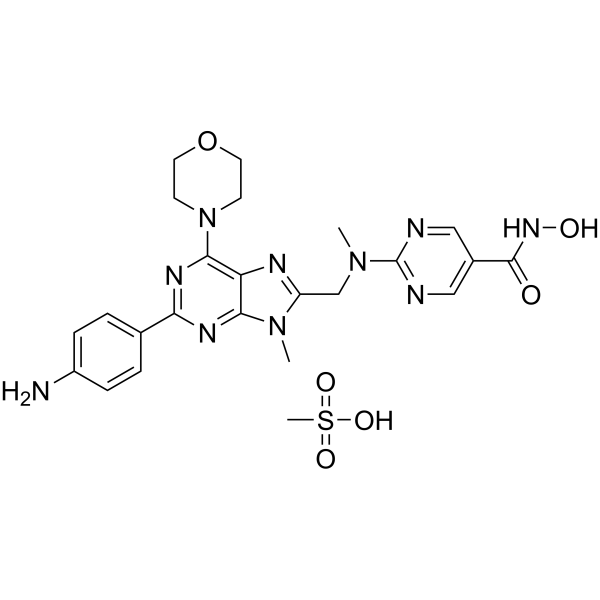
Purinostat mesylate, the mesylate salt of Purinostat, is an inhibitor of class I and class IIb HDACs with IC50s from 0.81 to 11.5 nM. It exhibits anticancer activity by inducing apoptosis and affecting cell cycle of LAMA84 and 188 BL-2 cells.
Physicochemical Properties
| Molecular Formula | C24H30N10O6S |
| Molecular Weight | 586.623402118683 |
| Exact Mass | 586.207 |
| CAS # | 2650188-32-0 |
| PubChem CID | 127044510 |
| Appearance | Off-white to light yellow solid powder |
| Hydrogen Bond Donor Count | 4 |
| Hydrogen Bond Acceptor Count | 14 |
| Rotatable Bond Count | 6 |
| Heavy Atom Count | 41 |
| Complexity | 820 |
| Defined Atom Stereocenter Count | 0 |
| InChi Key | QTSZBNQPNSJXAC-UHFFFAOYSA-N |
| InChi Code | InChI=1S/C23H26N10O3.CH4O3S/c1-31(23-25-11-15(12-26-23)22(34)30-35)13-17-27-18-20(32(17)2)28-19(14-3-5-16(24)6-4-14)29-21(18)33-7-9-36-10-8-33;1-5(2,3)4/h3-6,11-12,35H,7-10,13,24H2,1-2H3,(H,30,34);1H3,(H,2,3,4) |
| Chemical Name | 2-[[2-(4-aminophenyl)-9-methyl-6-morpholin-4-ylpurin-8-yl]methyl-methylamino]-N-hydroxypyrimidine-5-carboxamide;methanesulfonic acid |
| HS Tariff Code | 2934.99.9001 |
| Storage |
Powder-20°C 3 years 4°C 2 years In solvent -80°C 6 months -20°C 1 month |
| Shipping Condition | Room temperature (This product is stable at ambient temperature for a few days during ordinary shipping and time spent in Customs) |
Biological Activity
| ln Vitro | Inhibiting HDAC1, 2, 3, and 8 with IC50s of 0.81, 1.4, 1.7, and 3.8 nM, HDAC6 and 10 with IC50s of 11.5 and 1.1 nM, and HDAC4, 5, 7, 9, and 11 with IC50s of 1072, 426, 690, 622, and 3348 nM, respectively, are all possible with purinostat mesylate (1–10 μM)[1]. Purinostat mesylate (zero to sixty nanometers; 24 hours) alters the cell cycle and causes apoptosis in LAMA84 and 188 BL-2 cells[1]. |
| ln Vivo | Purinostat mesylate (5–10 mg/kg; intraperitoneally three times a week for five weeks) efficiently inhibits the growth of leukemia in vivo[1]. In BCR-ABL(T315I)-induced primary B-ALL mice, purinostat mesylate (5–10 mg/kg; intravenously three times a week for eight weeks) exhibits strong anti-leukemia effects[1]. |
| Cell Assay |
Cell Proliferation Assay[1] Cell Types: LAMA84 and 188 BL-2 cell lines Tested Concentrations: 0-80 nM Incubation Duration: 24, 48 and 72 hrs (hours) Experimental Results: Dramatically inhibited cell proliferation of LAMA84 and 188 BL-2 cells. Apoptosis Analysis[1] Cell Types: LAMA84 and 188 BL-2 cell lines Tested Concentrations: 0-60 nM Incubation Duration: 24 hrs (hours) Experimental Results: Induced apoptosis of LAMA84 and 188 BL-2 cells. Cell Cycle Analysis[1] Cell Types: LAMA84 and 188 BL- 2 cell lines Tested Concentrations: 0-40 nM Incubation Duration: 24 hrs (hours) Experimental Results: Dose-dependently blocked cell cycle progression at G0/G1 phase. Western Blot Analysis[1] Cell Types: LAMA84 and 188 BL-2 cell lines Tested Concentrations: 0- 40 nM Incubation Duration: 24 hrs (hours) Experimental Results: Dose-dependently increased the 191 levels of Ac-H3 and Ac-H4, and diminished HSP90. |
| Animal Protocol |
Animal/Disease Models: Non-irradiated C57BL/6 recipient mice with BL-2 cells injection[1] Doses: 5 and 10 mg/kg Route of Administration: intraperitoneal (ip)injection; 5-10 mg/kg three times a week; for five weeks Experimental Results: Dramatically prolonged the overall survival rate and suppressed leukemia progression of mice, and no tumor cell was detected after stopped treatment. Animal/Disease Models: Non-irradiated C57BL/6 recipient mice with BL-2 secondary transplantation[1] Doses: 10 mg/kg Route of Administration: intravenous (iv) injection; 10 mg/kg three times a week Experimental Results: Completely eliminated GFP+B220+ cells in spleens on day 3 with two times treatment and this complete inhibition was maintained for 26 days duration of treatment. Animal/Disease Models: B-ALL mouse with BCR-ABL(T315I)-induced leukemia[1] Doses: 5 and 10 mg/kg Route of Administration: intravenous (iv) injection; 5 and 10 mg /kg three times a week; for 8 weeks Experimental Results: Dramatically prolonged survival rate of BCR-ABL(T315I)-induced B-ALL mice. Survived all mice after treatment for 42 da |
| References |
[1]. Purinostat Mesylate Is a Uniquely Potent and Selective Inhibitor of HDACs for the Treatment of BCR-ABL-Induced B-Cell Acute Lymphoblastic Leukemia. Clin Cancer Res. 2019 Dec 15;25(24):7527-7539. |
| Additional Infomation | Purinostat Mesylate is the mesylate salt form of purinostat, an inhibitor of histone deacetylase (HDAC) classes I and IIb, with potential antineoplastic activities. Upon administration, purinostat selectively inhibits the catalytic activity of class I and IIb HDACs, which results in an accumulation of highly acetylated chromatin histones, the induction of chromatin remodeling and an altered pattern of gene expression. This leads to the inhibition of tumor oncogene transcription, and the selective transcription of tumor suppressor genes, which inhibits tumor cell division and induces tumor cell apoptosis. HDAC, an enzyme upregulated in many tumor types, deacetylates chromatin histone proteins. Class I HDACs are located in the nucleus and include HDACs 1, 2, 3, and 8; class IIb HDACs include HDAC 6 and 10 and are located in both the nucleus and the cytoplasm. |
Solubility Data
| Solubility (In Vitro) | May dissolve in DMSO (in most cases), if not, try other solvents such as H2O, Ethanol, or DMF with a minute amount of products to avoid loss of samples |
| Solubility (In Vivo) |
Note: Listed below are some common formulations that may be used to formulate products with low water solubility (e.g. < 1 mg/mL), you may test these formulations using a minute amount of products to avoid loss of samples. Injection Formulations (e.g. IP/IV/IM/SC) Injection Formulation 1: DMSO : Tween 80: Saline = 10 : 5 : 85 (i.e. 100 μL DMSO stock solution → 50 μL Tween 80 → 850 μL Saline) *Preparation of saline: Dissolve 0.9 g of sodium chloride in 100 mL ddH ₂ O to obtain a clear solution. Injection Formulation 2: DMSO : PEG300 :Tween 80 : Saline = 10 : 40 : 5 : 45 (i.e. 100 μL DMSO → 400 μLPEG300 → 50 μL Tween 80 → 450 μL Saline) Injection Formulation 3: DMSO : Corn oil = 10 : 90 (i.e. 100 μL DMSO → 900 μL Corn oil) Example: Take the Injection Formulation 3 (DMSO : Corn oil = 10 : 90) as an example, if 1 mL of 2.5 mg/mL working solution is to be prepared, you can take 100 μL 25 mg/mL DMSO stock solution and add to 900 μL corn oil, mix well to obtain a clear or suspension solution (2.5 mg/mL, ready for use in animals). Injection Formulation 4: DMSO : 20% SBE-β-CD in saline = 10 : 90 [i.e. 100 μL DMSO → 900 μL (20% SBE-β-CD in saline)] *Preparation of 20% SBE-β-CD in Saline (4°C,1 week): Dissolve 2 g SBE-β-CD in 10 mL saline to obtain a clear solution. Injection Formulation 5: 2-Hydroxypropyl-β-cyclodextrin : Saline = 50 : 50 (i.e. 500 μL 2-Hydroxypropyl-β-cyclodextrin → 500 μL Saline) Injection Formulation 6: DMSO : PEG300 : castor oil : Saline = 5 : 10 : 20 : 65 (i.e. 50 μL DMSO → 100 μLPEG300 → 200 μL castor oil → 650 μL Saline) Injection Formulation 7: Ethanol : Cremophor : Saline = 10: 10 : 80 (i.e. 100 μL Ethanol → 100 μL Cremophor → 800 μL Saline) Injection Formulation 8: Dissolve in Cremophor/Ethanol (50 : 50), then diluted by Saline Injection Formulation 9: EtOH : Corn oil = 10 : 90 (i.e. 100 μL EtOH → 900 μL Corn oil) Injection Formulation 10: EtOH : PEG300:Tween 80 : Saline = 10 : 40 : 5 : 45 (i.e. 100 μL EtOH → 400 μLPEG300 → 50 μL Tween 80 → 450 μL Saline) Oral Formulations Oral Formulation 1: Suspend in 0.5% CMC Na (carboxymethylcellulose sodium) Oral Formulation 2: Suspend in 0.5% Carboxymethyl cellulose Example: Take the Oral Formulation 1 (Suspend in 0.5% CMC Na) as an example, if 100 mL of 2.5 mg/mL working solution is to be prepared, you can first prepare 0.5% CMC Na solution by measuring 0.5 g CMC Na and dissolve it in 100 mL ddH2O to obtain a clear solution; then add 250 mg of the product to 100 mL 0.5% CMC Na solution, to make the suspension solution (2.5 mg/mL, ready for use in animals). Oral Formulation 3: Dissolved in PEG400 Oral Formulation 4: Suspend in 0.2% Carboxymethyl cellulose Oral Formulation 5: Dissolve in 0.25% Tween 80 and 0.5% Carboxymethyl cellulose Oral Formulation 6: Mixing with food powders Note: Please be aware that the above formulations are for reference only. InvivoChem strongly recommends customers to read literature methods/protocols carefully before determining which formulation you should use for in vivo studies, as different compounds have different solubility properties and have to be formulated differently. (Please use freshly prepared in vivo formulations for optimal results.) |
| Preparing Stock Solutions | 1 mg | 5 mg | 10 mg | |
| 1 mM | 1.7047 mL | 8.5234 mL | 17.0468 mL | |
| 5 mM | 0.3409 mL | 1.7047 mL | 3.4094 mL | |
| 10 mM | 0.1705 mL | 0.8523 mL | 1.7047 mL |