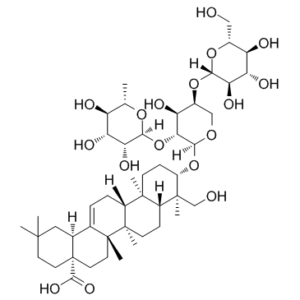
Pulsatilla saponin D (SB365), a naturally-occurring chemical isolated from the root of Pulsatilla koreana, has been used as a traditional medicine for the treatment of several diseases. SB365 strongly suppressed the growth and proliferation of colon cancer cells and induced their apoptosis. Also, SB365 showed anti-angiogenic activity by decreasing the expression of HIF-1α and VEGF. These results were confirmed by an in vivo study showing that SB365 significantly inhibited tumor growth by the induction of apoptosis and inhibition of angiogenesis with stronger anticancer activity than 5-FU. When further examined for its anticancer mechanism, SB365 effectively suppressed the AKT/mTOR pathway both in vitro and in vivo. Taken together, our study demonstrated that SB365 inhibits the AKT/mTOR pathway, leading to the suppression of tumor growth and angiogenesis together with induction of apoptosis. Therefore, SB365 is a good candidate as a natural product for use in the treatment of colon cancer.
Physicochemical Properties
| Molecular Formula | C47H76O17 |
| Molecular Weight | 913.0962 |
| Exact Mass | 912.508 |
| CAS # | 68027-15-6 |
| PubChem CID | 11650910 |
| Appearance | Off-white to light yellow solid powder |
| Density | 1.4±0.1 g/cm3 |
| Boiling Point | 997.6±65.0 °C at 760 mmHg |
| Flash Point | 285.4±27.8 °C |
| Vapour Pressure | 0.0±0.6 mmHg at 25°C |
| Index of Refraction | 1.619 |
| LogP | 5.77 |
| Hydrogen Bond Donor Count | 10 |
| Hydrogen Bond Acceptor Count | 17 |
| Rotatable Bond Count | 9 |
| Heavy Atom Count | 64 |
| Complexity | 1750 |
| Defined Atom Stereocenter Count | 23 |
| SMILES | C[C@H]1[C@@H]([C@H]([C@H]([C@@H](O1)O[C@@H]2[C@H]([C@H](CO[C@H]2O[C@H]3CC[C@]4([C@H]([C@]3(C)CO)CC[C@@]5([C@@H]4CC=C6[C@]5(CC[C@@]7([C@H]6CC(CC7)(C)C)C(=O)O)C)C)C)O[C@H]8[C@@H]([C@H]([C@@H]([C@H](O8)CO)O)O)O)O)O)O)O |
| InChi Key | SOLICHUQXFAOEP-YDIXZRNLSA-N |
| InChi Code | InChI=1S/C47H76O17/c1-22-30(50)33(53)35(55)38(60-22)64-37-32(52)26(62-39-36(56)34(54)31(51)25(19-48)61-39)20-59-40(37)63-29-11-12-43(4)27(44(29,5)21-49)10-13-46(7)28(43)9-8-23-24-18-42(2,3)14-16-47(24,41(57)58)17-15-45(23,46)6/h8,22,24-40,48-56H,9-21H2,1-7H3,(H,57,58)/t22-,24-,25+,26-,27+,28+,29-,30-,31+,32-,33+,34-,35+,36+,37+,38-,39-,40-,43-,44-,45+,46+,47-/m0/s1 |
| Chemical Name | (4aS,6aR,6aS,6bR,8aR,9R,10S,12aR,14bS)-9-(hydroxymethyl)-10-[(2S,3R,4S,5S)-4-hydroxy-5-[(2S,3R,4S,5S,6R)-3,4,5-trihydroxy-6-(hydroxymethyl)oxan-2-yl]oxy-3-[(2S,3R,4R,5R,6S)-3,4,5-trihydroxy-6-methyloxan-2-yl]oxyoxan-2-yl]oxy-2,2,6a,6b,9,12a-hexamethyl-1,3,4,5,6,6a,7,8,8a,10,11,12,13,14b-tetradecahydropicene-4a-carboxylic acid |
| Synonyms | SB365; SB-365; SB 365; Hederacolchiside A |
| HS Tariff Code | 2934.99.9001 |
| Storage |
Powder-20°C 3 years 4°C 2 years In solvent -80°C 6 months -20°C 1 month Note: This product requires protection from light (avoid light exposure) during transportation and storage. |
| Shipping Condition | Room temperature (This product is stable at ambient temperature for a few days during ordinary shipping and time spent in Customs) |
Biological Activity
| ln Vitro |
Apoptotic effects are demonstrated by pulsatilla saponin D (SB365), which is also associated with elevated cleaved caspase-3 and poly(ADP-ribose) polymerase evidence [1]. In gastric cancer cells, pulsatilla saponin D (SB365) significantly suppresses c-Met expression [1]. The growth and proliferation of five human pancreatic cancer cell lines (MIAPaCa-2, BXPC-3, PANC-1, AsPC-1, and HPAC) are significantly inhibited by pulsatilla saponin D (SB365) [2]. The anti-angiogenic effect of Pulsatilla saponin D (SB365) is demonstrated by its ability to decrease the expression of VEGF and HIF-1α. In NSCLC cancer cells, pulsatilla saponin D (0.3 ng/mL to 10 μg/mL) shows anti-tumor action [4]. SB365 (Pulsatilla saponin D) suppressed the growth and proliferation of five human pancreatic cancer cell lines (MIAPaCa-2, BXPC-3, PANC-1, AsPC-1, and HPAC) in a dose-dependent manner, with inhibition starting at 1 µM and up to 80% inhibition at 5-10 µM. The IC₅₀ values for the five cell lines ranged from 0.8 to 2 µM. [2] SB365 induced apoptosis in pancreatic cancer cells, as demonstrated by increased levels of cleaved caspase-3, decreased Bcl-2 expression, nuclear condensation, DNA fragmentation (TUNEL-positive cells), loss of mitochondrial membrane potential (ΔΨm), and increased cytochrome c release from mitochondria. [2] SB365 exerted anti-angiogenic effects by decreasing the expression of HIF-1α and VEGF under hypoxic conditions (induced by 100 µM CoCl₂) in BXPC-3 cells. [2] SB365 inhibited tumor sphere formation of PANC-1 cells in a dose-dependent manner in a low-attachment plate culture system. [2] |
| ln Vivo |
In the Lewis lung cancer model, pulsatilla saponin D (6.4 mg/kg) demonstrates anticancer efficacy [4]. In a PANC-1 xenograft model in nude mice, intraperitoneal administration of SB365 at 30 mg/kg three times per week for 37 days significantly inhibited tumor growth, resulting in a 55% reduction in tumor volume and a 51% reduction in tumor weight compared to the control group. [2] SB365 treatment reduced proliferation marker PCNA expression, decreased angiogenesis markers VEGF and CD34, and increased apoptosis markers cleaved caspase-3 and TUNEL-positive cells in tumor tissues. [2] No significant change in body weight was observed in the SB365-treated group compared to the control, indicating low systemic toxicity at the therapeutic dose. [2] |
| Cell Assay |
Cytotoxicity assay[4] Cell Types: A-549, SKMEL-2, MCF-7 and Lewis lung cancer (LLC) cells. Tested Concentrations: 0.3 ng/mL to 10 μg/mL. Incubation Duration: 72 hrs (hours). Experimental Results: The ED50 value of A-549 cells was 6.3 μg/mL. Cell viability was measured using the MTT assay. Pancreatic cancer cells were seeded in 96-well plates at a density of 1-3×10⁴ cells/well, incubated for 24 h, and then treated with various concentrations of SB365 (0, 1, 2, 5, 10, 20 µM) or DMSO control for 48 h. MTT solution was added, and after 4 h incubation, formazan crystals were dissolved in DMSO. Absorbance was measured at 540 nm. [2] For immunofluorescence, cells were plated on cover glasses, treated with 10 µM SB365, fixed, blocked, incubated with primary antibodies (e.g., Ki-67, cytochrome c, HIF-1α, VEGF), followed by fluorescent secondary antibody and DAPI staining, and visualized by confocal microscopy. [2] Apoptosis was assessed by DAPI staining and TUNEL assay. Cells were treated with 10 µM SB365 for 24 h, fixed, and stained for nuclear morphology and DNA fragmentation. [2] Mitochondrial membrane potential was measured using JC-1 staining. Cells were treated with 10 µM SB365 for 6 h, incubated with JC-1 dye, and analyzed by fluorescence microscopy. [2] Western blotting was performed on cell lysates from SB365-treated BXPC-3 cells. Proteins were separated by SDS-PAGE, transferred to membranes, and probed with antibodies against Bcl-2, cleaved caspase-3, and β-actin. [2] Tumor sphere assay was conducted by seeding PANC-1 cells in ultra-low attachment plates with defined medium containing growth factors. Spheres were treated with SB365 and counted after 14 days. [2] |
| Animal Protocol |
Animal/Disease Models: 2x2x2 mm3 tumor fragments from Lewis lung cancer (LLC) were transplanted subcutaneously (sc) (sc) into the auxiliary area of BDF1 mice [4]. Doses: 6.4 mg/kg. Route of Administration: intraperitoneal (ip) injection on days 1 to 7 and 9 to 14. Experimental Results: Such potent antitumor effect on solid tumors (IR, 82%), higher than that of doxorubicin (IR, 64%). Male athymic BALB/c nude mice (6 weeks old) were subcutaneously inoculated with PANC-1 cells (5×10⁶ cells/mouse). When tumor volume reached 50–100 mm³, mice were randomly divided into control and treatment groups. SB365 was dissolved in PBS and administered intraperitoneally at 30 mg/kg, three times per week for 37 days. Control mice received PBS vehicle. Tumor dimensions were measured twice weekly, and volume was calculated as length × width² × 0.5. At the end of the study, tumors were excised and weighed. [2] |
| Toxicity/Toxicokinetics |
In the xenograft study, SB365 administration at 30 mg/kg did not cause significant body weight loss in mice compared to the control group, suggesting minimal systemic toxicity at this dose. [2] |
| References |
[1]. SB365, Pulsatilla saponin D, targets c-Met and exerts antiangiogenic and antitumor activities. Carcinogenesis. 2013 Sep;34(9):2156-69. [2]. SB365, Pulsatilla saponin D suppresses proliferation and induces apoptosis of pancreatic cancer cells. Oncol Rep. 2013 Aug;30(2):801-8. [3]. SB365, Pulsatilla saponin D suppresses the proliferation of human colon cancer cells and induces apoptosis by modulating the AKT/mTOR signalling pathway. Food Chem. 2013 Jan 1;136(1):26-33. [4]. Pulsatilla saponin D: the antitumor principle from Pulsatilla koreana. Arch Pharm Res. 2004 Sep;27(9):915-8. |
| Additional Infomation |
Pulsatilla saponin D is a triterpenoid. It has a role as a metabolite. Pulsatilla saponin D has been reported in Serjania salzmanniana, Anemone coronaria, and Hedera colchica with data available. SB365 is a saponin D isolated from the roots of Pulsatilla koreana, a plant used in traditional medicine. [2] It exhibits anticancer activity through multiple mechanisms: inhibition of cell proliferation, induction of mitochondrial-mediated apoptosis, and suppression of angiogenesis via HIF-1α/VEGF pathway. [2] SB365 is proposed as a potential natural product candidate for the treatment of pancreatic cancer. [2] |
Solubility Data
| Solubility (In Vitro) | DMSO : ≥ 39 mg/mL (~42.71 mM) |
| Solubility (In Vivo) |
Solubility in Formulation 1: ≥ 2.08 mg/mL (2.28 mM) (saturation unknown) in 10% DMSO + 40% PEG300 + 5% Tween80 + 45% Saline (add these co-solvents sequentially from left to right, and one by one), clear solution. For example, if 1 mL of working solution is to be prepared, you can add 100 μL of 20.8 mg/mL clear DMSO stock solution to 400 μL PEG300 and mix evenly; then add 50 μL Tween-80 to the above solution and mix evenly; then add 450 μL normal saline to adjust the volume to 1 mL. Preparation of saline: Dissolve 0.9 g of sodium chloride in 100 mL ddH₂ O to obtain a clear solution. Solubility in Formulation 2: ≥ 2.08 mg/mL (2.28 mM) (saturation unknown) in 10% DMSO + 90% (20% SBE-β-CD in Saline) (add these co-solvents sequentially from left to right, and one by one), clear solution. For example, if 1 mL of working solution is to be prepared, you can add 100 μL of 20.8 mg/mL clear DMSO stock solution to 900 μL of 20% SBE-β-CD physiological saline solution and mix evenly. Preparation of 20% SBE-β-CD in Saline (4°C,1 week): Dissolve 2 g SBE-β-CD in 10 mL saline to obtain a clear solution. Solubility in Formulation 3: ≥ 2.08 mg/mL (2.28 mM) (saturation unknown) in 10% DMSO + 90% Corn Oil (add these co-solvents sequentially from left to right, and one by one), clear solution. For example, if 1 mL of working solution is to be prepared, you can add 100 μL of 20.8 mg/mL clear DMSO stock solution to 900 μL of corn oil and mix evenly. (Please use freshly prepared in vivo formulations for optimal results.) |
| Preparing Stock Solutions | 1 mg | 5 mg | 10 mg | |
| 1 mM | 1.0952 mL | 5.4759 mL | 10.9517 mL | |
| 5 mM | 0.2190 mL | 1.0952 mL | 2.1903 mL | |
| 10 mM | 0.1095 mL | 0.5476 mL | 1.0952 mL |