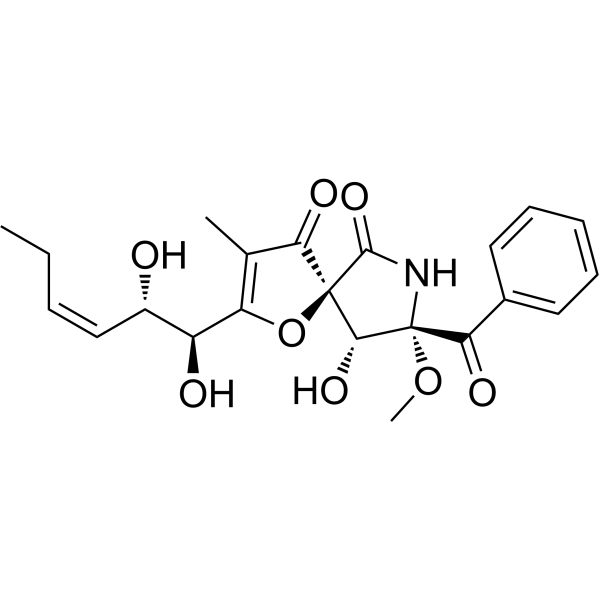
Physicochemical Properties
| Molecular Formula | C22H25NO8 |
| Molecular Weight | 431.44 |
| Exact Mass | 431.158 |
| CAS # | 58523-30-1 |
| PubChem CID | 9845622 |
| Appearance | Typically exists as solid at room temperature |
| Density | 1.4±0.1 g/cm3 |
| Boiling Point | 751.5±60.0 °C at 760 mmHg |
| Melting Point | 126.0-126.9℃ |
| Flash Point | 408.3±32.9 °C |
| Vapour Pressure | 0.0±2.6 mmHg at 25°C |
| Index of Refraction | 1.626 |
| LogP | 3.23 |
| Hydrogen Bond Donor Count | 4 |
| Hydrogen Bond Acceptor Count | 8 |
| Rotatable Bond Count | 7 |
| Heavy Atom Count | 31 |
| Complexity | 814 |
| Defined Atom Stereocenter Count | 5 |
| SMILES | CC/C=C\[C@@H]([C@@H](C1=C(C(=O)[C@@]2(O1)[C@H]([C@@](NC2=O)(C(=O)C3=CC=CC=C3)OC)O)C)O)O |
| InChi Key | SLYDIPAXCVVRNY-UOWMTANKSA-N |
| InChi Code | InChI=1S/C22H25NO8/c1-4-5-11-14(24)15(25)16-12(2)17(26)21(31-16)19(28)22(30-3,23-20(21)29)18(27)13-9-7-6-8-10-13/h5-11,14-15,19,24-25,28H,4H2,1-3H3,(H,23,29)/b11-5-/t14-,15-,19+,21+,22+/m0/s1 |
| Chemical Name | (5S,8S,9R)-8-benzoyl-2-[(Z,1S,2S)-1,2-dihydroxyhex-3-enyl]-9-hydroxy-8-methoxy-3-methyl-1-oxa-7-azaspiro[4.4]non-2-ene-4,6-dione |
| HS Tariff Code | 2934.99.9001 |
| Storage |
Powder-20°C 3 years 4°C 2 years In solvent -80°C 6 months -20°C 1 month |
| Shipping Condition | Room temperature (This product is stable at ambient temperature for a few days during ordinary shipping and time spent in Customs) |
Biological Activity
| Targets | Microbial Metabolite |
| ln Vitro | Pseurotin A has an IC50 value of 1.2 μM and suppresses PCSK9 expression in HepG2 cells. In BT-474 and T47D BC cell lines, peterotin A (25–100 μM; 72 hours) dramatically decreased the PCSK9 level in a dose-dependent manner. The LDLR level is dramatically increased in a dose-dependent manner by priseurotin A (25-100 μM; 72 hours)[3]. In hormone-dependent BC cells, peterotin A (40-200 μM; 24-72 hours) exhibits anti-proliferative activity[3]. |
| ln Vivo | Pseurotin A exhibits anti-tumor efficacy at 10 mg/kg; po; 7X/week, for 30 days[3]. |
| Cell Assay |
Cell Viability Assay[3] Cell Types: BT-474 cells, T47D cells Tested Concentrations: 40-200 μM Incubation Duration: 24-72 hrs (hours) Experimental Results: demonstrated weak but time and dose-dependent inhibition of the growth of BT-474 and T47D BC cells, with gradual decrease of the IC50 values over time (260.83-93.64 μM and 267.84-113.08 μM, respectively). |
| Animal Protocol |
Animal/Disease Models: HFD-fed orthotopic athymic mice (bearing BT-474 tumor cells xenograft mode)[1] Doses: 10 mg/kg Route of Administration: Po; 7X/week, 30 days Experimental Results: Dramatically suppressed the growth of BT474 tumors. |
| References |
[1]. Pseurotin A and its analogues as inhibitors of immunoglobulin E [correction of immunoglobuline E] production. Bioorg Med Chem Lett. 2009;19(5):1457-1460. [2]. Maiya S, Grundmann A, Li X, Li SM, Turner G. Identification of a hybrid PKS/NRPS required for pseurotin A biosynthesis in the human pathogen Aspergillus fumigatus. Chembiochem. 2007;8(14):1736-1743. [3]. Pseurotin A as a novel suppressor of hormone dependent breast cancer progression and recurrence by inhibiting PCSK9 secretion and interaction with LDL receptor. Pharmacol Res. 2020;158:104847. |
| Additional Infomation |
Pseurotin A is a spirocyclic that is 1-oxa-7-azaspiro[4.4]non-2-ene-4,6-dione bearing 1,2-dihydroxyhex-3-en-1-yl, methyl, methoxy, benzoyl and hydroxy substituents at positions 2, 3, 8, 8 and 9 respectively. It has a role as a metabolite. It is an azaspiro compound, an oxaspiro compound and a lactam. Pseurotin A has been reported in Aspergillus insulicola, Cordyceps tenuipes, and other organisms with data available. |
Solubility Data
| Solubility (In Vitro) | May dissolve in DMSO (in most cases), if not, try other solvents such as H2O, Ethanol, or DMF with a minute amount of products to avoid loss of samples |
| Solubility (In Vivo) |
Note: Listed below are some common formulations that may be used to formulate products with low water solubility (e.g. < 1 mg/mL), you may test these formulations using a minute amount of products to avoid loss of samples. Injection Formulations (e.g. IP/IV/IM/SC) Injection Formulation 1: DMSO : Tween 80: Saline = 10 : 5 : 85 (i.e. 100 μL DMSO stock solution → 50 μL Tween 80 → 850 μL Saline) *Preparation of saline: Dissolve 0.9 g of sodium chloride in 100 mL ddH ₂ O to obtain a clear solution. Injection Formulation 2: DMSO : PEG300 :Tween 80 : Saline = 10 : 40 : 5 : 45 (i.e. 100 μL DMSO → 400 μLPEG300 → 50 μL Tween 80 → 450 μL Saline) Injection Formulation 3: DMSO : Corn oil = 10 : 90 (i.e. 100 μL DMSO → 900 μL Corn oil) Example: Take the Injection Formulation 3 (DMSO : Corn oil = 10 : 90) as an example, if 1 mL of 2.5 mg/mL working solution is to be prepared, you can take 100 μL 25 mg/mL DMSO stock solution and add to 900 μL corn oil, mix well to obtain a clear or suspension solution (2.5 mg/mL, ready for use in animals). Injection Formulation 4: DMSO : 20% SBE-β-CD in saline = 10 : 90 [i.e. 100 μL DMSO → 900 μL (20% SBE-β-CD in saline)] *Preparation of 20% SBE-β-CD in Saline (4°C,1 week): Dissolve 2 g SBE-β-CD in 10 mL saline to obtain a clear solution. Injection Formulation 5: 2-Hydroxypropyl-β-cyclodextrin : Saline = 50 : 50 (i.e. 500 μL 2-Hydroxypropyl-β-cyclodextrin → 500 μL Saline) Injection Formulation 6: DMSO : PEG300 : castor oil : Saline = 5 : 10 : 20 : 65 (i.e. 50 μL DMSO → 100 μLPEG300 → 200 μL castor oil → 650 μL Saline) Injection Formulation 7: Ethanol : Cremophor : Saline = 10: 10 : 80 (i.e. 100 μL Ethanol → 100 μL Cremophor → 800 μL Saline) Injection Formulation 8: Dissolve in Cremophor/Ethanol (50 : 50), then diluted by Saline Injection Formulation 9: EtOH : Corn oil = 10 : 90 (i.e. 100 μL EtOH → 900 μL Corn oil) Injection Formulation 10: EtOH : PEG300:Tween 80 : Saline = 10 : 40 : 5 : 45 (i.e. 100 μL EtOH → 400 μLPEG300 → 50 μL Tween 80 → 450 μL Saline) Oral Formulations Oral Formulation 1: Suspend in 0.5% CMC Na (carboxymethylcellulose sodium) Oral Formulation 2: Suspend in 0.5% Carboxymethyl cellulose Example: Take the Oral Formulation 1 (Suspend in 0.5% CMC Na) as an example, if 100 mL of 2.5 mg/mL working solution is to be prepared, you can first prepare 0.5% CMC Na solution by measuring 0.5 g CMC Na and dissolve it in 100 mL ddH2O to obtain a clear solution; then add 250 mg of the product to 100 mL 0.5% CMC Na solution, to make the suspension solution (2.5 mg/mL, ready for use in animals). Oral Formulation 3: Dissolved in PEG400 Oral Formulation 4: Suspend in 0.2% Carboxymethyl cellulose Oral Formulation 5: Dissolve in 0.25% Tween 80 and 0.5% Carboxymethyl cellulose Oral Formulation 6: Mixing with food powders Note: Please be aware that the above formulations are for reference only. InvivoChem strongly recommends customers to read literature methods/protocols carefully before determining which formulation you should use for in vivo studies, as different compounds have different solubility properties and have to be formulated differently. (Please use freshly prepared in vivo formulations for optimal results.) |
| Preparing Stock Solutions | 1 mg | 5 mg | 10 mg | |
| 1 mM | 2.3178 mL | 11.5891 mL | 23.1782 mL | |
| 5 mM | 0.4636 mL | 2.3178 mL | 4.6356 mL | |
| 10 mM | 0.2318 mL | 1.1589 mL | 2.3178 mL |