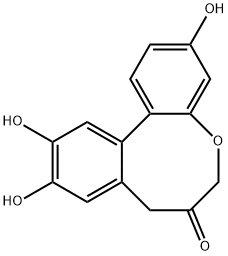
Protosappanin A is a novel and potent immunosuppressive agent isolated from Caesalpinia sappan L. Protosappanin A inhibits JAK2/STAT3-dependent inflammation pathway through down-regulating the phosphorylation of JAK2/STAT3.
Physicochemical Properties
| Molecular Formula | C15H12O5 |
| Molecular Weight | 272.2528 |
| Exact Mass | 272.068 |
| CAS # | 102036-28-2 |
| Related CAS # | 102036-28-2; |
| PubChem CID | 128001 |
| Appearance | White to off-white solid powder |
| Density | 1.5±0.1 g/cm3 |
| Boiling Point | 613.1±55.0 °C at 760 mmHg |
| Flash Point | 238.8±25.0 °C |
| Vapour Pressure | 0.0±1.8 mmHg at 25°C |
| Index of Refraction | 1.689 |
| LogP | 1.2 |
| Hydrogen Bond Donor Count | 3 |
| Hydrogen Bond Acceptor Count | 5 |
| Rotatable Bond Count | 0 |
| Heavy Atom Count | 20 |
| Complexity | 371 |
| Defined Atom Stereocenter Count | 0 |
| InChi Key | MUKYVRVYBBYJSI-UHFFFAOYSA-N |
| InChi Code | InChI=1S/C15H12O5/c16-9-1-2-11-12-6-14(19)13(18)4-8(12)3-10(17)7-20-15(11)5-9/h1-2,4-6,16,18-19H,3,7H2 |
| Chemical Name | 5,14,15-trihydroxy-8-oxatricyclo[10.4.0.02,7]hexadeca-1(16),2(7),3,5,12,14-hexaen-10-one |
| HS Tariff Code | 2934.99.9001 |
| Storage |
Powder-20°C 3 years 4°C 2 years In solvent -80°C 6 months -20°C 1 month Note: Please store this product in a sealed and protected environment (e.g. under nitrogen), avoid exposure to moisture and light. |
| Shipping Condition | Room temperature (This product is stable at ambient temperature for a few days during ordinary shipping and time spent in Customs) |
Biological Activity
| ln Vitro | In LPS-activated BV2 microglia, protosappanin A (PTA: 12.5, 25, 50 μM, 24 hours) markedly reduced TNF-α and IL-1β production. PTA decreased the mRNA expression of MCP-1, IL-1β, and IL-6 in the BV2 microglial cell line in a dose-dependent manner [1]. In response to LPS treatment, protosappanin A (PTA: 12.5, 25, 50 μM, 24 hours) suppresses the JAK2/STAT3-dependent inflammatory pathway by downregulating JAK2 and STAT3 phosphorylation as well as STAT3 nuclear translocation [1]. Protosappanin A (PTA: 12.5, 25, 50 μM, 24 hours) significantly inhibits the NF-κB-dependent oxidative and nitrative stress-induced increase in LPS by interfering with the interaction between the transmembrane protein CD14 and Toll-like receptor 4. BV2 microglia [2]. |
| Cell Assay |
Western Blot analysis [1] Cell Types: mouse BV2 microglial cell line. Tested Concentrations: 12.5, 25, 50 μM. Incubation Duration: 24 hrs (hours). Experimental Results: Inhibited LPS-induced release of NO, TNF-α and IL-1β in BV2 cells. LPS-induced IL-6, IL-1β and MCP-1 gene expression was attenuated in BV2 cells. Inhibits LPS-induced activation of the JAK2/STAT3 pathway in BV2 cells. |
| References |
[1]. Protosappanin A exerts anti-neuroinflammatory effect by inhibiting JAK2-STAT3 pathway in lipopolysaccharide-induced BV2 microglia. Chin J Nat Med. 2017 Sep;15(9):674-679. [2]. Protosappanin A inhibits oxidative and nitrative stress via interfering the interaction of transmembrane protein CD14 with Toll-like receptor-4 in lipopolysaccharide-induced BV-2 microglia. Int Immunopharmacol, 2012, 14(4): 558- 569. |
| Additional Infomation |
Protosappanin A is a member of catechols. It has a role as a metabolite. Protosappanin A has been reported in Alpinia japonica, Biancaea sappan, and Biancaea decapetala with data available. |
Solubility Data
| Solubility (In Vitro) | DMSO : ~125 mg/mL (~459.14 mM) |
| Solubility (In Vivo) |
Solubility in Formulation 1: ≥ 2.08 mg/mL (7.64 mM) (saturation unknown) in 10% DMSO + 40% PEG300 + 5% Tween80 + 45% Saline (add these co-solvents sequentially from left to right, and one by one), clear solution. For example, if 1 mL of working solution is to be prepared, you can add 100 μL of 20.8 mg/mL clear DMSO stock solution to 400 μL PEG300 and mix evenly; then add 50 μL Tween-80 to the above solution and mix evenly; then add 450 μL normal saline to adjust the volume to 1 mL. Preparation of saline: Dissolve 0.9 g of sodium chloride in 100 mL ddH₂ O to obtain a clear solution. Solubility in Formulation 2: ≥ 2.08 mg/mL (7.64 mM) (saturation unknown) in 10% DMSO + 90% (20% SBE-β-CD in Saline) (add these co-solvents sequentially from left to right, and one by one), clear solution. For example, if 1 mL of working solution is to be prepared, you can add 100 μL of 20.8 mg/mL clear DMSO stock solution to 900 μL of 20% SBE-β-CD physiological saline solution and mix evenly. Preparation of 20% SBE-β-CD in Saline (4°C,1 week): Dissolve 2 g SBE-β-CD in 10 mL saline to obtain a clear solution. Solubility in Formulation 3: ≥ 2.08 mg/mL (7.64 mM) (saturation unknown) in 10% DMSO + 90% Corn Oil (add these co-solvents sequentially from left to right, and one by one), clear solution. For example, if 1 mL of working solution is to be prepared, you can add 100 μL of 20.8 mg/mL clear DMSO stock solution to 900 μL of corn oil and mix evenly. (Please use freshly prepared in vivo formulations for optimal results.) |
| Preparing Stock Solutions | 1 mg | 5 mg | 10 mg | |
| 1 mM | 3.6731 mL | 18.3655 mL | 36.7309 mL | |
| 5 mM | 0.7346 mL | 3.6731 mL | 7.3462 mL | |
| 10 mM | 0.3673 mL | 1.8365 mL | 3.6731 mL |