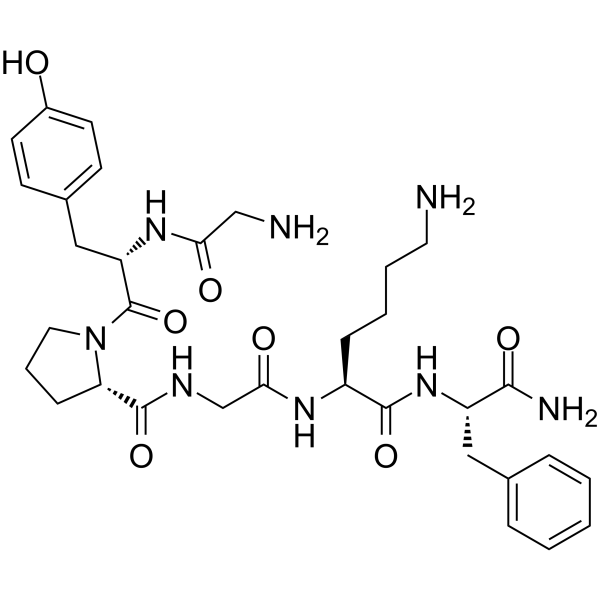
Physicochemical Properties
| Molecular Formula | C33H46N8O7 |
| Molecular Weight | 666.76774 |
| Exact Mass | 666.349 |
| CAS # | 245443-52-1 |
| PubChem CID | 90471153 |
| Sequence | H-Gly-Tyr-Pro-Gly-Lys-Phe-NH2 |
| SequenceShortening | GYPGKF or GYPGKF-NH2 |
| Appearance | White to off-white solid |
| LogP | 1.914 |
| Hydrogen Bond Donor Count | 8 |
| Hydrogen Bond Acceptor Count | 9 |
| Rotatable Bond Count | 18 |
| Heavy Atom Count | 48 |
| Complexity | 1090 |
| Defined Atom Stereocenter Count | 4 |
| SMILES | NC([C@@H](NC([C@@H](NC(CNC([C@@H]1CCCN1C([C@@H](NC(CN)=O)CC2=CC=C(O)C=C2)=O)=O)=O)CCCCN)=O)CC3=CC=CC=C3)=O |
| InChi Key | NAIYNSCJEHHFMV-FWEHEUNISA-N |
| InChi Code | InChI=1S/C33H46N8O7/c34-15-5-4-9-24(31(46)40-25(30(36)45)17-21-7-2-1-3-8-21)38-29(44)20-37-32(47)27-10-6-16-41(27)33(48)26(39-28(43)19-35)18-22-11-13-23(42)14-12-22/h1-3,7-8,11-14,24-27,42H,4-6,9-10,15-20,34-35H2,(H2,36,45)(H,37,47)(H,38,44)(H,39,43)(H,40,46)/t24-,25-,26-,27-/m0/s1 |
| Chemical Name | (2S)-1-[(2S)-2-[(2-aminoacetyl)amino]-3-(4-hydroxyphenyl)propanoyl]-N-[2-[[(2S)-6-amino-1-[[(2S)-1-amino-1-oxo-3-phenylpropan-2-yl]amino]-1-oxohexan-2-yl]amino]-2-oxoethyl]pyrrolidine-2-carboxamide |
| HS Tariff Code | 2934.99.9001 |
| Storage |
Powder-20°C 3 years 4°C 2 years In solvent -80°C 6 months -20°C 1 month Note: Please store this product in a sealed and protected environment, avoid exposure to moisture. |
| Shipping Condition | Room temperature (This product is stable at ambient temperature for a few days during ordinary shipping and time spent in Customs) |
Biological Activity
| Targets |
PAR4 (proteinase-activated receptor-4) Human platelet Protease-Activated Receptor-4 (PAR4) (EC50 values vary by activating peptide analogues: e.g., PAR4 tethered-ligand-derived peptide AYPGKF-NH₂: EC50 = 3.2 μM; modified peptide AYPGK-NH₂: EC50 = 7.8 μM; AYPG-NH₂: EC50 = 21.5 μM) [1] |
| ln Vitro |
The agonistic efficacy of AYPGKF-NH2 is considerably reduced by a factor of 25 by GYPGKF-NH2 [1]. Thrombin is the most potent agonist of human platelets and its effects are primarily mediated through the protease-activated receptors (PARs)-1 and -4. Although PAR-1 has higher affinity for thrombin than PAR-4, both receptors contribute to thrombin-mediated actions on platelets. Recently, a potent and selective PAR-1 antagonist (vorapaxar) was approved for clinical use in selected patients. In contrast, despite the fact that several PAR-4 antagonists have been developed, few of them have been tested in clinical trials. The aim of the present study was to elucidate the molecular requirements involving the PAR-4 mechanism of activation by peptide analogues of its tethered-ligand. Eight synthetic PAR-4 tethered-ligand peptide analogues were synthesized and studied for their agonistic/antagonistic potency and selectivity toward human washed platelet aggregation, using light transmittance aggregometry. In addition, in silico studies were conducted to describe the receptor-peptide interactions that are developed following PAR-4 exposure to the above analogues. To provide a first structure-activity relationship rationale on the bioactivity profiles recorded for the studied analogues, molecular docking was applied in a homology model of PAR-4, derived using the crystal structure of PAR-1. The following peptide analogues were synthesized: AYPGKF-NH2 (1), GYPGKF-NH2 (2), Ac-AYPGKF-NH2 (3), trans-cinnamoyl-AYPGKF-NH2 (4), YPGKF-NH2 (5), Ac-YPGKF-NH2 (6), trans-cinnamoyl-YPGKF-NH2 (7), and caffeoyl-YPGKF-NH2 (8). Peptide (1) is a selective PAR-4 agonist inducing platelet aggregation with an IC50 value of 26.2 μM. Substitution of Ala-1 with Gly-1 resulted in peptide (2), which significantly reduces the agonistic potency of peptide (1) by 25-fold. Importantly, substitution of Ala-1 with trans-cinnamoyl-1 resulted in peptide (7), which completely abolishes the agonistic activity of peptide (1) and renders it with a potent antagonistic activity toward peptide (1)-induced platelet aggregation. All other peptides tested were inactive. Tyr-2, residue, along with its neighboring environment was a key determinant in the PAR-4 recognition mode. When the neighboring residues to Tyr-2 provided an optimum spatial ability for the ligand to enter into the binding site of the transmembrane receptor, a biological response was propagated. These results were compared with the predicted binding poses of small molecule antagonists of PAR-4, denoted as YD-3, ML-354, and BMS-986120. π-π stacking interaction with Tyr-183 appears to be critical and common for both small molecules antagonists and the peptide trans-cinnamoyl-YPGKF-NH2. Conclusively, the lipophilicity, size, and aromatic nature of the residue preceding Tyr-2 are determining factors on whether a human platelet PAR-4 tethered-ligand peptide analogue will exert an agonistic or antagonistic activity.[1] In isolated human platelets, Protease-Activated Receptor-4 (PAR4) is activated by its tethered-ligand-derived peptide analogues, inducing concentration-dependent platelet aggregation. The parent peptide AYPGKF-NH₂ (mimicking PAR4’s tethered ligand) showed the highest activity: at 3.2 μM (EC50), platelet aggregation reached 50%; at 10 μM, aggregation rate was 85% [1] Truncation of the peptide analogues reduced PAR4 activation: AYPGK-NH₂ (missing C-terminal F) had an EC50 of 7.8 μM, with 72% aggregation at 10 μM; AYPG-NH₂ (missing C-terminal KF) had an EC50 of 21.5 μM, with 48% aggregation at 30 μM. Substitution of proline (P) with alanine (A) in the peptide abolished PAR4 activation, confirming P as a critical residue for PAR4-ligand interaction [1] PAR4 activation by peptide analogues triggered intracellular calcium ([Ca²⁺]i) mobilization: AYPGKF-NH₂ (10 μM) induced a 2.8-fold increase in [Ca²⁺]i compared to baseline, which was blocked by PAR4-specific antibody, confirming PAR4-dependent signaling [1] |
| ln Vivo | In guinea pigs, GYPGKF-NH2 (500 μM) does not trigger IAS strips to contract or relax. Activation of proteinase-activated receptor-1 (PAR1) and PAR2 stimulates contraction of the rat but relaxation of the guinea pig colon. The aim of the present study was to investigate PAR effects on internal anal sphincter (IAS) motility. We measured relaxation of isolated muscle strips from the guinea pig IAS caused by PAR agonists using isometric transducers. Reverse transcription polymerase chain reaction (RT-PCR) was performed to determine the existence of PAR. In the IAS, thrombin and PAR1 peptide agonists TFLLR-NH2 and SFLLRN-NH2 evoked moderate to marked relaxation in a concentration-dependent manner. In addition, trypsin and PAR2 peptide agonists 2-furoyl-LIGRLO-NH2, SLIGRL-NH2 and SLIGKV-NH2 produced relaxation. In contrast, both PAR1 and PAR2 inactive control peptides did not elicit relaxation. Furthermore, the selective PAR1 antagonist vorapaxar and PAR2 antagonist GB 83 specifically inhibited thrombin and trypsin-induced relaxations, respectively. RT-PCR revealed the presence of PAR1 and PAR2 in the IAS. This indicates that PAR1 and PAR2 mediate the IAS relaxation. The relaxant responses of TFLLR-NH2 and trypsin were attenuated by N(omega)-Nitro-L-arginine (L-NNA), indicating involvement of NO. These responses were not affected by tetrodotoxin, implying that the PAR effects are not neurally mediated. On the other hand, PAR4 agonists GYPGKF-NH2, GYPGQV-NH2 and AYPGKF-NH2 did not cause relaxation or contraction, suggesting that PAR4 is not involved in the sphincter motility. Taken together, these results demonstrate that both PAR1 and PAR2 mediate relaxation of the guinea pig IAS through the NO pathway. PAR1 and PAR2 may regulate IAS tone and might be potential therapeutic targets for anal motility disorders. [2]. |
| Enzyme Assay |
Human platelets were isolated from fresh venous blood by differential centrifugation, washed with platelet wash buffer, and resuspended to a concentration of 2×10⁸ platelets/mL. Protease-Activated Receptor-4 (PAR4) activating peptide analogues (0.1-100 μM) were added to platelet suspensions in aggregometer cuvettes, and aggregation was monitored continuously for 5 minutes at 37°C with stirring (1000 rpm). Aggregation rate was calculated as the percentage of maximum light transmission relative to buffer control. EC50 values were derived from concentration-response curves [1] Intracellular calcium mobilization assay: Isolated platelets were loaded with fluorescent calcium indicator (Fura-2 AM) at 37°C for 30 minutes, washed to remove excess dye. Peptide analogues (0.1-100 μM) were added, and [Ca²⁺]i was measured by fluorescence spectrophotometry (excitation at 340 nm and 380 nm, emission at 510 nm). Results were expressed as the ratio of fluorescence intensities (340/380 nm) [1] |
| Cell Assay |
Human platelet isolation and preparation: Fresh human blood was collected into anticoagulant-containing tubes, centrifuged at low speed to separate platelet-rich plasma (PRP). PRP was further centrifuged to pellet platelets, which were resuspended in buffer containing calcium and magnesium. Platelet concentration was adjusted to 2×10⁸ cells/mL for subsequent experiments [1] PAR4 activation and inhibition assay: Platelet suspensions were preincubated with PAR4-specific antibody (10 μg/mL) or isotype control for 15 minutes at 37°C. AYPGKF-NH₂ (10 μM) was added, and platelet aggregation and [Ca²⁺]i mobilization were measured as described above. The antibody inhibited PAR4-mediated aggregation by 78% and [Ca²⁺]i mobilization by 82%, confirming specific activation of PAR4 [1] |
| References |
[1]. Molecular requirements involving the human platelet protease-activated receptor-4 mechanism of activation by peptide analogues of its tethered-ligand. Platelets. 2017 Mar 7:1-10. doi: 10.1080/09537104.2017.1282607. [Epub ahead of print]. [2]. Proteinase-activated receptor-1 (PAR1) and PAR2 mediate relaxation of guinea pig internal anal sphincter. Regul Pept. 2014 Feb 10;189:46-50. |
| Additional Infomation |
Protease-Activated Receptor-4 (PAR4) is a G protein-coupled receptor (GPCR) belonging to the protease-activated receptor family, predominantly expressed on human platelets and immune cells [1] Its activation mechanism involves proteolytic cleavage by serine proteases (e.g., thrombin), which exposes a tethered ligand at the N-terminus of PAR4. This tethered ligand binds to the receptor’s extracellular domain, triggering conformational changes and intracellular signaling (e.g., calcium mobilization, platelet aggregation) [1] Peptide analogues of PAR4’s tethered ligand (e.g., AYPGKF-NH₂) mimic the natural activation process, serving as tools to study PAR4 function. Structural features of these peptides (e.g., proline residue at position 3, C-terminal amidation) are critical for high-affinity binding and activation of PAR4 [1] |
Solubility Data
| Solubility (In Vitro) | H2O : ~50 mg/mL (~75 mM) |
| Solubility (In Vivo) |
Solubility in Formulation 1: 100 mg/mL (149.98 mM) in PBS (add these co-solvents sequentially from left to right, and one by one), clear solution; with sonication. Solubility in Formulation 2: PBS: ~100 mg/mL (150 mM) (Please use freshly prepared in vivo formulations for optimal results.) |
| Preparing Stock Solutions | 1 mg | 5 mg | 10 mg | |
| 1 mM | 1.4998 mL | 7.4988 mL | 14.9977 mL | |
| 5 mM | 0.3000 mL | 1.4998 mL | 2.9995 mL | |
| 10 mM | 0.1500 mL | 0.7499 mL | 1.4998 mL |