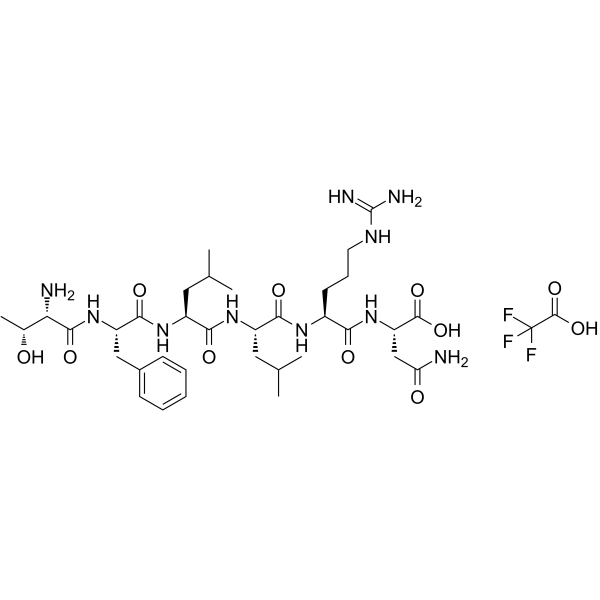
Physicochemical Properties
| Molecular Formula | C37H59F3N10O11 |
| Molecular Weight | 876.92 |
| Related CAS # | Protease-Activated Receptor-1, PAR-1 Agonist;141136-85-8 |
| Appearance | White to off-white solid powder |
| HS Tariff Code | 2934.99.9001 |
| Storage |
Powder-20°C 3 years 4°C 2 years In solvent -80°C 6 months -20°C 1 month Note: Please store this product in a sealed and protected environment, avoid exposure to moisture. |
| Shipping Condition | Room temperature (This product is stable at ambient temperature for a few days during ordinary shipping and time spent in Customs) |
Biological Activity
| ln Vitro | In human HT-29 colon cancer cells that express PAR1 endogenously, protease-activated receptor-1, PAR-1 antagonist, activates protein kinase C isoenzymes alpha and epsilon. At the cellular level, HT-29 cell migration and matrix adhesion were induced by Protease-Activated Receptor-1, PAR-1 Agonist, and thrombin through a PKCepsilon-dependent mechanism. This was determined by the fact that the PKC inhibitors bisindolylmaleimide I and the PKCepsilon translocation inhibitory peptide EAVSLKPT, but not Gö 6976, inhibited the effects of PAR1-mediated processes. |
| References |
[1]. Thrombin-induced ATP release from human umbilical vein endothelial cells. Am J Physiol Cell Physiol. 2012 Mar 15;302(6):C915-23. [2]. PAR1-type thrombin receptor stimulates migration and matrix adhesion of human colon carcinoma cells by a PKCepsilon-dependent mechanism. Oncol Res. 2004;14(10):475-482. |
Solubility Data
| Solubility (In Vitro) | H2O :~6.67 mg/mL (~7.61 mM) |
| Solubility (In Vivo) |
Solubility in Formulation 1: 5 mg/mL (5.70 mM) in PBS (add these co-solvents sequentially from left to right, and one by one), clear solution; with sonication. (Please use freshly prepared in vivo formulations for optimal results.) |
| Preparing Stock Solutions | 1 mg | 5 mg | 10 mg | |
| 1 mM | 1.1404 mL | 5.7018 mL | 11.4035 mL | |
| 5 mM | 0.2281 mL | 1.1404 mL | 2.2807 mL | |
| 10 mM | 0.1140 mL | 0.5702 mL | 1.1404 mL |