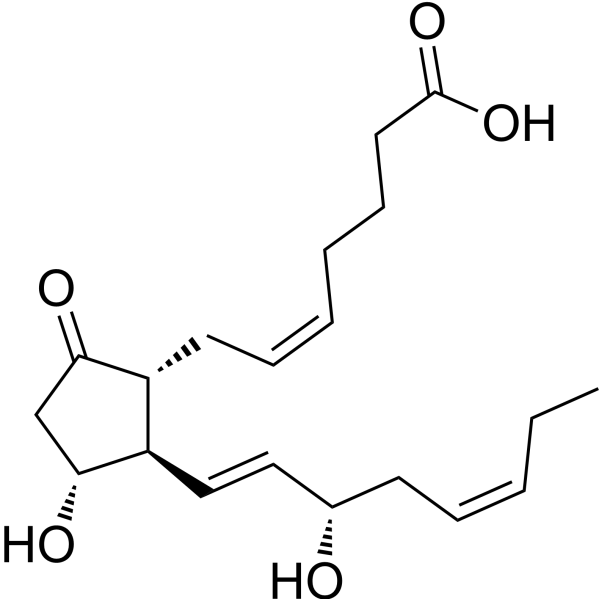
Physicochemical Properties
| Molecular Formula | C20H30O5 |
| Molecular Weight | 350.45 |
| Exact Mass | 350.209 |
| CAS # | 802-31-3 |
| PubChem CID | 5280937 |
| Appearance | Colorless to light yellow liquid |
| Density | 1.2±0.1 g/cm3 |
| Boiling Point | 541.0±50.0 °C at 760 mmHg |
| Flash Point | 295.0±26.6 °C |
| Vapour Pressure | 0.0±3.3 mmHg at 25°C |
| Index of Refraction | 1.575 |
| LogP | 1.43 |
| Hydrogen Bond Donor Count | 3 |
| Hydrogen Bond Acceptor Count | 5 |
| Rotatable Bond Count | 11 |
| Heavy Atom Count | 25 |
| Complexity | 506 |
| Defined Atom Stereocenter Count | 4 |
| SMILES | CC/C=C\C[C@@H](/C=C/[C@H]1[C@@H](CC(=O)[C@@H]1C/C=C\CCCC(=O)O)O)O |
| InChi Key | CBOMORHDRONZRN-QLOYDKTKSA-N |
| InChi Code | InChI=1S/C20H30O5/c1-2-3-6-9-15(21)12-13-17-16(18(22)14-19(17)23)10-7-4-5-8-11-20(24)25/h3-4,6-7,12-13,15-17,19,21,23H,2,5,8-11,14H2,1H3,(H,24,25)/b6-3-,7-4-,13-12+/t15-,16+,17+,19+/m0/s1 |
| Chemical Name | (Z)-7-[(1R,2R,3R)-3-hydroxy-2-[(1E,3S,5Z)-3-hydroxyocta-1,5-dienyl]-5-oxocyclopentyl]hept-5-enoic acid |
| Synonyms | prostaglandin E3; PGE3; 802-31-3; delta(17)-PGE1; PGE1, delta(17)-; delta(17)-Prostaglandin E1; ZED6SBL53S; CHEBI:28031; |
| HS Tariff Code | 2934.99.9001 |
| Storage |
Powder-20°C 3 years 4°C 2 years In solvent -80°C 6 months -20°C 1 month |
| Shipping Condition | Room temperature (This product is stable at ambient temperature for a few days during ordinary shipping and time spent in Customs) |
Biological Activity
| Targets |
Modulates macrophage polarization via EP4 receptor. [1] |
| ln Vitro |
PGE3 (1 μM) promoted M1-to-M2 polarization switch in LPS/IFNγ-stimulated RAW264.7 macrophages: Downregulated M1 markers (iNOS, TNF-α, IL-6) and upregulated M2 markers (CD206, Arg1, IL-10) at mRNA and protein levels (qPCR/Western blot). Reduced macrophage migration toward prostate cancer cell-conditioned medium in transwell assays. Inhibited STAT1 phosphorylation while enhancing STAT6 phosphorylation in macrophages. Suppressed proliferation of prostate cancer cells (PC3, TRAMP-C2) co-cultured with PGE3-treated macrophages by 40-60% (CCK-8 assay). [1] Prostaglandin E3 (1-10000 nM) inhibits M1 and induces the expression of M2a markers in polarized macrophages [1]. |
| ln Vivo |
In CT26 colon cancer allograft mice (prostate cancer model not used), PGE3 (1 μg/day) significantly reduced tumor volume by 55% after 14 days vs. control. Flow cytometry of tumor-infiltrating immune cells showed increased M2 macrophages (F4/80⁺CD206⁺) and decreased M1 macrophages (F4/80⁺iNOS⁺). Immunohistochemistry confirmed reduced Ki-67 and increased caspase-3 cleavage in tumors. [1] Prostaglandin E3 (1 µmol/L; ip) exerts anti-inflammatory function by regulating macrophage polarization in the LPS (HY-D1056) (5 mg/kg)-induced acute inflammation model[1]. Prostaglandin E3 (1 µmol/L; every 3 days for 4 weeks) exhibits anti-tumor activity by regulating macrophage polarization[1]. |
| Cell Assay |
Macrophage polarization: RAW264.7 cells stimulated with LPS/IFNγ ± PGE3 (0.1-10 μM). M1/M2 markers analyzed by qPCR, Western blot, and flow cytometry (surface CD206). Migration assay: Macrophage migration toward cancer cell-conditioned medium assessed using transwell chambers. Phospho-STAT detection: Western blot for p-STAT1 and p-STAT6 in macrophage lysates. Co-culture proliferation: Prostate cancer cells co-cultured with PGE3-treated macrophages; viability measured by CCK-8. [1] |
| Animal Protocol |
Animal/Disease Models:5 weeks, Nude mice (BABL/c) (PC3 xenograft model)[1] Doses: 1 µmol/L for 50 µL Route of Administration: Injected next to the tumour, every 3 days for 4 weeks Experimental Results: Decreased the weights of transplanted tumours, inhibits the expression of CD68 and CD206. CT26 allograft model: BALB/c mice subcutaneously injected with CT26 cells. PGE3 dissolved in saline, administered intraperitoneally at 1 μg/day for 14 days. Control group received saline. [1] |
| Toxicity/Toxicokinetics |
No significant weight loss or behavioral abnormalities observed in mice during 14-day treatment. [1] |
| References |
[1]. Prostaglandin E3 attenuates macrophage-associated inflammation and prostate tumour growth by modulating polarization. J Cell Mol Med. 2021 Jun;25(12):5586-5601. |
| Additional Infomation |
PGE3 is an ω-3 fatty acid-derived prostaglandin. Its anti-tumor mechanism involves reprogramming tumor-associated macrophages (TAMs) from pro-inflammatory M1 to anti-inflammatory M2 phenotype via EP4 receptor/STAT signaling, thereby inhibiting tumor growth. Highlights potential as an immunomodulatory agent for cancer therapy. [1] Prostaglandin E3 is a prostaglandins E. It has a role as a human metabolite. It is a conjugate acid of a prostaglandin E3(1-). prostaglandin E3 has been reported in Homo sapiens with data available. Prostaglandin E3 is an eicosanoid that is generated by the action of cyclooxygenases on the omega-3 fatty acid eicosapentaenoic acid (EPA). Prostaglandin E3 regulates ocular pressure, exerts anti-inflammatory activities and may inhibit tumor cell proliferation. Prostaglandin E3 may be used as a biomarker for EPA to evaluate the association between EPA and its antineoplastic activity. |
Solubility Data
| Solubility (In Vitro) | May dissolve in DMSO (in most cases), if not, try other solvents such as H2O, Ethanol, or DMF with a minute amount of products to avoid loss of samples |
| Solubility (In Vivo) |
Note: Listed below are some common formulations that may be used to formulate products with low water solubility (e.g. < 1 mg/mL), you may test these formulations using a minute amount of products to avoid loss of samples. Injection Formulations (e.g. IP/IV/IM/SC) Injection Formulation 1: DMSO : Tween 80: Saline = 10 : 5 : 85 (i.e. 100 μL DMSO stock solution → 50 μL Tween 80 → 850 μL Saline) *Preparation of saline: Dissolve 0.9 g of sodium chloride in 100 mL ddH ₂ O to obtain a clear solution. Injection Formulation 2: DMSO : PEG300 :Tween 80 : Saline = 10 : 40 : 5 : 45 (i.e. 100 μL DMSO → 400 μLPEG300 → 50 μL Tween 80 → 450 μL Saline) Injection Formulation 3: DMSO : Corn oil = 10 : 90 (i.e. 100 μL DMSO → 900 μL Corn oil) Example: Take the Injection Formulation 3 (DMSO : Corn oil = 10 : 90) as an example, if 1 mL of 2.5 mg/mL working solution is to be prepared, you can take 100 μL 25 mg/mL DMSO stock solution and add to 900 μL corn oil, mix well to obtain a clear or suspension solution (2.5 mg/mL, ready for use in animals). Injection Formulation 4: DMSO : 20% SBE-β-CD in saline = 10 : 90 [i.e. 100 μL DMSO → 900 μL (20% SBE-β-CD in saline)] *Preparation of 20% SBE-β-CD in Saline (4°C,1 week): Dissolve 2 g SBE-β-CD in 10 mL saline to obtain a clear solution. Injection Formulation 5: 2-Hydroxypropyl-β-cyclodextrin : Saline = 50 : 50 (i.e. 500 μL 2-Hydroxypropyl-β-cyclodextrin → 500 μL Saline) Injection Formulation 6: DMSO : PEG300 : castor oil : Saline = 5 : 10 : 20 : 65 (i.e. 50 μL DMSO → 100 μLPEG300 → 200 μL castor oil → 650 μL Saline) Injection Formulation 7: Ethanol : Cremophor : Saline = 10: 10 : 80 (i.e. 100 μL Ethanol → 100 μL Cremophor → 800 μL Saline) Injection Formulation 8: Dissolve in Cremophor/Ethanol (50 : 50), then diluted by Saline Injection Formulation 9: EtOH : Corn oil = 10 : 90 (i.e. 100 μL EtOH → 900 μL Corn oil) Injection Formulation 10: EtOH : PEG300:Tween 80 : Saline = 10 : 40 : 5 : 45 (i.e. 100 μL EtOH → 400 μLPEG300 → 50 μL Tween 80 → 450 μL Saline) Oral Formulations Oral Formulation 1: Suspend in 0.5% CMC Na (carboxymethylcellulose sodium) Oral Formulation 2: Suspend in 0.5% Carboxymethyl cellulose Example: Take the Oral Formulation 1 (Suspend in 0.5% CMC Na) as an example, if 100 mL of 2.5 mg/mL working solution is to be prepared, you can first prepare 0.5% CMC Na solution by measuring 0.5 g CMC Na and dissolve it in 100 mL ddH2O to obtain a clear solution; then add 250 mg of the product to 100 mL 0.5% CMC Na solution, to make the suspension solution (2.5 mg/mL, ready for use in animals). Oral Formulation 3: Dissolved in PEG400 Oral Formulation 4: Suspend in 0.2% Carboxymethyl cellulose Oral Formulation 5: Dissolve in 0.25% Tween 80 and 0.5% Carboxymethyl cellulose Oral Formulation 6: Mixing with food powders Note: Please be aware that the above formulations are for reference only. InvivoChem strongly recommends customers to read literature methods/protocols carefully before determining which formulation you should use for in vivo studies, as different compounds have different solubility properties and have to be formulated differently. (Please use freshly prepared in vivo formulations for optimal results.) |
| Preparing Stock Solutions | 1 mg | 5 mg | 10 mg | |
| 1 mM | 2.8535 mL | 14.2674 mL | 28.5347 mL | |
| 5 mM | 0.5707 mL | 2.8535 mL | 5.7069 mL | |
| 10 mM | 0.2853 mL | 1.4267 mL | 2.8535 mL |