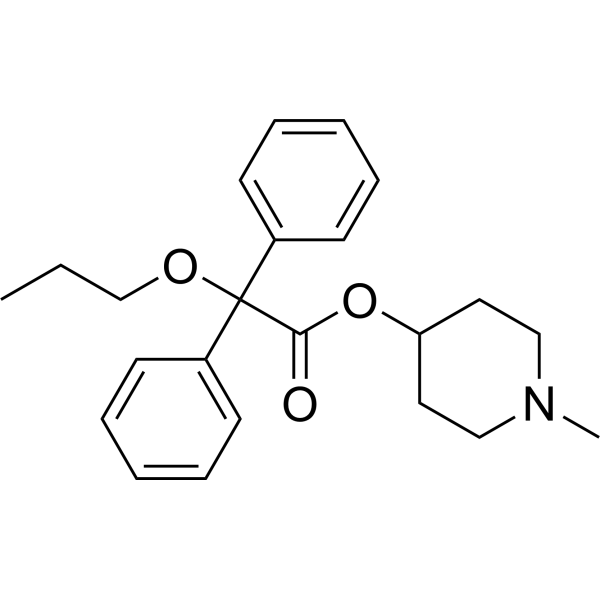
Physicochemical Properties
| Molecular Formula | C23H29NO3 |
| Molecular Weight | 367.48126 |
| Exact Mass | 367.215 |
| CAS # | 60569-19-9 |
| Related CAS # | Propiverine hydrochloride;54556-98-8 |
| PubChem CID | 4942 |
| Appearance | Typically exists as solid at room temperature |
| Density | 1.08 g/cm3 |
| Boiling Point | 468.8ºC at 760 mmHg |
| Melting Point | 224-226 |
| Flash Point | 134.6ºC |
| Index of Refraction | 1.57 |
| LogP | 3.932 |
| Hydrogen Bond Donor Count | 0 |
| Hydrogen Bond Acceptor Count | 4 |
| Rotatable Bond Count | 8 |
| Heavy Atom Count | 27 |
| Complexity | 429 |
| Defined Atom Stereocenter Count | 0 |
| SMILES | CCCOC(C1=CC=CC=C1)(C2=CC=CC=C2)C(=O)OC3CCN(C)CC3 |
| InChi Key | QPCVHQBVMYCJOM-UHFFFAOYSA-N |
| InChi Code | InChI=1S/C23H29NO3/c1-3-18-26-23(19-10-6-4-7-11-19,20-12-8-5-9-13-20)22(25)27-21-14-16-24(2)17-15-21/h4-13,21H,3,14-18H2,1-2H3 |
| Chemical Name | (1-methylpiperidin-4-yl) 2,2-diphenyl-2-propoxyacetate |
| HS Tariff Code | 2934.99.9001 |
| Storage |
Powder-20°C 3 years 4°C 2 years In solvent -80°C 6 months -20°C 1 month |
| Shipping Condition | Room temperature (This product is stable at ambient temperature for a few days during ordinary shipping and time spent in Customs) |
Biological Activity
| ADME/Pharmacokinetics |
Absorption, Distribution and Excretion Propiverine is rapidly absorbed from the gastrointestinal tract with maximum plasma concentrations attained after 2.3 hours. the mean absolute bioavailability of mictonorm 15 mg tablets (propiverine) is 40.5 %. It undergoes heavy first-pass metabolism in the liver. Following the ingestion of 30 mg propiverine, 60% radioactivity was recovered in urine and 21% was recovered in feces within 12 days. Less than 1% of an oral dose is excreted unchanged in the urine. In one study, the volume of distribution was calculated in 21 healthy volunteers after intravenous (IV) administration of propiverine hydrochloride was measured to range from 125 to 4731 (average 2791) indicating, that a large amount of available propiverine is distributed to peripheral compartments. Mean total clearance after single dose administration of 30 mg is 371 mL/min (191 – 870 mL/min). Metabolism / Metabolites The major metabolites were found to be as follows; 4-piperidyl diphenylpropoxyacetate (DM-P-4), 1-methyl-4-piperidyl benzilate (Dpr-P-4) and 1-methyl-4-piperidyl diphenyl-(2 carboxy) ethoxyacetate (ω-COOH-P-4) in the liver, Dpt-p-4, DM-P-4 in the kidney, and DM-P-4, DPr-P-4 in the lung. In the same pharmacokinetic study, All pharmacologically active compounds such as the unchanged compound, 1-methyl-4-piperidyl benzilate N-oxide (DPr-P-4 (N→O)), Dpt-p-4 and 1-methyl-4-piperidyl diphenylpropoxyacetate N-oxide (P-4 (N→O)) were present in the urinary bladder, a target organ for P-4, at higher concentrations than in the plasma. Propiverine is metabolized by both intestinal and hepatic enzymes. The main metabolic pathway involves the oxidation of the _piperidyl-N _and is mediated by _CYP 3A4_ and _flavin-containing monooxygenases (FMO) _1 and 3 and results in the formation of the second main metabolite M-5, the plasma concentration of which is greater in concentration that of the parent substance propiverine. Four metabolites have been identified in the urine following propiverine ingestion; 3 them are pharmacologically active metabolites that may contribute to its therapeutic effect (M-5, M-6, M-23). The mean absolute bioavailability of propiverine IR 15 mg is 40.5%. Biological Half-Life In three studies including a total of 37 healthy volunteers mean elimination half-life was 14.1, 20.1 and 22.1 hours, respectively. |
| Toxicity/Toxicokinetics |
Protein Binding 90-95% for the parent compound and about 60% for the main metabolite. |
| References |
[1]. McKeage K. Propiverine: a review of its use in the treatment of adults and children with overactive bladder associated with idiopathic or neurogenic detrusor overactivity, and in men with lower urinary tract symptoms. Clin Drug Investig. 2013 Jan;33(1):71-91. [2]. Madersbacher H, Mürtz G. Efficacy, tolerability and safety profile of propiverine in the treatment of the overactive bladder (non-neurogenic and neurogenic). World J Urol. 2001 Nov;19(5):324-35. |
| Additional Infomation |
Propiverine is a diarylmethane. Propiverine is a widely used antimuscarinic drug with a mixed mode of action in the treatment of symptoms associated with overactive bladder (OAB). Overactive bladder (OAB) is a chronic condition of the lower urinary tract characterized by urinary urgency, increased frequency of urination, and nocturia (frequent waking during the night to urinate). OAB has a negative impact on quality of life and may lead to leakage and inconvenient urinary accidents,. Overactive bladder syndrome affects millions of elderly individuals in the United States and shows equal prevalence in men and women. The impact of OAB on quality of life is sometimes devastating, especially to elderly patients with other medical conditions. Propiverine hydrochloride is a bladder detrusor muscle relaxant drug with dual antimuscarinic and calcium-modulating properties for the treatment of OAB. Drug Indication Indicated for symptomatic treatment of urinary incontinence and/or increased urinary frequency and urgency in patients with overactive bladder (OAB). Propiverine may also be used in patients with neurogenic bladder as a result of spinal cord injury. Mechanism of Action Propiverine demonstrates both anticholinergic and calcium-modulating properties. The efferent connection of the pelvic nerve is inhibited due to the anticholinergic action exerted by this drug, leading to relaxation of bladder smooth muscle. Propiverine blocks calcium ion influx and modulates the intracellular calcium in urinary bladder smooth muscle cells, resulting in the inhibition of muscle spasm. The bladder contains several muscarinic receptors. Acetylcholine is the main contractile neurotransmitter in the human bladder detrusor muscle, and antimuscarinics such as propiverine exert their effects by competitively inhibiting the binding of acetylcholine at muscarinic receptors on detrusor smooth muscle cells and other structures within the bladder wall. In one study, After oral treatment with propiverine, the bladder showed the highest concentration of M-2, indicating a targeted distribution of this metabolite into the bladder. Therefore, muscarinic receptor-2 may highly contribute to the relatively selective and long-lasting occupation of bladder muscarinic receptors after oral ingestion of propiverine. Pharmacodynamics Propiverine hydrochloride inhibits abnormal contractions of bladder smooth muscle in vivo through not only its anticholinergic activity but also its concurrent calcium antagonistic activity. Through the above-mentioned mechanism, propiverine is able to relieve the symptoms of overactive bladder. In animal models, this administration of this drug leads to a dose-dependent decrease in intravesical pressure of the bladder and an increase in bladder capacity. In patients with symptoms of OAB resulting from idiopathic detrusor muscle overactivity (IDO) or neurogenic detrusor overactivity (NDO), propiverine showed dose-dependent efficacy and tolerability. |
Solubility Data
| Solubility (In Vitro) | May dissolve in DMSO (in most cases), if not, try other solvents such as H2O, Ethanol, or DMF with a minute amount of products to avoid loss of samples |
| Solubility (In Vivo) |
Note: Listed below are some common formulations that may be used to formulate products with low water solubility (e.g. < 1 mg/mL), you may test these formulations using a minute amount of products to avoid loss of samples. Injection Formulations (e.g. IP/IV/IM/SC) Injection Formulation 1: DMSO : Tween 80: Saline = 10 : 5 : 85 (i.e. 100 μL DMSO stock solution → 50 μL Tween 80 → 850 μL Saline) *Preparation of saline: Dissolve 0.9 g of sodium chloride in 100 mL ddH ₂ O to obtain a clear solution. Injection Formulation 2: DMSO : PEG300 :Tween 80 : Saline = 10 : 40 : 5 : 45 (i.e. 100 μL DMSO → 400 μLPEG300 → 50 μL Tween 80 → 450 μL Saline) Injection Formulation 3: DMSO : Corn oil = 10 : 90 (i.e. 100 μL DMSO → 900 μL Corn oil) Example: Take the Injection Formulation 3 (DMSO : Corn oil = 10 : 90) as an example, if 1 mL of 2.5 mg/mL working solution is to be prepared, you can take 100 μL 25 mg/mL DMSO stock solution and add to 900 μL corn oil, mix well to obtain a clear or suspension solution (2.5 mg/mL, ready for use in animals). Injection Formulation 4: DMSO : 20% SBE-β-CD in saline = 10 : 90 [i.e. 100 μL DMSO → 900 μL (20% SBE-β-CD in saline)] *Preparation of 20% SBE-β-CD in Saline (4°C,1 week): Dissolve 2 g SBE-β-CD in 10 mL saline to obtain a clear solution. Injection Formulation 5: 2-Hydroxypropyl-β-cyclodextrin : Saline = 50 : 50 (i.e. 500 μL 2-Hydroxypropyl-β-cyclodextrin → 500 μL Saline) Injection Formulation 6: DMSO : PEG300 : castor oil : Saline = 5 : 10 : 20 : 65 (i.e. 50 μL DMSO → 100 μLPEG300 → 200 μL castor oil → 650 μL Saline) Injection Formulation 7: Ethanol : Cremophor : Saline = 10: 10 : 80 (i.e. 100 μL Ethanol → 100 μL Cremophor → 800 μL Saline) Injection Formulation 8: Dissolve in Cremophor/Ethanol (50 : 50), then diluted by Saline Injection Formulation 9: EtOH : Corn oil = 10 : 90 (i.e. 100 μL EtOH → 900 μL Corn oil) Injection Formulation 10: EtOH : PEG300:Tween 80 : Saline = 10 : 40 : 5 : 45 (i.e. 100 μL EtOH → 400 μLPEG300 → 50 μL Tween 80 → 450 μL Saline) Oral Formulations Oral Formulation 1: Suspend in 0.5% CMC Na (carboxymethylcellulose sodium) Oral Formulation 2: Suspend in 0.5% Carboxymethyl cellulose Example: Take the Oral Formulation 1 (Suspend in 0.5% CMC Na) as an example, if 100 mL of 2.5 mg/mL working solution is to be prepared, you can first prepare 0.5% CMC Na solution by measuring 0.5 g CMC Na and dissolve it in 100 mL ddH2O to obtain a clear solution; then add 250 mg of the product to 100 mL 0.5% CMC Na solution, to make the suspension solution (2.5 mg/mL, ready for use in animals). Oral Formulation 3: Dissolved in PEG400 Oral Formulation 4: Suspend in 0.2% Carboxymethyl cellulose Oral Formulation 5: Dissolve in 0.25% Tween 80 and 0.5% Carboxymethyl cellulose Oral Formulation 6: Mixing with food powders Note: Please be aware that the above formulations are for reference only. InvivoChem strongly recommends customers to read literature methods/protocols carefully before determining which formulation you should use for in vivo studies, as different compounds have different solubility properties and have to be formulated differently. (Please use freshly prepared in vivo formulations for optimal results.) |
| Preparing Stock Solutions | 1 mg | 5 mg | 10 mg | |
| 1 mM | 2.7212 mL | 13.6062 mL | 27.2124 mL | |
| 5 mM | 0.5442 mL | 2.7212 mL | 5.4425 mL | |
| 10 mM | 0.2721 mL | 1.3606 mL | 2.7212 mL |