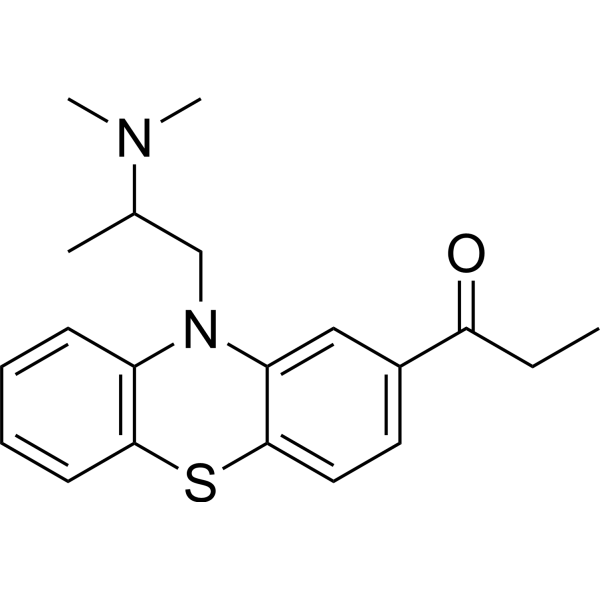
Physicochemical Properties
| Molecular Formula | C20H24N2OS |
| Molecular Weight | 340.483 |
| Exact Mass | 340.161 |
| CAS # | 362-29-8 |
| PubChem CID | 4940 |
| Appearance | Typically exists as solid at room temperature |
| Density | 1.137g/cm3 |
| Boiling Point | 500.8ºC at 760mmHg |
| Melting Point |
MP: 160-161 °C; CRYSTALS FROM ISOPROPANOL /MALEATE/ MP: 201-206 °C /HYDROCHLORIDE/ MP: 240-242 °C /METHIODIDE/ |
| Flash Point | 256.7ºC |
| LogP | 4.897 |
| Hydrogen Bond Donor Count | 0 |
| Hydrogen Bond Acceptor Count | 4 |
| Rotatable Bond Count | 5 |
| Heavy Atom Count | 24 |
| Complexity | 441 |
| Defined Atom Stereocenter Count | 0 |
| SMILES | CCC(C1=CC=C2C(N(C3=CC=CC=C3S2)CC(N(C)C)C)=C1)=O |
| InChi Key | UVOIBTBFPOZKGP-UHFFFAOYSA-N |
| InChi Code | InChI=1S/C20H24N2OS/c1-5-18(23)15-10-11-20-17(12-15)22(13-14(2)21(3)4)16-8-6-7-9-19(16)24-20/h6-12,14H,5,13H2,1-4H3 |
| Chemical Name | 1-[10-[2-(dimethylamino)propyl]phenothiazin-2-yl]propan-1-one |
| HS Tariff Code | 2934.99.9001 |
| Storage |
Powder-20°C 3 years 4°C 2 years In solvent -80°C 6 months -20°C 1 month |
| Shipping Condition | Room temperature (This product is stable at ambient temperature for a few days during ordinary shipping and time spent in Customs) |
Biological Activity
| ln Vivo | The rapid absorption of propiomazine (0.2 mg/kg, nasal treatment, rats) is accompanied by a swift decrease in plasma concentrations[3]. Rats that are given propiomazine (25 mg/kg, ip, at 0 and 3 h after challenge) are protected from hepatic injury caused by CCl4[4]. In rats, propiomazine (0.31–20 mg/kg, IV) raises the levels of plasma prolactin[5]. |
| ADME/Pharmacokinetics |
Absorption, Distribution and Excretion APPROX HALF OF METABOLITES OF COMMONLY USED PHENOTHIAZINES ARE FOUND IN URINE & REST IN FECES. ULTIMATE SOJOURN OF PHENOTHIAZINE DRUGS IN BODY IS EXCEEDINGLY LONG. 6 MO AFTER DISCONTINUATION OF THESE DRUGS, VARIOUS METABOLITES ARE DETECTABLE IN URINE. /PHENOTHIAZINES/ PHENOTHIAZINE TRANQUILIZERS CROSS PLACENTA RAPIDLY, & THEY HAVE BEEN MEASURED FOR MANY YR IN URINE & TISSUES OF NEONATES OF TREATED MOTHERS, BUT VERY LOW BLOOD LEVELS OF MOTHERS & FETUSES HAVE BEEN MEASURED ONLY RECENTLY... /PHENOTHIAZINES/ Metabolism / Metabolites Unknown, but most likely hepatic as with other phenothiazines. Unknown, but most likely hepatic as with other phenothiazines. |
| Toxicity/Toxicokinetics |
Toxicity Summary Propiomazine is an antagonist at types 1, 2, and 4 dopamine receptors, serotonin (5-HT) receptor types 2A and 2C, muscarinic receptors 1 through 5, alpha(1)-receptors, and histamine H1-receptors. Its main use as a sedative is due to its antihistamine effect. Protein Binding 81% Interactions ...ENHANCES EFFECT OF CNS DEPRESSANTS: HENCE, DOSE OF BARBITURATES GIVEN CONCOMITANTLY SHOULD BE REDUCED 1/2, DOSES OF MEPERIDINE & MORPHINE SHOULD BE REDUCED 1/4 TO 1/2. /HYDROCHLORIDE/ ...ENHANCES ACTION OF...ANALGESICS & ANESTHETICS. /HYDROCHLORIDE/ .../REPORTED/ TO PROTECT EXPTL ANIMALS AGAINST HEPATOTOXIC EFFECTS OF CARBON TETRACHLORIDE... PHYSOSTIGMINE WAS GIVEN TO 17 PT INLABOR PREVIOUSLY GIVEN SCOPOLAMINE ALONE OR MEPERIDINE & PROPIOMAZINE IN COMBINATION, TO ASCERTAIN ITS EFFECT ON REVERSING THE LOSS OF FETAL HEART RATE VARIABILITY. WITH MEPERIDINE & PROPIOMAZINE COMBINATION, REVERSION OCCURRED IN 10 PT. |
| References |
[1]. Effects of single doses of propiomazine, a phenothiazine hypnotic, on sleep and oxygenation in patients with stable chronic obstructive pulmonary disease. Respiration. 1990;57(4):239-42. [2]. Thunander Sundbom L, etal. Sedating antihistamines - risk of severe intoxication. Lakartidningen. 2021 Sep 30;118:21037. [3]. Bioavailability of the sedative propiomazine after nasal administration in rats. International Journal of Pharmaceutics, 1996, 144 (2), 217-224. [4]. Promethazine protection in carbon tetrachloride liver injury. An electron microscopic study. Arch Pathol. 1969 Jan;87(1):46-51. [5]. Effect of propiomazine on plasma prolactin in the rat: counteraction by L-dopa. Proc Soc Exp Biol Med. 1985 Apr;178(4):606-9. |
| Additional Infomation |
Propiomazine is a member of the class of phenothiazines that is 10H-phenothiazine substituted by a 2-(dimethylamino)propyl group at nitrogen atom and a propanoyl group at position 2. It has a role as a phenothiazine antipsychotic drug, a dopaminergic antagonist, a serotonergic antagonist, a muscarinic antagonist, a histamine antagonist and a sedative. It is a member of phenothiazines, an aromatic ketone and a tertiary amino compound. It derives from a hydride of a 10H-phenothiazine. Propiomazine, an atypical antipsychotic agent, is used to treat both negative and positive symptoms of schizophrenia, acute mania with bipolar disorder, agitation, and psychotic symptoms in dementia. Future uses may include the treatment of obsessive-compulsive disorder and severe behavioral disorders in autism. Structurally and pharmacologically similar to clozapine, propiomazine binds to alpha(1), dopamine, histamine H1, muscarinic, and serotonin type 2 (5-HT2) receptors. Propiomazine is a phenothiazine derivative and atypical antipsychotic agent with sedative, antiemetic and antipsychotic activities. Propiomazine binds to a variety of receptors, including alpha1, dopamine, histamine H1, muscarinic, and serotonin type 2 (5-HT2) receptors. Propiomazine exerts its antiemetic and sedative effects through antagonism at histamine H1 receptors; Its antipsychotic effect is attributed to antagonistic activities at dopamine and 5-HT2 receptors. Propiomazine, an atypical antipsychotic agent, is used to treat both negative and positive symptoms of schizophrenia, acute mania with bipolar disorder, agitation, and psychotic symptoms in dementia. Future uses may include the treatment of obsessive-compulsive disorder and severe behavioral disorders in autism. Structurally and pharmacologically similar to clozapine, propiomazine binds to alpha(1), dopamine, histamine H1, muscarinic, and serotonin type 2 (5-HT2) receptors. Drug Indication Propiomazine is largely used for its antihistamininc sleep inducing effects in treating insomnia. Mechanism of Action Propiomazine acts as an antagonist of dopamine 1, 2, and 4 receptors, serotonin (5-HT) receptor types 2A and 2C, muscarinic receptors 1 through 5, alpha(1)-receptors, and histamine H1-receptors. Its main use as a sedative is due to its antihistamine effect. ...ALSO HAS AN ANTIEMETIC ACTION. /HYDROCHLORIDE/ Therapeutic Uses Antipsychotic Agents, Phenothiazine A SUBSTITUTED PHENOTHIAZINE USED PRIMARILY FOR ITS SEDATIVE PROPERTIES. IT IS INDICATED FOR RELIEF OF RESTLESSNESS & APPREHENSION BEFORE & DURING SURGERY. IT IS ALSO USED AS ADJUNCT TO ANALGESICS FOR APPREHENSION & RESTLESSNESS DURING LABOR. /HYDROCHLORIDE/ Drug Warnings PT SHOULD BE WARNED ABOUT PERFORMING HAZARDOUS TASKS WHILE ON THE DRUG. ITS SAFE USE DURING THE FIRST TRIMESTER OF PREGNANCY HAS NOT BEEN ESTABLISHED. UNTOWARD EFFECTS ARE USUALLY MILD & RESEMBLE THOSE INDUCED BY OTHER SEDATIVE PHENOTHIAZINES. /HYDROCHLORIDE/ SINCE SEVERE CHEMICAL IRRITATION MAY OCCUR WHEN PERIVASCULAR EXTRAVASATION OF SOLN OCCURS, CARE SHOULD BE EXERCISED WHEN IV ROUTE IS EMPLOYED. /HYDROCHLORIDE/ Pharmacodynamics Although propiomazine is a phenothiazine, it is not used as an antipsychotic. It posesses antihistamine effects and is mostly used as a sedative in treating insomnia. |
Solubility Data
| Solubility (In Vitro) | May dissolve in DMSO (in most cases), if not, try other solvents such as H2O, Ethanol, or DMF with a minute amount of products to avoid loss of samples |
| Solubility (In Vivo) |
Note: Listed below are some common formulations that may be used to formulate products with low water solubility (e.g. < 1 mg/mL), you may test these formulations using a minute amount of products to avoid loss of samples. Injection Formulations (e.g. IP/IV/IM/SC) Injection Formulation 1: DMSO : Tween 80: Saline = 10 : 5 : 85 (i.e. 100 μL DMSO stock solution → 50 μL Tween 80 → 850 μL Saline) *Preparation of saline: Dissolve 0.9 g of sodium chloride in 100 mL ddH ₂ O to obtain a clear solution. Injection Formulation 2: DMSO : PEG300 :Tween 80 : Saline = 10 : 40 : 5 : 45 (i.e. 100 μL DMSO → 400 μLPEG300 → 50 μL Tween 80 → 450 μL Saline) Injection Formulation 3: DMSO : Corn oil = 10 : 90 (i.e. 100 μL DMSO → 900 μL Corn oil) Example: Take the Injection Formulation 3 (DMSO : Corn oil = 10 : 90) as an example, if 1 mL of 2.5 mg/mL working solution is to be prepared, you can take 100 μL 25 mg/mL DMSO stock solution and add to 900 μL corn oil, mix well to obtain a clear or suspension solution (2.5 mg/mL, ready for use in animals). Injection Formulation 4: DMSO : 20% SBE-β-CD in saline = 10 : 90 [i.e. 100 μL DMSO → 900 μL (20% SBE-β-CD in saline)] *Preparation of 20% SBE-β-CD in Saline (4°C,1 week): Dissolve 2 g SBE-β-CD in 10 mL saline to obtain a clear solution. Injection Formulation 5: 2-Hydroxypropyl-β-cyclodextrin : Saline = 50 : 50 (i.e. 500 μL 2-Hydroxypropyl-β-cyclodextrin → 500 μL Saline) Injection Formulation 6: DMSO : PEG300 : castor oil : Saline = 5 : 10 : 20 : 65 (i.e. 50 μL DMSO → 100 μLPEG300 → 200 μL castor oil → 650 μL Saline) Injection Formulation 7: Ethanol : Cremophor : Saline = 10: 10 : 80 (i.e. 100 μL Ethanol → 100 μL Cremophor → 800 μL Saline) Injection Formulation 8: Dissolve in Cremophor/Ethanol (50 : 50), then diluted by Saline Injection Formulation 9: EtOH : Corn oil = 10 : 90 (i.e. 100 μL EtOH → 900 μL Corn oil) Injection Formulation 10: EtOH : PEG300:Tween 80 : Saline = 10 : 40 : 5 : 45 (i.e. 100 μL EtOH → 400 μLPEG300 → 50 μL Tween 80 → 450 μL Saline) Oral Formulations Oral Formulation 1: Suspend in 0.5% CMC Na (carboxymethylcellulose sodium) Oral Formulation 2: Suspend in 0.5% Carboxymethyl cellulose Example: Take the Oral Formulation 1 (Suspend in 0.5% CMC Na) as an example, if 100 mL of 2.5 mg/mL working solution is to be prepared, you can first prepare 0.5% CMC Na solution by measuring 0.5 g CMC Na and dissolve it in 100 mL ddH2O to obtain a clear solution; then add 250 mg of the product to 100 mL 0.5% CMC Na solution, to make the suspension solution (2.5 mg/mL, ready for use in animals). Oral Formulation 3: Dissolved in PEG400 Oral Formulation 4: Suspend in 0.2% Carboxymethyl cellulose Oral Formulation 5: Dissolve in 0.25% Tween 80 and 0.5% Carboxymethyl cellulose Oral Formulation 6: Mixing with food powders Note: Please be aware that the above formulations are for reference only. InvivoChem strongly recommends customers to read literature methods/protocols carefully before determining which formulation you should use for in vivo studies, as different compounds have different solubility properties and have to be formulated differently. (Please use freshly prepared in vivo formulations for optimal results.) |
| Preparing Stock Solutions | 1 mg | 5 mg | 10 mg | |
| 1 mM | 2.9370 mL | 14.6852 mL | 29.3703 mL | |
| 5 mM | 0.5874 mL | 2.9370 mL | 5.8741 mL | |
| 10 mM | 0.2937 mL | 1.4685 mL | 2.9370 mL |