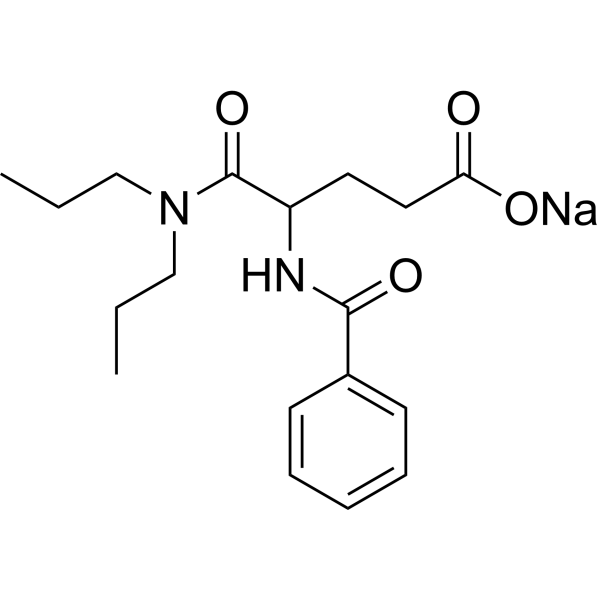
Physicochemical Properties
| Molecular Formula | C18H25N2O4NA |
| Molecular Weight | 356.3919 |
| Exact Mass | 356.171 |
| CAS # | 99247-33-3 |
| Related CAS # | Proglumide;6620-60-6;Proglumide hemicalcium;85068-56-0 |
| PubChem CID | 23677833 |
| Appearance | White to off-white solid powder |
| LogP | 1.538 |
| Hydrogen Bond Donor Count | 1 |
| Hydrogen Bond Acceptor Count | 4 |
| Rotatable Bond Count | 10 |
| Heavy Atom Count | 25 |
| Complexity | 419 |
| Defined Atom Stereocenter Count | 0 |
| InChi Key | UFMWGCINVOIJSO-UHFFFAOYSA-M |
| InChi Code | InChI=1S/C18H26N2O4.Na/c1-3-12-20(13-4-2)18(24)15(10-11-16(21)22)19-17(23)14-8-6-5-7-9-14;/h5-9,15H,3-4,10-13H2,1-2H3,(H,19,23)(H,21,22);/q;+1/p-1 |
| Chemical Name | sodium;4-benzamido-5-(dipropylamino)-5-oxopentanoate |
| HS Tariff Code | 2934.99.9001 |
| Storage |
Powder-20°C 3 years 4°C 2 years In solvent -80°C 6 months -20°C 1 month Note: Please store this product in a sealed and protected environment (e.g. under nitrogen), avoid exposure to moisture. |
| Shipping Condition | Room temperature (This product is stable at ambient temperature for a few days during ordinary shipping and time spent in Customs) |
Biological Activity
| ln Vitro | Proglutamine at concentrations of 0.3–10 mM quantitatively suppressed CCK-stimulated amylase production in an in vitro investigation, but proglutamine at values of 0–3 mM had no effect on basal amylase. liberated. The dose-response curve of amylase release vs CCK moves to the right as proglutamine concentration rises. Proglumide's inhibitory action is reversible. Proglumide is additionally selective for CCK and related peptides [2]. Proglumide dosage dramatically decreased [3H]-bust daily injection into HT29 cells with an IC50 of 6.5 mM in a dose-dependent manner. Proglumide has a dose-dependent effect in reducing the overall number of questions, with a dose-dependence of up to 70% on cells [3]. |
| ln Vivo | Proglumide treatment (250–750 mg/kg; intraperitoneal injection; adult Sprague Dawley Project) dramatically reduces brain oxidation, cognitive dysfunction, and engineering activity [1]. |
| Animal Protocol |
Animal/Disease Models: Adult male Sprague Dawley rats (200) -250 g; 2 months old) induced status epilepticus (SE) [1] Doses: 250 mg/kg, 500 mg/kg and 750 mg/kg administered Methods: intraperitoneal (ip) injection Experimental Results: Dose-dependent and significant increase in latency to seizures and SE. Significant and dose-dependent attenuated Li-PC (SE)-induced increases in thiobarbituric acid (TBARS) and catalase (CAT), attenuated Li-Pc-induced decreases in SOD, and attenuated GSH and Depletion of glutathione-S transferase (GST). Hippocampus and striatum. |
| References |
[1]. The effects of quinacrine, proglumide, and pentoxifylline on seizure activity, cognitive deficit, and oxidative stress in rat lithium-pilocarpine model of status epilepticus. Oxid Med Cell Longev. 2014;2014:630509. [2]. In vitro and in vivo effect of proglumide on cholecystokinin-stimulated amylase release in mouse pancreatic acini. Gastroenterol Jpn. 1984 Feb;19(1):53-8. [3]. Selective CCK-A but not CCK-B receptor antagonists inhibit HT-29 cell proliferation: synergism with pharmacological levels of melatonin. J Pineal Res. 2005 Oct;39(3):243-50. [4]. Further studies on the specificity of proglumide as a selective cholecystokinin antagonist in the central nervous system. Ann N Y Acad Sci. 1985;448:345-51. [5]. Gastric and duodenal antiulcer and cytoprotective effects of proglumide in rats. J Pharmacol Exp Ther. 1987 May;241(2):602-7. |
Solubility Data
| Solubility (In Vitro) | H2O : ~100 mg/mL (~280.59 mM) |
| Solubility (In Vivo) |
Solubility in Formulation 1: 100 mg/mL (280.59 mM) in PBS (add these co-solvents sequentially from left to right, and one by one), clear solution; with sonication. (Please use freshly prepared in vivo formulations for optimal results.) |
| Preparing Stock Solutions | 1 mg | 5 mg | 10 mg | |
| 1 mM | 2.8059 mL | 14.0296 mL | 28.0591 mL | |
| 5 mM | 0.5612 mL | 2.8059 mL | 5.6118 mL | |
| 10 mM | 0.2806 mL | 1.4030 mL | 2.8059 mL |