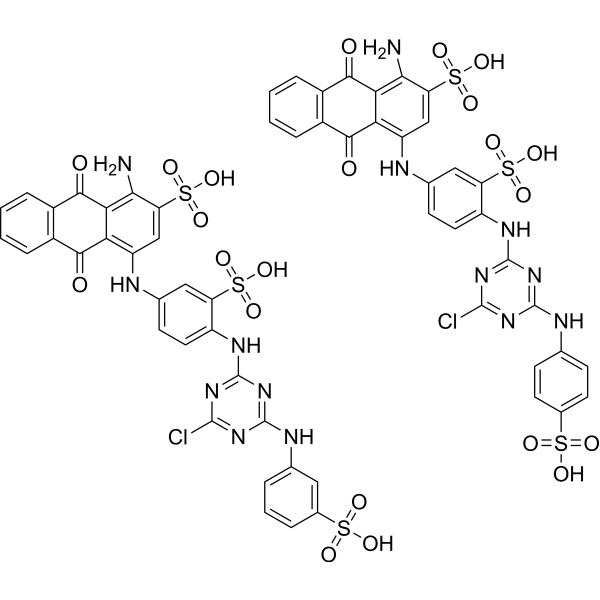
Physicochemical Properties
| Molecular Formula | C29H20N7O11S3CL |
| Molecular Weight | 774.157400000001 |
| Exact Mass | 773.007 |
| CAS # | 12236-82-7 |
| Appearance | Light brown to black solid powder |
| Density | 1.845 g/cm3 |
| Melting Point | >300ºC |
| Index of Refraction | 1.777 |
| LogP | 7.896 |
| HS Tariff Code | 2934.99.9001 |
| Storage |
Powder-20°C 3 years 4°C 2 years In solvent -80°C 6 months -20°C 1 month Note: This product requires protection from light (avoid light exposure) during transportation and storage. |
| Shipping Condition | Room temperature (This product is stable at ambient temperature for a few days during ordinary shipping and time spent in Customs) |
Biological Activity
| ln Vitro | Reactive Blue 2 works as an ATP receptor antagonist and produces Ca2+ oscillations in HeLa cells. Reactive Blue 2 boosts Ca2+ responses to histamine associated with the PLC cascade. Reactive Blue 2 may activate the PLC cascade and cause Ca2+ oscillations in an extracellular Ca2+-dependent way [1]. Application of Reactive Blue 2 enhances K+ secretion in a dose-dependent manner, this rise is characterized by a peak followed by partial relaxation to steady state. Reactive Blue 2 has antagonistic activity at P2Y4, and the antagonistic potency at P2Y4 reflects the potency in K+ secretion [2]. The anthraquinone dye Reactive Blue 2 was discovered to be a strong inhibitor of protein kinases isolated and purified from thylakoids. The inhibition method is non-competitive with a Ki of 8 µM for the membrane-bound kinase and 6 µM for the pure enzyme. The inhibitor does not alter the substrate preference of the endogenous kinase and can be removed from the membrane by washing [3]. Reactive Blue 2 preferentially inhibits processes mediated through P2y purinergic receptors, at least within a restricted dose range. In preparations that enhance tone with norepinephrine, ATP and 2-methylthioATP (but not α,β-methylene ATP) cause vasorelaxation. These relaxations are suppressed in the presence of reactive blue 2 [4]. Reactive Blue 2 suppresses ATP-induced oscillations in a concentration-dependent manner at doses of 0.3-10 μM [5]. |
| References |
[1]. Reactive blue 2 induces calcium oscillations in HeLa cells. Jpn J Physiol. 2001 Jun;51(3):389-93. [2]. Reactive blue 2, an antagonist of rat P2Y4, increases K+ secretion in rat cochlea strial marginal cells. Hear Res. 2006 Sep;219(1-2):66-73. [3]. Reactive blue 2 is a potent inhibitor of a thylakoid protein kinase. Eur J Biochem. 1991 Apr 23;197(2):467-71. [4]. P2-purinoceptors of two subtypes in the rabbit mesenteric artery: reactive blue 2 selectively inhibits responses mediated via the P2y-but not the P2x-purinoceptor. Br J Pharmacol. 1987 Feb;90(2):383-91. [5]. Suramin and reactive blue 2 are antagonists for a newly identified purinoceptor on rat megakaryocyte. Br J Pharmacol. 1994 Jan;111(1):245-9. |
Solubility Data
| Solubility (In Vitro) |
DMSO : ≥ 110 mg/mL (~142.09 mM) H2O : ~10 mg/mL (~12.92 mM) Ethanol : ~1 mg/mL (~1.29 mM) |
| Solubility (In Vivo) |
Note: Listed below are some common formulations that may be used to formulate products with low water solubility (e.g. < 1 mg/mL), you may test these formulations using a minute amount of products to avoid loss of samples. Injection Formulations (e.g. IP/IV/IM/SC) Injection Formulation 1: DMSO : Tween 80: Saline = 10 : 5 : 85 (i.e. 100 μL DMSO stock solution → 50 μL Tween 80 → 850 μL Saline) *Preparation of saline: Dissolve 0.9 g of sodium chloride in 100 mL ddH ₂ O to obtain a clear solution. Injection Formulation 2: DMSO : PEG300 :Tween 80 : Saline = 10 : 40 : 5 : 45 (i.e. 100 μL DMSO → 400 μLPEG300 → 50 μL Tween 80 → 450 μL Saline) Injection Formulation 3: DMSO : Corn oil = 10 : 90 (i.e. 100 μL DMSO → 900 μL Corn oil) Example: Take the Injection Formulation 3 (DMSO : Corn oil = 10 : 90) as an example, if 1 mL of 2.5 mg/mL working solution is to be prepared, you can take 100 μL 25 mg/mL DMSO stock solution and add to 900 μL corn oil, mix well to obtain a clear or suspension solution (2.5 mg/mL, ready for use in animals). Injection Formulation 4: DMSO : 20% SBE-β-CD in saline = 10 : 90 [i.e. 100 μL DMSO → 900 μL (20% SBE-β-CD in saline)] *Preparation of 20% SBE-β-CD in Saline (4°C,1 week): Dissolve 2 g SBE-β-CD in 10 mL saline to obtain a clear solution. Injection Formulation 5: 2-Hydroxypropyl-β-cyclodextrin : Saline = 50 : 50 (i.e. 500 μL 2-Hydroxypropyl-β-cyclodextrin → 500 μL Saline) Injection Formulation 6: DMSO : PEG300 : castor oil : Saline = 5 : 10 : 20 : 65 (i.e. 50 μL DMSO → 100 μLPEG300 → 200 μL castor oil → 650 μL Saline) Injection Formulation 7: Ethanol : Cremophor : Saline = 10: 10 : 80 (i.e. 100 μL Ethanol → 100 μL Cremophor → 800 μL Saline) Injection Formulation 8: Dissolve in Cremophor/Ethanol (50 : 50), then diluted by Saline Injection Formulation 9: EtOH : Corn oil = 10 : 90 (i.e. 100 μL EtOH → 900 μL Corn oil) Injection Formulation 10: EtOH : PEG300:Tween 80 : Saline = 10 : 40 : 5 : 45 (i.e. 100 μL EtOH → 400 μLPEG300 → 50 μL Tween 80 → 450 μL Saline) Oral Formulations Oral Formulation 1: Suspend in 0.5% CMC Na (carboxymethylcellulose sodium) Oral Formulation 2: Suspend in 0.5% Carboxymethyl cellulose Example: Take the Oral Formulation 1 (Suspend in 0.5% CMC Na) as an example, if 100 mL of 2.5 mg/mL working solution is to be prepared, you can first prepare 0.5% CMC Na solution by measuring 0.5 g CMC Na and dissolve it in 100 mL ddH2O to obtain a clear solution; then add 250 mg of the product to 100 mL 0.5% CMC Na solution, to make the suspension solution (2.5 mg/mL, ready for use in animals). Oral Formulation 3: Dissolved in PEG400 Oral Formulation 4: Suspend in 0.2% Carboxymethyl cellulose Oral Formulation 5: Dissolve in 0.25% Tween 80 and 0.5% Carboxymethyl cellulose Oral Formulation 6: Mixing with food powders Note: Please be aware that the above formulations are for reference only. InvivoChem strongly recommends customers to read literature methods/protocols carefully before determining which formulation you should use for in vivo studies, as different compounds have different solubility properties and have to be formulated differently. (Please use freshly prepared in vivo formulations for optimal results.) |
| Preparing Stock Solutions | 1 mg | 5 mg | 10 mg | |
| 1 mM | 1.2917 mL | 6.4586 mL | 12.9172 mL | |
| 5 mM | 0.2583 mL | 1.2917 mL | 2.5834 mL | |
| 10 mM | 0.1292 mL | 0.6459 mL | 1.2917 mL |