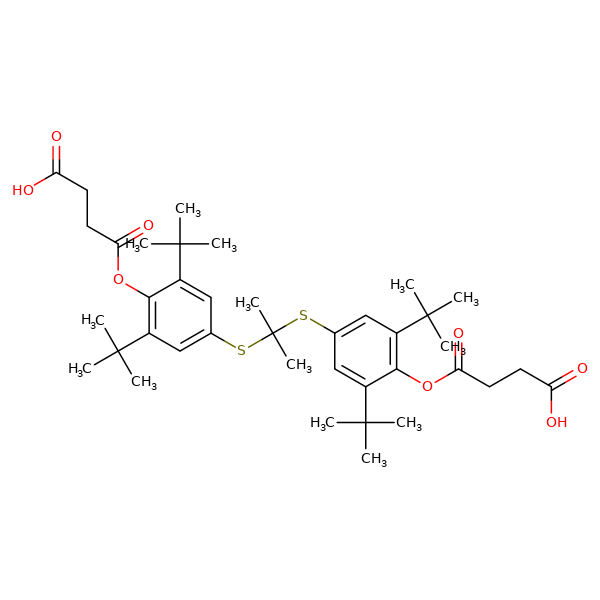
Physicochemical Properties
| Molecular Formula | C39H56O8S2 |
| Molecular Weight | 716.99 |
| Exact Mass | 716.342 |
| CAS # | 216168-45-5 |
| PubChem CID | 9961854 |
| Appearance | White to off-white solid powder |
| LogP | 10.037 |
| Hydrogen Bond Donor Count | 2 |
| Hydrogen Bond Acceptor Count | 10 |
| Rotatable Bond Count | 18 |
| Heavy Atom Count | 49 |
| Complexity | 1020 |
| Defined Atom Stereocenter Count | 0 |
| SMILES | CC(C)(C)C1=CC(=CC(=C1OC(=O)CCC(=O)O)C(C)(C)C)SC(C)(C)SC2=CC(=C(C(=C2)C(C)(C)C)OC(=O)CCC(=O)O)C(C)(C)C |
| InChi Key | GDMOONAMTVOJQU-UHFFFAOYSA-N |
| InChi Code | InChI=1S/C39H56O8S2/c1-35(2,3)25-19-23(20-26(36(4,5)6)33(25)46-31(44)17-15-29(40)41)48-39(13,14)49-24-21-27(37(7,8)9)34(28(22-24)38(10,11)12)47-32(45)18-16-30(42)43/h19-22H,15-18H2,1-14H3,(H,40,41)(H,42,43) |
| Chemical Name | 4-[2,6-ditert-butyl-4-[2-[3,5-ditert-butyl-4-(3-carboxypropanoyloxy)phenyl]sulfanylpropan-2-ylsulfanyl]phenoxy]-4-oxobutanoic acid |
| HS Tariff Code | 2934.99.9001 |
| Storage |
Powder-20°C 3 years 4°C 2 years In solvent -80°C 6 months -20°C 1 month |
| Shipping Condition | Room temperature (This product is stable at ambient temperature for a few days during ordinary shipping and time spent in Customs) |
Biological Activity
| ln Vitro |
One derivative of probucol is probucol disuccinate [1]. Probucol disuccinate exhibited antioxidant activity in vitro, with a DPPH free radical scavenging IC50 value of 23.6 μM [1] - In human hepatoma HepG2 cells, Probucol disuccinate inhibited intracellular lipid accumulation by 38% at a concentration of 50 μM, without significant cytotoxicity (cell viability > 85% at 100 μM) [1] - The compound showed inhibitory effects on LDL oxidation in vitro, reducing the formation of oxidized LDL by 45% at 20 μM after 24 hours of incubation [1] |
| ln Vivo |
In C57BL/6 mice fed a high-fat diet, oral administration of Probucol disuccinate at 50 mg/kg once daily for 4 weeks reduced serum total cholesterol by 32% and triglycerides by 27% compared to the model group [1] - In apolipoprotein E knockout (ApoE-/-) mice, Probucol disuccinate (100 mg/kg, p.o., q.d. for 8 weeks) decreased aortic atherosclerotic plaque area by 41% and reduced serum oxidative stress markers (malondialdehyde) by 35% [1] |
| Enzyme Assay |
DPPH radical scavenging assay: A series of concentrations of Probucol disuccinate were mixed with DPPH solution (0.1 mM) in ethanol. The mixture was incubated in the dark at room temperature for 30 minutes, and the absorbance at 517 nm was measured. The IC50 value was calculated from the concentration-response curve of radical scavenging rate [1] - LDL oxidation inhibition assay: Human LDL was incubated with CuSO4 (10 μM) to induce oxidation, and Probucol disuccinate was added at different concentrations. After incubation at 37°C for 24 hours, the content of oxidized LDL was determined by thiobarbituric acid reactive substances (TBARS) assay, and the inhibition rate was calculated [1] |
| Cell Assay |
HepG2 cell lipid accumulation assay: HepG2 cells were seeded in 6-well plates and cultured overnight, then treated with oleic acid (0.2 mM) to induce lipid accumulation. Probucol disuccinate was added at serial concentrations, and the cells were incubated for 24 hours. After fixation with formaldehyde, the cells were stained with Oil Red O, and the lipid content was quantified by measuring the absorbance at 510 nm after elution [1] - Cell viability assay: HepG2 cells were seeded in 96-well plates and treated with Probucol disuccinate at concentrations ranging from 10 to 200 μM for 24 hours. MTT reagent was added and incubated for 4 hours, then the formazan crystals were dissolved, and the absorbance at 570 nm was measured to calculate cell viability [1] |
| Animal Protocol |
High-fat diet-induced hyperlipidemia mouse model: C57BL/6 mice (6-8 weeks old) were fed a high-fat diet for 2 weeks to establish the model. Mice were randomized into groups (n=10 per group), and Probucol disuccinate was formulated in 0.5% carboxymethylcellulose sodium solution and administered orally at 25 mg/kg, 50 mg/kg, or 100 mg/kg once daily for 4 weeks. Control group received vehicle. Serum lipid parameters (total cholesterol, triglycerides, LDL-C, HDL-C) were measured at the end of the study [1] - Atherosclerotic mouse model: ApoE-/- mice (8 weeks old) were fed a high-cholesterol diet. Probucol disuccinate (100 mg/kg, p.o., q.d.) was administered for 8 weeks. At the end of the experiment, mice were sacrificed, and the aorta was isolated for atherosclerotic plaque staining and quantification. Serum oxidative stress markers and inflammatory factors were detected [1] |
| ADME/Pharmacokinetics |
Probucol disuccinate showed higher water solubility (12.8 mg/mL) compared to the parent compound Probucol (<0.1 mg/mL) [1] - In rat pharmacokinetic studies, oral administration of Probucol disuccinate (50 mg/kg) resulted in an oral bioavailability of 42%, which was 2.3-fold higher than that of Probucol (18%) [1] - The plasma elimination half-life (t1/2) of Probucol disuccinate in rats was 6.8 hours, and it was widely distributed in the liver, spleen, and adipose tissue [1] |
| Toxicity/Toxicokinetics |
Acute toxicity study in mice: Single oral doses of Probucol disuccinate up to 2000 mg/kg did not cause mortality or significant body weight loss. No obvious abnormalities were observed in gross pathological examination of major organs [1] - Repeat-dose toxicity study in rats (4 weeks, oral administration of 100, 300, or 600 mg/kg/day): No dose-related toxicity was found. Hematological, biochemical, and histopathological parameters were within normal ranges [1] - Plasma protein binding rate of Probucol disuccinate in human plasma was 86%, as determined by equilibrium dialysis [1] |
| References | [1]. Probucol |
| Additional Infomation |
Probucol disuccinate is a succinate derivative of Probucol, designed to improve the water solubility and oral bioavailability of the parent compound [1] The compound exerts pharmacological effects mainly through antioxidant activity and regulation of lipid metabolism, showing potential in the treatment of hyperlipidemia and atherosclerosis [1] Compared with Probucol, Probucol disuccinate has better solubility and bioavailability, which may enhance its in vivo efficacy and reduce dosing frequency [1] |
Solubility Data
| Solubility (In Vitro) | May dissolve in DMSO (in most cases), if not, try other solvents such as H2O, Ethanol, or DMF with a minute amount of products to avoid loss of samples |
| Solubility (In Vivo) |
Note: Listed below are some common formulations that may be used to formulate products with low water solubility (e.g. < 1 mg/mL), you may test these formulations using a minute amount of products to avoid loss of samples. Injection Formulations (e.g. IP/IV/IM/SC) Injection Formulation 1: DMSO : Tween 80: Saline = 10 : 5 : 85 (i.e. 100 μL DMSO stock solution → 50 μL Tween 80 → 850 μL Saline) *Preparation of saline: Dissolve 0.9 g of sodium chloride in 100 mL ddH ₂ O to obtain a clear solution. Injection Formulation 2: DMSO : PEG300 :Tween 80 : Saline = 10 : 40 : 5 : 45 (i.e. 100 μL DMSO → 400 μLPEG300 → 50 μL Tween 80 → 450 μL Saline) Injection Formulation 3: DMSO : Corn oil = 10 : 90 (i.e. 100 μL DMSO → 900 μL Corn oil) Example: Take the Injection Formulation 3 (DMSO : Corn oil = 10 : 90) as an example, if 1 mL of 2.5 mg/mL working solution is to be prepared, you can take 100 μL 25 mg/mL DMSO stock solution and add to 900 μL corn oil, mix well to obtain a clear or suspension solution (2.5 mg/mL, ready for use in animals). Injection Formulation 4: DMSO : 20% SBE-β-CD in saline = 10 : 90 [i.e. 100 μL DMSO → 900 μL (20% SBE-β-CD in saline)] *Preparation of 20% SBE-β-CD in Saline (4°C,1 week): Dissolve 2 g SBE-β-CD in 10 mL saline to obtain a clear solution. Injection Formulation 5: 2-Hydroxypropyl-β-cyclodextrin : Saline = 50 : 50 (i.e. 500 μL 2-Hydroxypropyl-β-cyclodextrin → 500 μL Saline) Injection Formulation 6: DMSO : PEG300 : castor oil : Saline = 5 : 10 : 20 : 65 (i.e. 50 μL DMSO → 100 μLPEG300 → 200 μL castor oil → 650 μL Saline) Injection Formulation 7: Ethanol : Cremophor : Saline = 10: 10 : 80 (i.e. 100 μL Ethanol → 100 μL Cremophor → 800 μL Saline) Injection Formulation 8: Dissolve in Cremophor/Ethanol (50 : 50), then diluted by Saline Injection Formulation 9: EtOH : Corn oil = 10 : 90 (i.e. 100 μL EtOH → 900 μL Corn oil) Injection Formulation 10: EtOH : PEG300:Tween 80 : Saline = 10 : 40 : 5 : 45 (i.e. 100 μL EtOH → 400 μLPEG300 → 50 μL Tween 80 → 450 μL Saline) Oral Formulations Oral Formulation 1: Suspend in 0.5% CMC Na (carboxymethylcellulose sodium) Oral Formulation 2: Suspend in 0.5% Carboxymethyl cellulose Example: Take the Oral Formulation 1 (Suspend in 0.5% CMC Na) as an example, if 100 mL of 2.5 mg/mL working solution is to be prepared, you can first prepare 0.5% CMC Na solution by measuring 0.5 g CMC Na and dissolve it in 100 mL ddH2O to obtain a clear solution; then add 250 mg of the product to 100 mL 0.5% CMC Na solution, to make the suspension solution (2.5 mg/mL, ready for use in animals). Oral Formulation 3: Dissolved in PEG400 Oral Formulation 4: Suspend in 0.2% Carboxymethyl cellulose Oral Formulation 5: Dissolve in 0.25% Tween 80 and 0.5% Carboxymethyl cellulose Oral Formulation 6: Mixing with food powders Note: Please be aware that the above formulations are for reference only. InvivoChem strongly recommends customers to read literature methods/protocols carefully before determining which formulation you should use for in vivo studies, as different compounds have different solubility properties and have to be formulated differently. (Please use freshly prepared in vivo formulations for optimal results.) |
| Preparing Stock Solutions | 1 mg | 5 mg | 10 mg | |
| 1 mM | 1.3947 mL | 6.9736 mL | 13.9472 mL | |
| 5 mM | 0.2789 mL | 1.3947 mL | 2.7894 mL | |
| 10 mM | 0.1395 mL | 0.6974 mL | 1.3947 mL |