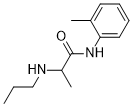
Physicochemical Properties
| Molecular Formula | C13H20N2O |
| Molecular Weight | 220.32 |
| Exact Mass | 220.157 |
| CAS # | 721-50-6 |
| Related CAS # | Prilocaine hydrochloride;1786-81-8;Prilocaine acetate |
| PubChem CID | 4906 |
| Appearance | White to off-white solid powder |
| Density | 1.0±0.1 g/cm3 |
| Boiling Point | 361.6±25.0 °C at 760 mmHg |
| Melting Point | 37-38ºC |
| Flash Point | 134.3±23.3 °C |
| Vapour Pressure | 0.0±0.8 mmHg at 25°C |
| Index of Refraction | 1.543 |
| LogP | 1.74 |
| Hydrogen Bond Donor Count | 2 |
| Hydrogen Bond Acceptor Count | 2 |
| Rotatable Bond Count | 5 |
| Heavy Atom Count | 16 |
| Complexity | 218 |
| Defined Atom Stereocenter Count | 0 |
| InChi Key | MVFGUOIZUNYYSO-UHFFFAOYSA-N |
| InChi Code | InChI=1S/C13H20N2O/c1-4-9-14-11(3)13(16)15-12-8-6-5-7-10(12)2/h5-8,11,14H,4,9H2,1-3H3,(H,15,16) |
| Chemical Name | N-(2-methylphenyl)-2-(propylamino)propanamide |
| HS Tariff Code | 2934.99.9001 |
| Storage |
Powder-20°C 3 years 4°C 2 years In solvent -80°C 6 months -20°C 1 month |
| Shipping Condition | Room temperature (This product is stable at ambient temperature for a few days during ordinary shipping and time spent in Customs) |
Biological Activity
| ln Vitro | Prlocaine has a greater inhibitory impact on the plasma membrane Na,K-ATPase of transformed fibroblasts (LM cells) at 37 °C (43.8 mM) than it does at 25 °C (28.2 mM) [2]. |
| ADME/Pharmacokinetics |
Absorption, Distribution and Excretion Prilocaine is metabolized in both the liver and the kidney and excreted via the kidney. /CONCERNING/ HYDROLYSIS OF AMIDE BOND OF PRILOCAINE... PLASMA CONCN OF R-(-)-ENANTIOMER WERE FOUND TO BE LOWER THAN THOSE OF THE S-(+)-ENANTIOMER AFTER IV ADMIN TO CAT. IN VITRO STUDIES USING LIVER PREPN FROM VARIOUS MAMMALS CONFIRMED THE R-(-)-ISOMER TO BE HYDROLYZED @ MUCH HIGHER RATES THAN THE S-(+) FORM... THERE IS...MORE RAPID PRODN OF METHEMOGLOBINEMIA BY D-(-) FORM, CAUSED PRESUMABLY BY HIGHER BLOOD LEVELS OF HYDROLYSIS PRODUCT, O-TOLUIDINE. PRILOCAINE FETAL/MATERNAL CONCN RATIO: 1.0 /FROM TABLE/ PRILOCAINE DOSE 0.2 G IV GAVE BLOOD CONCN 0.26 MG% @ 0.3 HR & 0.14 MG% @ 0.17 HR; DOSE 0.4 G IV GAVE BLOOD CONCN 0.15 MG% @ 0.12 HR & 0.08 MG% @ 0.33 HR; DOSE 0.4 G EPIDURAL BLOCK GAVE BLOOD CONCN 0.26 MG% @ 0.25 HR (PEAK); DOSE 0.4 G INTERCOSTAL BLOCK GAVE BLOOD CONCN 0.40 MG% @ 0.25 HR. /FROM TABLE/ Metabolism / Metabolites The amide-linked local anesthetics are, in general, degraded by the hepatic endoplasmic reticulum, the initial reactions involving N-dealkylation and subsequent hydrolysis. However, with prilocaine, the initial step is hydrolytic, forming o-toluidine metabolites that can cause methemoglobinemia. BIOTRANSFORMATION OF PRILOCAINE...IN RATS GAVE O-TOLUIDINE & N-PROPYLALANINE. Biological Half-Life MEPIVACAINE-HCL (I-HCL) & PRILOCAINE-HCL (II-HCL) WERE INFUSED IV 250 MG INTO HEALTHY VOLUNTEERS. T/2 FOR I WAS GENERALLY LONGER THAN II; TOTAL BODY CLEARANCE II CONSISTENTLY GREATER THAN I. II CLEARANCE EXCEEDED NORMAL HEPATIC BLOOD FLOW: EXTRA-HEPATIC METAB SITE IS POSTULATED. |
| Toxicity/Toxicokinetics |
Interactions ...MOUSE TRIALS INDICATE INCR TOXICITY WHEN COMBINED WITH TETRACAINE. ...PRILOCAINE...REPORTED TO INTERACT WITH SUCCINYLCHOLINE /RESULTING IN INCR IN INTENSITY & DURATION OF SUCCINYLCHOLINE-INDUCED NEUROMUSCULAR BLOCKADE & RESP DEPRESSION; OTHER DEPOLARIZING MUSCLE RELAXANTS (EG DECAMETHONIUM) & NONDEPOLARIZING MUSCLE RELAXANTS (EG GALLAMINE TRIETHIODIDE & PANCURONIUM) MAY BEHAVE SIMILARLY/. .../PRILOCAINE/ PRODUCED A SLIGHT INCR IN INTENSITY OF NEUROMUSCULAR BLOCKADE /OF ALCURONIUM CHLORIDE/. ...MARKED DECR IN TIDAL VOL, INDICATING RESP DEPRESSION, WAS OBSERVED... EPINEPHRINE PROLONGS THE EFFECT /OF PRILOCAINE/. /PRILOCAINE HCL/ For more Interactions (Complete) data for PRILOCAINE (15 total), please visit the HSDB record page. |
| References |
[1]. Neurotoxic effects of local anesthetics on the mouse neuroblastoma NB2a cell line. Biotech Histochem. 2015 Apr;90(3):216-22. [2]. Effects of local anaesthetics on the activity of the Na,K-ATPase of canine renal medulla. Pharmacol Res. 2000 Jan;41(1):1-7. |
| Additional Infomation |
Prilocaine is an amino acid amide in which N-propyl-DL-alanine and 2-methylaniline have combined to form the amide bond; used as a local anaesthetic. It has a role as a local anaesthetic and an anticonvulsant. It is an amino acid amide and a monocarboxylic acid amide. A local anesthetic that is similar pharmacologically to lidocaine. Currently, it is used most often for infiltration anesthesia in dentistry. (From AMA Drug Evaluations Annual, 1992, p165) Prilocaine is an Amide Local Anesthetic. The physiologic effect of prilocaine is by means of Local Anesthesia. Prilocaine is a toluidine derivative and intermediate-acting amino amide with local anesthetic property. Prilocaine stabilizes the neuronal membrane by preferential binding to and inhibiting depolarization of the voltage-gated sodium channel. This results in a decrease in membrane permeability and subsequent inhibition of the ionic sodium influx required for the initiation and conduction of impulses. A local anesthetic that is similar pharmacologically to LIDOCAINE. Currently, it is used most often for infiltration anesthesia in dentistry. See also: Prilocaine Hydrochloride (has salt form) ... View More ... Drug Indication Used as a local anaesthetic and is often used in dentistry. Mechanism of Action Prilocaine acts on sodium channels on the neuronal cell membrane, limiting the spread of seizure activity and reducing seizure propagation. The antiarrhythmic actions are mediated through effects on sodium channels in Purkinje fibers. ... BLOCK CONDUCTION IN NERVE PERHAPS BY COMPETING WITH CA @ SOME SITE THAT CONTROLS PERMEABILITY OF MEMBRANE ... CA IS ALSO INVOLVED IN ACTION OF LOCAL ANESTHETICS ON SMOOTH MUSCLE ... & ON ADRENAL MEDULLA ... /LOCAL ANESTHETICS/ ... PREVENT THE GENERATION & THE CONDUCTION OF THE NERVE IMPULSE. THEIR PRIMARY SITE OF ACTION IS THE CELL MEMBRANE. ... BLOCK CONDUCTION BY DECREASING OR PREVENTING THE LARGE TRANSIENT INCREASE IN THE PERMEABILITY OF EXCITABLE MEMBRANES TO NA+ THAT NORMALLY IS PRODUCED BY A SLIGHT DEPOLARIZATION OF THE MEMBRANE. /LOCAL ANESTHETICS/ AS ANESTHETIC ACTION PROGRESSIVELY DEVELOPS IN A NERVE, THRESHOLD FOR ELECTRICAL EXCITABILITY INCR & SAFETY FACTOR FOR CONDUCTION DECR; WHEN THIS ACTION IS SUFFICIENTLY WELL-DEVELOPED, BLOCK OF CONDUCTION IS PRODUCED. /LOCAL ANESTHETICS/ .../2 POSSIBILITIES:/ ACHIEVE BLOCK BY INCR SURFACE PRESSURE OF LIPID LAYER THAT CONSTITUTES NERVE MEMBRANE...CLOSING PORES THROUGH WHICH IONS MOVE. ... /OR:/ AFFECT PERMEABILITY BY INCR DEGREE OF DISORDER OF MEMBRANE. /LOCAL ANESTHETICS/ Therapeutic Uses Anesthetics, Local AN AGENT CHEMICALLY SIMILAR TO LIDOCAINE & MEPIVACAINE USED FOR LOCAL & REGIONAL-BLOCK ANESTHESIA. IN ONSET OF ACTION & EFFECTIVENESS 1-3% SOLN... EQUIVALENT TO LIDOCAINE & MEPIVACAINE IN 1%-2% CONCN. ITS DURATION OF ACTION IS INTERMEDIATE TO SHORTER-ACTING LIDOCAINE & LONGER-ACTING MEPIVACAINE. /PRILOCAINE HCL/ PRILOCAINE HYDROCHLORIDE ... HAS BEEN EMPLOYED ... FOR SPINAL ANESTHESIA. /PRILOCAINE HCL/ ... ACT ON ANY PART OF THE NERVOUS SYSTEM & ON EVERY TYPE OF NERVE FIBER. /LOCAL ANESTHETICS/ For more Therapeutic Uses (Complete) data for PRILOCAINE (10 total), please visit the HSDB record page. Drug Warnings AS WITH OTHER LOCAL ANESTHETICS, PRILOCAINE HCL IS CONTRAINDICATED IN PRESENCE OF SHOCK, SEVERE CARDIOVASCULAR DISEASE, OR HEART BLOCK. /PRILOCAINE HCL/ ... SHOULD NOT BE ADMIN TO PT WITH IDIOPATHIC OR CONGENITAL METHEMOGLOBINEMIA, ANEMIA, OR CARDIAC OR VENTILATORY FAILURE WITH HYPOXIA; IT SHOULD BE USED WITH CAUTION FOR CONTINUOUS EPIDURAL ANESTHESIA SINCE THE METHEMOGLOBINEMIC EFFECT OF INDIVIDUAL DOSES IS ADDITIVE. /PRILOCAINE HCL/ IN PRESENCE OF HEMORRHAGE, SYMPATHETIC BLOCK PRODUCED BY EPIDURAL ANESTHESIA BECOMES EXTREMELY SIGNIFICANT & MAY RESULT IN RAPID & DELETeRIOUS CIRCULATORY CHANGES. /LOCAL ANESTHETICS/ TWO OUTSTANDING DANGERS /OF CAUDAL ANESTHESIA/ ARE (1) INTRODUCING NEEDLE INTO VENOUS PLEXUS LINING SACRAL CANAL, WITH RESULTANT INTRAVASCULAR INJECTION OF DRUG, & (2) PENETRATING DURA, WITH DEVELOPMENT OF HIGH LEVEL OF SPINAL ANESTHESIA. /LOCAL ANESTHETICS/ For more Drug Warnings (Complete) data for PRILOCAINE (16 total), please visit the HSDB record page. Pharmacodynamics Prilocaine binds to the intracellular surface of sodium channels which blocks the subsequent influx of sodium into the cell. Action potential propagation and never function is, therefore, prevented. This block is reversible and when the drug diffuses away from the cell, sodium channel function is restored and nerve propagation returns. |
Solubility Data
| Solubility (In Vitro) |
DMSO : ~100 mg/mL (~453.91 mM) H2O : ~2.5 mg/mL (~11.35 mM) |
| Solubility (In Vivo) |
Solubility in Formulation 1: ≥ 2.5 mg/mL (11.35 mM) (saturation unknown) in 10% DMSO + 40% PEG300 + 5% Tween80 + 45% Saline (add these co-solvents sequentially from left to right, and one by one), clear solution. For example, if 1 mL of working solution is to be prepared, you can add 100 μL of 25.0 mg/mL clear DMSO stock solution to 400 μL PEG300 and mix evenly; then add 50 μL Tween-80 to the above solution and mix evenly; then add 450 μL normal saline to adjust the volume to 1 mL. Preparation of saline: Dissolve 0.9 g of sodium chloride in 100 mL ddH₂ O to obtain a clear solution. Solubility in Formulation 2: ≥ 2.5 mg/mL (11.35 mM) (saturation unknown) in 10% DMSO + 90% (20% SBE-β-CD in Saline) (add these co-solvents sequentially from left to right, and one by one), clear solution. For example, if 1 mL of working solution is to be prepared, you can add 100 μL of 25.0 mg/mL clear DMSO stock solution to 900 μL of 20% SBE-β-CD physiological saline solution and mix evenly. Preparation of 20% SBE-β-CD in Saline (4°C,1 week): Dissolve 2 g SBE-β-CD in 10 mL saline to obtain a clear solution. Solubility in Formulation 3: ≥ 2.5 mg/mL (11.35 mM) (saturation unknown) in 10% DMSO + 90% Corn Oil (add these co-solvents sequentially from left to right, and one by one), clear solution. For example, if 1 mL of working solution is to be prepared, you can add 100 μL of 25.0 mg/mL clear DMSO stock solution to 900 μL of corn oil and mix evenly. Solubility in Formulation 4: 50 mg/mL (226.95 mM) in PBS (add these co-solvents sequentially from left to right, and one by one), clear solution; with ultrasonication. (Please use freshly prepared in vivo formulations for optimal results.) |
| Preparing Stock Solutions | 1 mg | 5 mg | 10 mg | |
| 1 mM | 4.5389 mL | 22.6943 mL | 45.3885 mL | |
| 5 mM | 0.9078 mL | 4.5389 mL | 9.0777 mL | |
| 10 mM | 0.4539 mL | 2.2694 mL | 4.5389 mL |