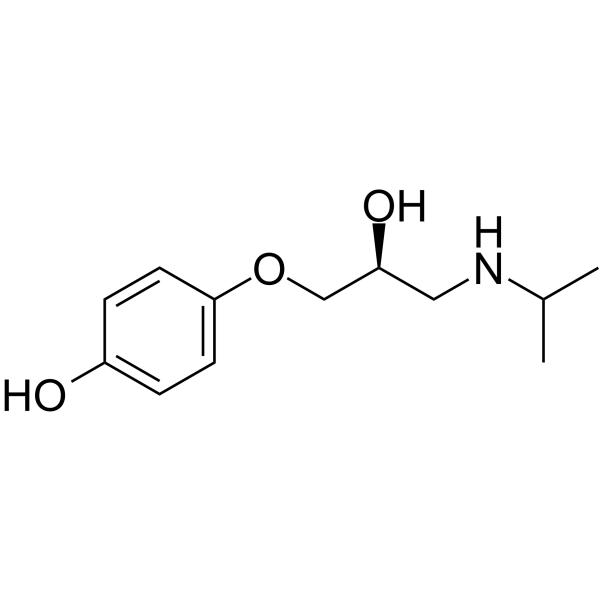
Physicochemical Properties
| Molecular Formula | C12H19NO3 |
| Molecular Weight | 225.28 |
| Exact Mass | 225.136 |
| Elemental Analysis | C, 55.07; H, 7.70; Cl, 13.54; N, 5.35; O, 18.34 |
| CAS # | 57526-81-5 |
| Related CAS # | 61260-05-7 (hydrochloride) |
| PubChem CID | 42396 |
| Appearance | White to off-white solid powder |
| Density | 1.1±0.1 g/cm3 |
| Boiling Point | 397.7±32.0 °C at 760 mmHg |
| Flash Point | 194.3±25.1 °C |
| Vapour Pressure | 0.0±1.0 mmHg at 25°C |
| Index of Refraction | 1.538 |
| LogP | 1.04 |
| Hydrogen Bond Donor Count | 3 |
| Hydrogen Bond Acceptor Count | 4 |
| Rotatable Bond Count | 6 |
| Heavy Atom Count | 16 |
| Complexity | 179 |
| Defined Atom Stereocenter Count | 1 |
| SMILES | CC(C)NC[C@@H](COC1=CC=C(C=C1)O)O |
| InChi Key | ADUKCCWBEDSMEB-NSHDSACASA-N |
| InChi Code | InChI=1S/C12H19NO3/c1-9(2)13-7-11(15)8-16-12-5-3-10(14)4-6-12/h3-6,9,11,13-15H,7-8H2,1-2H3/t11-/m0/s1 |
| Chemical Name | 4-[(2S)-2-hydroxy-3-(propan-2-ylamino)propoxy]phenol |
| Synonyms | Prenalterol; 57526-81-5; Prenalterolum; (S)-4-(2-Hydroxy-3-(isopropylamino)propoxy)phenol; Prenalterol [INN:BAN]; Prenalterolum [INN-Latin]; 4-[(2S)-2-hydroxy-3-(propan-2-ylamino)propoxy]phenol; EINECS 260-791-5; |
| HS Tariff Code | 2934.99.9001 |
| Storage |
Powder-20°C 3 years 4°C 2 years In solvent -80°C 6 months -20°C 1 month |
| Shipping Condition | Room temperature (This product is stable at ambient temperature for a few days during ordinary shipping and time spent in Customs) |
Biological Activity
| Targets | β1-receptor |
| ln Vivo | Gastrointestinal motility is influenced by adrenergic modulation. Our aim was to identify specific subtypes of adrenergic receptors involved in inhibitory mechanisms that modulate gut smooth muscle contractile activity. Muscle strips of rat ileal longitudinal muscle were evaluated for spontaneous contractile activity and for equimolar dose-responses (10(-7) to 3 x 10(-5) M) to the adrenergic agents norepinephrine (nonselective agonist), phenylephrine (alpha(1)-agonist), clonidine (alpha(2)-agonist), prenalterol (beta(1)-agonist), ritodrine (beta(2)-agonist), and ZD7114 (beta(3)-agonist) in the presence and absence of tetrodotoxin (nonselective nerve blocker). Norepinephrine (3 x 10(-5) M) inhibited 65 +/- 6% (mean +/- SEM) of spontaneous contractile activity. The same molar dose of ritodrine, phenylephrine, or ZD7114 resulted in less inhibition (46 +/- 7%, 31 +/- 5%, and 39 +/- 3%, respectively; P < 0.05). The calculated molar concentration of ZD7114 needed to induce 50% inhibition was similar to that of norepinephrine, whereas higher concentrations of phenylephrine or ritodrine were required. Clonidine and prenalterol had no effect on contractile activity. Blockade of intramural neural transmission by tetrodotoxin affected the responses to ritodrine and phenylephrine (but not to norepinephrine or ZD7114), suggesting that these agents exert part of their effects via neurally mediated enteric pathways. Our results suggest that adrenergic modulation of contractile activity in the rat ileum is mediated primarily by muscular beta(3)-, beta(2)-, and alpha(1)-receptor mechanisms; the latter two also involve neural pathways [1]. |
| References |
[1]. alpha- and beta-adrenergic receptor mechanisms in spontaneous contractile activity of rat ileal longitudinal smooth muscle. J Gastrointest Surg. 2005;9(2):227-235. |
| Additional Infomation |
Prenalterol is an aromatic ether. A partial adrenergic agonist with functional beta 1-receptor specificity and inotropic effect. It is effective in the treatment of acute CARDIAC FAILURE, postmyocardial infarction low-output syndrome, SHOCK, and reducing ORTHOSTATIC HYPOTENSION in the SHY-RAGER SYNDROME. See also: Prenalterol Hydrochloride (annotation moved to). |
Solubility Data
| Solubility (In Vitro) | DMSO : ~100 mg/mL (~443.89 mM) |
| Solubility (In Vivo) |
Note: Listed below are some common formulations that may be used to formulate products with low water solubility (e.g. < 1 mg/mL), you may test these formulations using a minute amount of products to avoid loss of samples. Injection Formulations (e.g. IP/IV/IM/SC) Injection Formulation 1: DMSO : Tween 80: Saline = 10 : 5 : 85 (i.e. 100 μL DMSO stock solution → 50 μL Tween 80 → 850 μL Saline) *Preparation of saline: Dissolve 0.9 g of sodium chloride in 100 mL ddH ₂ O to obtain a clear solution. Injection Formulation 2: DMSO : PEG300 :Tween 80 : Saline = 10 : 40 : 5 : 45 (i.e. 100 μL DMSO → 400 μLPEG300 → 50 μL Tween 80 → 450 μL Saline) Injection Formulation 3: DMSO : Corn oil = 10 : 90 (i.e. 100 μL DMSO → 900 μL Corn oil) Example: Take the Injection Formulation 3 (DMSO : Corn oil = 10 : 90) as an example, if 1 mL of 2.5 mg/mL working solution is to be prepared, you can take 100 μL 25 mg/mL DMSO stock solution and add to 900 μL corn oil, mix well to obtain a clear or suspension solution (2.5 mg/mL, ready for use in animals). Injection Formulation 4: DMSO : 20% SBE-β-CD in saline = 10 : 90 [i.e. 100 μL DMSO → 900 μL (20% SBE-β-CD in saline)] *Preparation of 20% SBE-β-CD in Saline (4°C,1 week): Dissolve 2 g SBE-β-CD in 10 mL saline to obtain a clear solution. Injection Formulation 5: 2-Hydroxypropyl-β-cyclodextrin : Saline = 50 : 50 (i.e. 500 μL 2-Hydroxypropyl-β-cyclodextrin → 500 μL Saline) Injection Formulation 6: DMSO : PEG300 : castor oil : Saline = 5 : 10 : 20 : 65 (i.e. 50 μL DMSO → 100 μLPEG300 → 200 μL castor oil → 650 μL Saline) Injection Formulation 7: Ethanol : Cremophor : Saline = 10: 10 : 80 (i.e. 100 μL Ethanol → 100 μL Cremophor → 800 μL Saline) Injection Formulation 8: Dissolve in Cremophor/Ethanol (50 : 50), then diluted by Saline Injection Formulation 9: EtOH : Corn oil = 10 : 90 (i.e. 100 μL EtOH → 900 μL Corn oil) Injection Formulation 10: EtOH : PEG300:Tween 80 : Saline = 10 : 40 : 5 : 45 (i.e. 100 μL EtOH → 400 μLPEG300 → 50 μL Tween 80 → 450 μL Saline) Oral Formulations Oral Formulation 1: Suspend in 0.5% CMC Na (carboxymethylcellulose sodium) Oral Formulation 2: Suspend in 0.5% Carboxymethyl cellulose Example: Take the Oral Formulation 1 (Suspend in 0.5% CMC Na) as an example, if 100 mL of 2.5 mg/mL working solution is to be prepared, you can first prepare 0.5% CMC Na solution by measuring 0.5 g CMC Na and dissolve it in 100 mL ddH2O to obtain a clear solution; then add 250 mg of the product to 100 mL 0.5% CMC Na solution, to make the suspension solution (2.5 mg/mL, ready for use in animals). Oral Formulation 3: Dissolved in PEG400 Oral Formulation 4: Suspend in 0.2% Carboxymethyl cellulose Oral Formulation 5: Dissolve in 0.25% Tween 80 and 0.5% Carboxymethyl cellulose Oral Formulation 6: Mixing with food powders Note: Please be aware that the above formulations are for reference only. InvivoChem strongly recommends customers to read literature methods/protocols carefully before determining which formulation you should use for in vivo studies, as different compounds have different solubility properties and have to be formulated differently. (Please use freshly prepared in vivo formulations for optimal results.) |
| Preparing Stock Solutions | 1 mg | 5 mg | 10 mg | |
| 1 mM | 4.4389 mL | 22.1946 mL | 44.3892 mL | |
| 5 mM | 0.8878 mL | 4.4389 mL | 8.8778 mL | |
| 10 mM | 0.4439 mL | 2.2195 mL | 4.4389 mL |