Physicochemical Properties
| Molecular Formula | C173H271N51O55S2 |
| Molecular Weight | 4009.44157624245 |
| Exact Mass | 4007.9451 |
| CAS # | 187887-46-3 |
| Related CAS # | Pramlintide;151126-32-8;Pramlintide TFA |
| PubChem CID | 118984456 |
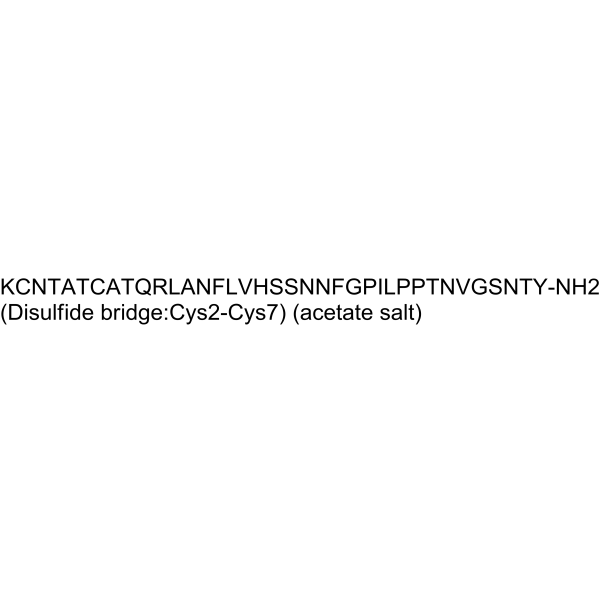
| Sequence | Lys-Cys-Asn-Thr-Ala-Thr-Cys-Ala-Thr-Gln-Arg-Leu-Ala-Asn-Phe-Leu-Val-His-Ser-Ser-Asn-Asn-Phe-Gly-Pro-Ile-Leu-Pro-Pro-Thr-Asn-Val-Gly-Ser-Asn-Thr-Tyr-NH2 (Disulfide bridge:Cys2-Cys7); H-Lys-Cys(1)-Asn-Thr-Ala-Thr-Cys(1)-Ala-Thr-Gln-Arg-Leu-Ala-Asn-Phe-Leu-Val-His-Ser-Ser-Asn-Asn-Phe-Gly-Pro-Ile-Leu-Pro-Pro-Thr-Asn-Val-Gly-Ser-Asn-Thr-Tyr-NH2.CH3CO2H; L-lysyl-L-cysteinyl-L-asparagyl-L-threonyl-L-alanyl-L-threonyl-L-cysteinyl-L-alanyl-L-threonyl-L-glutaminyl-L-arginyl-L-leucyl-L-alanyl-L-asparagyl-L-phenylalanyl-L-leucyl-L-valyl-L-histidyl-L-seryl-L-seryl-L-asparagyl-L-asparagyl-L-phenylalanyl-glycyl-L-prolyl-L-isoleucyl-L-leucyl-L-prolyl-L-prolyl-L-threonyl-L-asparagyl-L-valyl-glycyl-L-seryl-L-asparagyl-L-threonyl-L-tyrosinamide (2->7)-disulfide acetic acid |
| SequenceShortening | KCNTATCATQRLANFLVHSSNNFGPILPPTNVGSNTY-NH2 (Disulfide bridge:Cys2-Cys7); KCNTATCATQRLANFLVHSSNNFGPILPPTNVGSNTY |
| Appearance | White to off-white solid powder |
| Hydrogen Bond Donor Count | 57 |
| Hydrogen Bond Acceptor Count | 61 |
| Rotatable Bond Count | 110 |
| Heavy Atom Count | 281 |
| Complexity | 9690 |
| Defined Atom Stereocenter Count | 41 |
| SMILES | S1C[C@@H](C(N[C@@H](C)C(N[C@@H]([C@@H](C)O)C(N[C@@H](CCC(N)=O)C(N[C@H](C(N[C@H](C(N[C@@H](C)C(N[C@@H](CC(N)=O)C(N[C@@H](CC2C=CC=CC=2)C(N[C@@H](CC(C)C)C(N[C@@H](C(C)C)C(N[C@@H](CC2=CNC=N2)C(N[C@@H](CO)C(N[C@@H](CO)C(N[C@@H](CC(N)=O)C(N[C@@H](CC(N)=O)C(N[C@@H](CC2C=CC=CC=2)C(NCC(N2CCC[C@H]2C(N[C@@H]([C@@H](C)CC)C(N[C@@H](CC(C)C)C(N2CCC[C@H]2C(N2CCC[C@H]2C(N[C@H](C(N[C@H](C(N[C@H](C(NCC(N[C@H](C(N[C@H](C(N[C@H](C(N[C@H](C(N)=O)CC2C=CC(=CC=2)O)=O)[C@@H](C)O)=O)CC(N)=O)=O)CO)=O)=O)C(C)C)=O)CC(N)=O)=O)[C@@H](C)O)=O)=O)=O)=O)=O)=O)=O)=O)=O)=O)=O)=O)=O)=O)=O)=O)=O)=O)CC(C)C)=O)CCCNC(=N)N)=O)=O)=O)=O)NC([C@H]([C@@H](C)O)NC([C@H](C)NC([C@H]([C@@H](C)O)NC([C@H](CC(N)=O)NC([C@H](CS1)NC([C@H](CCCCN)N)=O)=O)=O)=O)=O)=O.OC(C)=O |
| InChi Key | DTPWZYSUQQHRKD-VIUAGAKSSA-N |
| InChi Code | InChI=1S/C171H267N51O53S2.C2H4O2/c1-21-81(12)130(163(268)207-110(56-78(6)7)169(274)222-53-33-42-118(222)170(275)221-52-32-41-117(221)160(265)219-135(89(20)230)167(272)206-109(66-125(180)238)151(256)212-128(79(8)9)161(266)186-68-126(239)192-111(70-223)154(259)203-107(64-123(178)236)152(257)218-134(88(19)229)166(271)195-98(136(181)241)57-92-43-45-94(231)46-44-92)214-159(264)116-40-31-51-220(116)127(240)69-187-141(246)101(58-90-34-24-22-25-35-90)199-148(253)105(62-121(176)234)201-149(254)106(63-122(177)235)202-155(260)112(71-224)209-156(261)113(72-225)208-146(251)103(60-93-67-184-75-188-93)205-162(267)129(80(10)11)213-150(255)100(55-77(4)5)198-145(250)102(59-91-36-26-23-27-37-91)200-147(252)104(61-120(175)233)196-137(242)82(13)189-144(249)99(54-76(2)3)197-142(247)96(39-30-50-185-171(182)183)193-143(248)97(47-48-119(174)232)194-165(270)132(86(17)227)215-138(243)83(14)190-157(262)114-73-276-277-74-115(210-140(245)95(173)38-28-29-49-172)158(263)204-108(65-124(179)237)153(258)217-131(85(16)226)164(269)191-84(15)139(244)216-133(87(18)228)168(273)211-114;1-2(3)4/h22-27,34-37,43-46,67,75-89,95-118,128-135,223-231H,21,28-33,38-42,47-66,68-74,172-173H2,1-20H3,(H2,174,232)(H2,175,233)(H2,176,234)(H2,177,235)(H2,178,236)(H2,179,237)(H2,180,238)(H2,181,241)(H,184,188)(H,186,266)(H,187,246)(H,189,249)(H,190,262)(H,191,269)(H,192,239)(H,193,248)(H,194,270)(H,195,271)(H,196,242)(H,197,247)(H,198,250)(H,199,253)(H,200,252)(H,201,254)(H,202,260)(H,203,259)(H,204,263)(H,205,267)(H,206,272)(H,207,268)(H,208,251)(H,209,261)(H,210,245)(H,211,273)(H,212,256)(H,213,255)(H,214,264)(H,215,243)(H,216,244)(H,217,258)(H,218,257)(H,219,265)(H4,182,183,185);1H3,(H,3,4)/t81-,82-,83-,84-,85+,86+,87+,88+,89+,95-,96-,97-,98-,99-,100-,101-,102-,103-,104-,105-,106-,107-,108-,109-,110-,111-,112-,113-,114-,115-,116-,117-,118-,128-,129-,130-,131-,132-,133-,134-,135-;/m0./s1 |
| Chemical Name | acetic acid;(2S)-N-[(2S)-1-[[(2S)-1-[[(2S)-1-[[(2S)-4-amino-1-[[(2S)-1-[[(2S)-1-[[(2S)-1-[[(2S)-1-[[(2S)-1-[[(2S)-1-[[(2S)-4-amino-1-[[(2S)-4-amino-1-[[(2S)-1-[[2-[(2S)-2-[[(2S,3S)-1-[[(2S)-1-[(2S)-2-[(2S)-2-[[(2S,3R)-1-[[(2S)-4-amino-1-[[(2S)-1-[[2-[[(2S)-1-[[(2S)-4-amino-1-[[(2S,3R)-1-[[(2S)-1-amino-3-(4-hydroxyphenyl)-1-oxopropan-2-yl]amino]-3-hydroxy-1-oxobutan-2-yl]amino]-1,4-dioxobutan-2-yl]amino]-3-hydroxy-1-oxopropan-2-yl]amino]-2-oxoethyl]amino]-3-methyl-1-oxobutan-2-yl]amino]-1,4-dioxobutan-2-yl]amino]-3-hydroxy-1-oxobutan-2-yl]carbamoyl]pyrrolidine-1-carbonyl]pyrrolidin-1-yl]-4-methyl-1-oxopentan-2-yl]amino]-3-methyl-1-oxopentan-2-yl]carbamoyl]pyrrolidin-1-yl]-2-oxoethyl]amino]-1-oxo-3-phenylpropan-2-yl]amino]-1,4-dioxobutan-2-yl]amino]-1,4-dioxobutan-2-yl]amino]-3-hydroxy-1-oxopropan-2-yl]amino]-3-hydroxy-1-oxopropan-2-yl]amino]-3-(1H-imidazol-4-yl)-1-oxopropan-2-yl]amino]-3-methyl-1-oxobutan-2-yl]amino]-4-methyl-1-oxopentan-2-yl]amino]-1-oxo-3-phenylpropan-2-yl]amino]-1,4-dioxobutan-2-yl]amino]-1-oxopropan-2-yl]amino]-4-methyl-1-oxopentan-2-yl]amino]-5-carbamimidamido-1-oxopentan-2-yl]-2-[[(2S,3R)-2-[[(2S)-2-[[(4R,7S,10S,13S,16S,19R)-16-(2-amino-2-oxoethyl)-19-[[(2S)-2,6-diaminohexanoyl]amino]-7,13-bis[(1R)-1-hydroxyethyl]-10-methyl-6,9,12,15,18-pentaoxo-1,2-dithia-5,8,11,14,17-pentazacycloicosane-4-carbonyl]amino]propanoyl]amino]-3-hydroxybutanoyl]amino]pentanediamide |
| Synonyms | 187887-46-3; Triproamylin acetate; UNII-JS41L76X7I; Tripro-amylin acetate; Pramlintide acetate anhydrous; |
| HS Tariff Code | 2934.99.9001 |
| Storage |
Powder-20°C 3 years 4°C 2 years In solvent -80°C 6 months -20°C 1 month Note: Please store this product in a sealed and protected environment, avoid exposure to moisture. |
| Shipping Condition | Room temperature (This product is stable at ambient temperature for a few days during ordinary shipping and time spent in Customs) |
Biological Activity
| Targets | Anticancer; amylin analog; diabetes |
| ln Vitro | In a dose-dependent manner, pramlintide suppresses the growth of HCT-116 and HT-29, with a greater efficacy against the latter (IC50 values of 48.67 and 9.10 μg/mL, respectively) [1]. The antiproliferative effects of 5-fluorouracil, oxaliplatin, or irinotecan were synergistically induced when 5, 10, and 20 μg/mL of Pramlintide was added to HCT-116 and HT-29 [1]. |
| Cell Assay |
MTT assay [1] The HCT-116 (wild-type p53) and HT-29 (mutant p53) cells were plated into the 96 well plates at a density of 5×10³ in 200 μL of medium per well and the cells were incubated and allowed to attach overnight. The attached cells in the plates were treated with a series of drug concentrations: pramlintide (0–102.4 μg/mL), 5-FU (0–200 μM), OXA (0–300 μM), or IRN (0–160 μM) alone or in combination with three different concentrations of pramlintide (5, 10, and 20 μg/mL) that correspond to 0.5×IC50, IC50, and 2×IC50 in HT-29. Cells grown in medium alone (for treatment with pramlintide only) or containing an equivalent amount of DMSO served as control (for other treatment conditions). [1] Cells were incubated with the drugs at the indicated concentrations for 72 hours. All measurements were done in triplicate. After that, cell proliferation assay was performed per the manufacturer’s protocol. Briefly, MTT dye was added to the treated cells at a final concentration of 0.5 mg/mL in PBS. Then, the plates were incubated at 37°C for 3 hours and the MTT was discarded and the formazan product was dissolved by adding 100 μL of DMSO to each well, followed by shaking for 5 minutes. Then, the plates were read using an enzyme-linked immunosorbent assay plate reader at 570 nm with a reference wavelength of 690 nm. Cell viability was calculated as follows: absorbance of the experimental group/absorbance of the control group. The IC50 value was defined as the concentration needed for a 50% reduction in cell viability. Dose–effect analyses and IC50 calculations were performed using Compusyn software 1.0 |
| References |
[1]. Pramlintide, an antidiabetic, is antineoplastic in colorectal cancer and synergizes with conventional chemotherapy. Clin Pharmacol. 2018 Mar 5;10:23-29. |
| Additional Infomation |
To investigate the synergistic potential of pramlintide with chemotherapy agents in colorectal cancer cell lines, we sought to test three different concentrations of pramlintide that correspond to 0.5×IC50, IC50, and 2×IC50 in each cell line. Nevertheless, due to high concentration requirements in HCT-116 cell lines, the limited amount of the drug available, and to be consistent with the investigated comparisons, we utilized pramlintide at concentrations of 5, 10, and 20 μg/mL, which correspond to 0.5×IC50, IC50, and 2×IC50 in HT-29. We demonstrated for the first time that at low and clinically achievable concentrations, pramlintide could synergistically inhibit colorectal cancer cell proliferation in HCT-116 and HT-29 cell lines when combined with 5-FU, OXA, and IRN in a concentration-dependent manner. These results suggest that pramlintide is a novel potential adjuvant anticancer agent with beneficial role in overcoming resistance to 5-FU, OXA, and IRN. Further in vivo and clinical studies are required to establish pramlintide as a valid chemopreventive and chemotherapeutic agent in colorectal cancer. [1] Despite the promising results we obtained from this study, there were some limitations. First, the antineoplastic potential of pramlintide was tested only using the short-term MTT assay. Second, we utilized only two representative cell lines to investigate the differential effect of pramlintide based on the p53 status; thus, the difference in the response to pramlintide between HT-29 and HCT-116 could be due to factors other than p53. [1] Conclusion This study shows for the first time that pramlintide has anticancer activity against colorectal cancer and has a synergistic effect with 5-FU, OXA, and IRN. Future work will more fully explore the antiproliferative mechanisms of pramlintide and the underlying molecular mechanisms of synergism. Moreover, the antineoplastic potential of pramlintide will be analyzed using other long-term assays, such as colony-forming assay, and in vivo models of colorectal cancer. [1] |
Solubility Data
| Solubility (In Vitro) | H2O: 50 mg/mL (12.47 mM) |
| Solubility (In Vivo) |
Note: Listed below are some common formulations that may be used to formulate products with low water solubility (e.g. < 1 mg/mL), you may test these formulations using a minute amount of products to avoid loss of samples. Injection Formulations (e.g. IP/IV/IM/SC) Injection Formulation 1: DMSO : Tween 80: Saline = 10 : 5 : 85 (i.e. 100 μL DMSO stock solution → 50 μL Tween 80 → 850 μL Saline) *Preparation of saline: Dissolve 0.9 g of sodium chloride in 100 mL ddH ₂ O to obtain a clear solution. Injection Formulation 2: DMSO : PEG300 :Tween 80 : Saline = 10 : 40 : 5 : 45 (i.e. 100 μL DMSO → 400 μLPEG300 → 50 μL Tween 80 → 450 μL Saline) Injection Formulation 3: DMSO : Corn oil = 10 : 90 (i.e. 100 μL DMSO → 900 μL Corn oil) Example: Take the Injection Formulation 3 (DMSO : Corn oil = 10 : 90) as an example, if 1 mL of 2.5 mg/mL working solution is to be prepared, you can take 100 μL 25 mg/mL DMSO stock solution and add to 900 μL corn oil, mix well to obtain a clear or suspension solution (2.5 mg/mL, ready for use in animals). Injection Formulation 4: DMSO : 20% SBE-β-CD in saline = 10 : 90 [i.e. 100 μL DMSO → 900 μL (20% SBE-β-CD in saline)] *Preparation of 20% SBE-β-CD in Saline (4°C,1 week): Dissolve 2 g SBE-β-CD in 10 mL saline to obtain a clear solution. Injection Formulation 5: 2-Hydroxypropyl-β-cyclodextrin : Saline = 50 : 50 (i.e. 500 μL 2-Hydroxypropyl-β-cyclodextrin → 500 μL Saline) Injection Formulation 6: DMSO : PEG300 : castor oil : Saline = 5 : 10 : 20 : 65 (i.e. 50 μL DMSO → 100 μLPEG300 → 200 μL castor oil → 650 μL Saline) Injection Formulation 7: Ethanol : Cremophor : Saline = 10: 10 : 80 (i.e. 100 μL Ethanol → 100 μL Cremophor → 800 μL Saline) Injection Formulation 8: Dissolve in Cremophor/Ethanol (50 : 50), then diluted by Saline Injection Formulation 9: EtOH : Corn oil = 10 : 90 (i.e. 100 μL EtOH → 900 μL Corn oil) Injection Formulation 10: EtOH : PEG300:Tween 80 : Saline = 10 : 40 : 5 : 45 (i.e. 100 μL EtOH → 400 μLPEG300 → 50 μL Tween 80 → 450 μL Saline) Oral Formulations Oral Formulation 1: Suspend in 0.5% CMC Na (carboxymethylcellulose sodium) Oral Formulation 2: Suspend in 0.5% Carboxymethyl cellulose Example: Take the Oral Formulation 1 (Suspend in 0.5% CMC Na) as an example, if 100 mL of 2.5 mg/mL working solution is to be prepared, you can first prepare 0.5% CMC Na solution by measuring 0.5 g CMC Na and dissolve it in 100 mL ddH2O to obtain a clear solution; then add 250 mg of the product to 100 mL 0.5% CMC Na solution, to make the suspension solution (2.5 mg/mL, ready for use in animals). Oral Formulation 3: Dissolved in PEG400 Oral Formulation 4: Suspend in 0.2% Carboxymethyl cellulose Oral Formulation 5: Dissolve in 0.25% Tween 80 and 0.5% Carboxymethyl cellulose Oral Formulation 6: Mixing with food powders Note: Please be aware that the above formulations are for reference only. InvivoChem strongly recommends customers to read literature methods/protocols carefully before determining which formulation you should use for in vivo studies, as different compounds have different solubility properties and have to be formulated differently. (Please use freshly prepared in vivo formulations for optimal results.) |
| Preparing Stock Solutions | 1 mg | 5 mg | 10 mg | |
| 1 mM | 0.2494 mL | 1.2471 mL | 2.4941 mL | |
| 5 mM | 0.0499 mL | 0.2494 mL | 0.4988 mL | |
| 10 mM | 0.0249 mL | 0.1247 mL | 0.2494 mL |