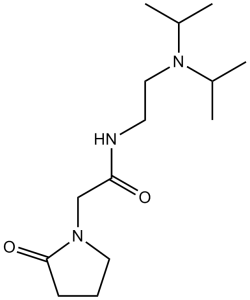
Pramiracetam (also known as CI-879) is investigated for its cognition-enhancing properties. A lower dosage of pramiracetam (100 mg/kg i.p.) was inadequate on NOS mRNA expression and chemical action. Interestingly, organization of pramiracetam (300 mg/kg i.p.) in rats pretreated (24 h before) with lithium chloride (LiCl) (3 mEq/kg i.p.) yielded a 40% expansion in cortical NOS action. Be that as it may, in LiCl-pretreated rats this nootropic neglected to influence cortical NOS mRNA expression; LiCl (3 mEq/kg i.p.) given alone delivered no impact. In summary, the present information show that pramiracetam given alone or in blend with LiCl builds NOS movement in mind cortical homogenates of rats and this might add to the components fundamental learning and memory change created by this nootropic.
Physicochemical Properties
| Molecular Formula | C14H27N3O2 | |
| Molecular Weight | 269.38 | |
| Exact Mass | 269.21 | |
| CAS # | 68497-62-1 | |
| Related CAS # |
|
|
| PubChem CID | 51712 | |
| Appearance | White to off-white solid powder | |
| Density | 1.0±0.1 g/cm3 | |
| Boiling Point | 461.0±30.0 °C at 760 mmHg | |
| Melting Point | 47 °C | |
| Flash Point | 232.6±24.6 °C | |
| Vapour Pressure | 0.0±1.1 mmHg at 25°C | |
| Index of Refraction | 1.495 | |
| LogP | 0.39 | |
| Hydrogen Bond Donor Count | 1 | |
| Hydrogen Bond Acceptor Count | 3 | |
| Rotatable Bond Count | 7 | |
| Heavy Atom Count | 19 | |
| Complexity | 308 | |
| Defined Atom Stereocenter Count | 0 | |
| InChi Key | ZULJGOSFKWFVRX-UHFFFAOYSA-N | |
| InChi Code | InChI=1S/C14H27N3O2/c1-11(2)17(12(3)4)9-7-15-13(18)10-16-8-5-6-14(16)19/h11-12H,5-10H2,1-4H3,(H,15,18) | |
| Chemical Name | N-(2-(diisopropylamino)ethyl)-2-(2-oxopyrrolidin-1-yl)acetamide | |
| Synonyms |
|
|
| HS Tariff Code | 2934.99.9001 | |
| Storage |
Powder-20°C 3 years 4°C 2 years In solvent -80°C 6 months -20°C 1 month |
|
| Shipping Condition | Room temperature (This product is stable at ambient temperature for a few days during ordinary shipping and time spent in Customs) |
Biological Activity
| ln Vivo | The effect of systemic administration of pramiracetam on neuronal type nitric oxide synthase (NOS) activity and NOS mRNA expression were studied in the hippocampus and cerebral cortex in rats. A dose of 300 mg/kg (i.p.) of this nootropic produced an approximately 20% increase in NOS activity in rat brain cortical homogenates but not in hippocampal homogenates; no significant changes were observed in NOS mRNA expression in the cortex and hippocampus. A lower dose of pramiracetam (100 mg/kg i.p.) was ineffective on NOS mRNA expression and enzyme activity. Interestingly, administration of pramiracetam (300 mg/kg i.p.) in rats pretreated (24 h before) with lithium chloride (LiCl) (3 mEq/kg i.p.) yielded a 40% increase in cortical NOS activity. However, in LiCl-pretreated rats this nootropic failed to affect cortical NOS mRNA expression; LiCl (3 mEq/kg i.p.) given alone produced no effect. In conclusion, the present data demonstrate that pramiracetam given alone or in combination with LiCl increases NOS activity in brain cortical homogenates of rats and this may contribute to the mechanisms underlying learning and memory improvement produced by this nootropic. |
| References | Neurology.1991Apr;41(4):570-4;Funct Neurol.1995 May-Jun;10(3):151-5. |
| Additional Infomation |
Pramiracetam is an organonitrogen compound and an organooxygen compound. It is functionally related to an alpha-amino acid. Pramiracetam has been previously approved in some eastern European countries under the brand names Pramistar, Neupramir, and Remen. It was also previously approved in the United States with orphan drug designation. Pramiracetam has been studied for the use in Alzheimer's disease and as an adjunct treatment to restore cognitive functioning post-electroconvulsive therapy in severe depression. |
Solubility Data
| Solubility (In Vitro) |
|
|||
| Solubility (In Vivo) |
Solubility in Formulation 1: ≥ 2.5 mg/mL (9.28 mM) (saturation unknown) in 10% DMSO + 40% PEG300 + 5% Tween80 + 45% Saline (add these co-solvents sequentially from left to right, and one by one), clear solution. For example, if 1 mL of working solution is to be prepared, you can add 100 μL of 25.0 mg/mL clear DMSO stock solution to 400 μL PEG300 and mix evenly; then add 50 μL Tween-80 to the above solution and mix evenly; then add 450 μL normal saline to adjust the volume to 1 mL. Preparation of saline: Dissolve 0.9 g of sodium chloride in 100 mL ddH₂ O to obtain a clear solution. Solubility in Formulation 2: ≥ 2.5 mg/mL (9.28 mM) (saturation unknown) in 10% DMSO + 90% (20% SBE-β-CD in Saline) (add these co-solvents sequentially from left to right, and one by one), clear solution. For example, if 1 mL of working solution is to be prepared, you can add 100 μL of 25.0 mg/mL clear DMSO stock solution to 900 μL of 20% SBE-β-CD physiological saline solution and mix evenly. Preparation of 20% SBE-β-CD in Saline (4°C,1 week): Dissolve 2 g SBE-β-CD in 10 mL saline to obtain a clear solution. Solubility in Formulation 3: ≥ 2.5 mg/mL (9.28 mM) (saturation unknown) in 10% DMSO + 90% Corn Oil (add these co-solvents sequentially from left to right, and one by one), clear solution. For example, if 1 mL of working solution is to be prepared, you can add 100 μL of 25.0 mg/mL clear DMSO stock solution to 900 μL of corn oil and mix evenly. Solubility in Formulation 4: 12.5 mg/mL (46.40 mM) in PBS (add these co-solvents sequentially from left to right, and one by one), clear solution; with ultrasonication. (Please use freshly prepared in vivo formulations for optimal results.) |
| Preparing Stock Solutions | 1 mg | 5 mg | 10 mg | |
| 1 mM | 3.7122 mL | 18.5611 mL | 37.1223 mL | |
| 5 mM | 0.7424 mL | 3.7122 mL | 7.4245 mL | |
| 10 mM | 0.3712 mL | 1.8561 mL | 3.7122 mL |