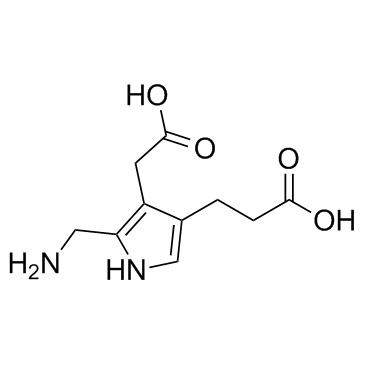
Physicochemical Properties
| Molecular Formula | C10H14N2O4 |
| Molecular Weight | 226.22916 |
| Exact Mass | 226.095 |
| CAS # | 487-90-1 |
| Related CAS # | Porphobilinogen-13C2 |
| PubChem CID | 1021 |
| Appearance | Off-white to light brown solid powder |
| Density | 1.421g/cm3 |
| Boiling Point | 478.6ºC at 760 mmHg |
| Melting Point | 174-177ºC |
| Flash Point | 243.2ºC |
| Vapour Pressure | 5.74E-10mmHg at 25°C |
| Index of Refraction | 1.621 |
| LogP | 0.818 |
| Hydrogen Bond Donor Count | 4 |
| Hydrogen Bond Acceptor Count | 5 |
| Rotatable Bond Count | 6 |
| Heavy Atom Count | 16 |
| Complexity | 270 |
| Defined Atom Stereocenter Count | 0 |
| InChi Key | QSHWIQZFGQKFMA-UHFFFAOYSA-N |
| InChi Code | InChI=1S/C10H14N2O4/c11-4-8-7(3-10(15)16)6(5-12-8)1-2-9(13)14/h5,12H,1-4,11H2,(H,13,14)(H,15,16) |
| Chemical Name | 3-[5-(aminomethyl)-4-(carboxymethyl)-1H-pyrrol-3-yl]propanoic acid |
| HS Tariff Code | 2934.99.9001 |
| Storage |
Powder-20°C 3 years 4°C 2 years In solvent -80°C 6 months -20°C 1 month |
| Shipping Condition | Room temperature (This product is stable at ambient temperature for a few days during ordinary shipping and time spent in Customs) |
Biological Activity
| ln Vitro | Porphobilinogen has the ability to function as a metabolic, neuro, and phototoxin. When phototoxins are exposed to light, they destroy cells. Nerve tissue and cells can sustain harm from neurotoxins. Endogenously generated compounds known as metabolic toxins have the potential to be harmful to health when present at prolonged high concentrations [1]. |
| References |
[1]. Neurotoxicity of tetraphenylporphinesulfonate TPPS4 and its relation to photodynamic therapy. Photochem Photobiol. 1987 Nov;46(5):801-7. |
| Additional Infomation |
Porphobilinogen is a dicarboxylic acid that is pyrole bearing aminomethyl, carboxymethyl and 2-carboxyethyl substituents at positions 2, 3 and 4 respectively. It has a role as a metabolite, an Escherichia coli metabolite and a mouse metabolite. It is a member of pyrroles, a dicarboxylic acid and an aralkylamino compound. It is a conjugate acid of a porphobilinogen(1-). Porphobilinogen is a pyrrole involved in porphyrin metabolism. It is generated by the enzyme ALA dehydratase, and converted into hydroxymethyl bilane by the enzyme porphobilinogen deaminase. Porphobilinogen is a metabolite found in or produced by Escherichia coli (strain K12, MG1655). Porphobilinogen has been reported in Homo sapiens, Brassica napus, and other organisms with data available. Porphobilinogen is a pyrrole involved in porphyrin metabolism. It consists of a pyrrole ring with acetyl, propionyl, and aminomethyl side chains; It is a key monopyrrolic intermediate in porphyrin, chlorophyll and vitamin B12 biosynthesis. Porphobilinogen is generated by the enzyme ALA dehydratase by combining two molecules of dALA together, and converted into hydroxymethyl bilane by the enzyme porphobilinogen deaminase. 4 molecules of porphobilinogen are condensed to form one molecule of uroporphyrinogen III, which is then converted successively to coproporphyrinogen III, protoporphyrin IX, and heme. Porphobilinogen is produced in excess and excreted in the urine in acute intermittent porphyria and several other porphyrias. Porphobilinogen is a metabolite found in or produced by Saccharomyces cerevisiae. |
Solubility Data
| Solubility (In Vitro) | May dissolve in DMSO (in most cases), if not, try other solvents such as H2O, Ethanol, or DMF with a minute amount of products to avoid loss of samples |
| Solubility (In Vivo) |
Note: Listed below are some common formulations that may be used to formulate products with low water solubility (e.g. < 1 mg/mL), you may test these formulations using a minute amount of products to avoid loss of samples. Injection Formulations (e.g. IP/IV/IM/SC) Injection Formulation 1: DMSO : Tween 80: Saline = 10 : 5 : 85 (i.e. 100 μL DMSO stock solution → 50 μL Tween 80 → 850 μL Saline) *Preparation of saline: Dissolve 0.9 g of sodium chloride in 100 mL ddH ₂ O to obtain a clear solution. Injection Formulation 2: DMSO : PEG300 :Tween 80 : Saline = 10 : 40 : 5 : 45 (i.e. 100 μL DMSO → 400 μLPEG300 → 50 μL Tween 80 → 450 μL Saline) Injection Formulation 3: DMSO : Corn oil = 10 : 90 (i.e. 100 μL DMSO → 900 μL Corn oil) Example: Take the Injection Formulation 3 (DMSO : Corn oil = 10 : 90) as an example, if 1 mL of 2.5 mg/mL working solution is to be prepared, you can take 100 μL 25 mg/mL DMSO stock solution and add to 900 μL corn oil, mix well to obtain a clear or suspension solution (2.5 mg/mL, ready for use in animals). Injection Formulation 4: DMSO : 20% SBE-β-CD in saline = 10 : 90 [i.e. 100 μL DMSO → 900 μL (20% SBE-β-CD in saline)] *Preparation of 20% SBE-β-CD in Saline (4°C,1 week): Dissolve 2 g SBE-β-CD in 10 mL saline to obtain a clear solution. Injection Formulation 5: 2-Hydroxypropyl-β-cyclodextrin : Saline = 50 : 50 (i.e. 500 μL 2-Hydroxypropyl-β-cyclodextrin → 500 μL Saline) Injection Formulation 6: DMSO : PEG300 : castor oil : Saline = 5 : 10 : 20 : 65 (i.e. 50 μL DMSO → 100 μLPEG300 → 200 μL castor oil → 650 μL Saline) Injection Formulation 7: Ethanol : Cremophor : Saline = 10: 10 : 80 (i.e. 100 μL Ethanol → 100 μL Cremophor → 800 μL Saline) Injection Formulation 8: Dissolve in Cremophor/Ethanol (50 : 50), then diluted by Saline Injection Formulation 9: EtOH : Corn oil = 10 : 90 (i.e. 100 μL EtOH → 900 μL Corn oil) Injection Formulation 10: EtOH : PEG300:Tween 80 : Saline = 10 : 40 : 5 : 45 (i.e. 100 μL EtOH → 400 μLPEG300 → 50 μL Tween 80 → 450 μL Saline) Oral Formulations Oral Formulation 1: Suspend in 0.5% CMC Na (carboxymethylcellulose sodium) Oral Formulation 2: Suspend in 0.5% Carboxymethyl cellulose Example: Take the Oral Formulation 1 (Suspend in 0.5% CMC Na) as an example, if 100 mL of 2.5 mg/mL working solution is to be prepared, you can first prepare 0.5% CMC Na solution by measuring 0.5 g CMC Na and dissolve it in 100 mL ddH2O to obtain a clear solution; then add 250 mg of the product to 100 mL 0.5% CMC Na solution, to make the suspension solution (2.5 mg/mL, ready for use in animals). Oral Formulation 3: Dissolved in PEG400 Oral Formulation 4: Suspend in 0.2% Carboxymethyl cellulose Oral Formulation 5: Dissolve in 0.25% Tween 80 and 0.5% Carboxymethyl cellulose Oral Formulation 6: Mixing with food powders Note: Please be aware that the above formulations are for reference only. InvivoChem strongly recommends customers to read literature methods/protocols carefully before determining which formulation you should use for in vivo studies, as different compounds have different solubility properties and have to be formulated differently. (Please use freshly prepared in vivo formulations for optimal results.) |
| Preparing Stock Solutions | 1 mg | 5 mg | 10 mg | |
| 1 mM | 4.4203 mL | 22.1014 mL | 44.2028 mL | |
| 5 mM | 0.8841 mL | 4.4203 mL | 8.8406 mL | |
| 10 mM | 0.4420 mL | 2.2101 mL | 4.4203 mL |