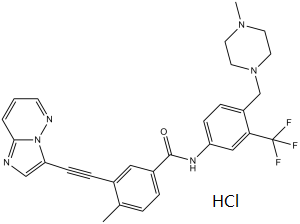
Ponatinib HCl (AP-24534 HCl; Iclusig), the hydrochloride salt of Ponatinib, is an orally bioavailable and multi-targeted kinase inhibitor approved by the US FDA on December 14, 2012 for the treatment of resistant or intolerant CML and Ph+ ALL. In cell-free assays, it inhibits Abl, PDGFRα, VEGFR2, FGFR1, and Src with IC50 values of 0.37 nM, 1.1 nM, 1.5 nM, 2.2 nM, and 5.4 nM, respectively. It might be used to treat acute lymphoblastic leukemia (ALL) and chronic myeloid leukemia (CML) in patients who have the Philadelphia chromosome (Ph+). Ponatinib inhibits both the unmutated and mutated forms of Bcr-Abl, including the highly drug-resistant missense mutation of Bcr-Abl, T315I. Moreover, it inhibits FMS-related tyrosine kinase receptor-3 (Flt3) and tyrosine kinase receptor TIE2.
Physicochemical Properties
| Molecular Formula | C29H28CLF3N6O |
| Molecular Weight | 569.03 |
| Exact Mass | 568.196 |
| Elemental Analysis | C, 61.21; H, 4.96; Cl, 6.23; F, 10.02; N, 14.77; O, 2.81 |
| CAS # | 1114544-31-8 |
| Related CAS # | Ponatinib;943319-70-8 |
| PubChem CID | 46908927 |
| Appearance | Off-white to light yellow solid powder |
| LogP | 5.206 |
| Hydrogen Bond Donor Count | 2 |
| Hydrogen Bond Acceptor Count | 8 |
| Rotatable Bond Count | 6 |
| Heavy Atom Count | 40 |
| Complexity | 910 |
| Defined Atom Stereocenter Count | 0 |
| SMILES | Cl.CN1CCN(CC2=CC=C(NC(C3=CC=C(C)C(C#CC4=CN=C5C=CC=NN45)=C3)=O)C=C2C(F)(F)F)CC1 |
| InChi Key | BWTNNZPNKQIADY-UHFFFAOYSA-N |
| InChi Code | InChI=1S/C29H27F3N6O.ClH/c1-20-5-6-22(16-21(20)8-10-25-18-33-27-4-3-11-34-38(25)27)28(39)35-24-9-7-23(26(17-24)29(30,31)32)19-37-14-12-36(2)13-15-37;/h3-7,9,11,16-18H,12-15,19H2,1-2H3,(H,35,39);1H |
| Chemical Name | 3-(2-imidazo[1,2-b]pyridazin-3-ylethynyl)-4-methyl-N-[4-[(4-methylpiperazin-1-yl)methyl]-3-(trifluoromethyl)phenyl]benzamide;hydrochloride |
| Synonyms | AP-24534 HCl; AP24534; AP 24534 HCl; Trade name: Iclusig |
| HS Tariff Code | 2934.99.9001 |
| Storage |
Powder-20°C 3 years 4°C 2 years In solvent -80°C 6 months -20°C 1 month Note: Please store this product in a sealed and protected environment, avoid exposure to moisture. |
| Shipping Condition | Room temperature (This product is stable at ambient temperature for a few days during ordinary shipping and time spent in Customs) |
Biological Activity
| Targets |
VEGFR2 (IC50 = 1.5 nM); FGFR1 (IC50 = 2.2 nM); PDGFRα (IC50 = 1.1 nM); Abl (IC50 = 0.37 nM); LYN (IC50 = 0.24 nM); Src (IC50 = 5.4 nM)
Ponatinib HCl (AP24534) acts as a pan-BCR-ABL inhibitor, targeting BCR-ABL (including the T315I mutant) [1] Ponatinib HCl (AP24534) inhibits native BCR-ABL and BCR-ABLT315I mutant kinase activity with low nanomolar IC50 values [2] Ponatinib HCl (AP24534) targets FLT3 (especially FLT3-ITD mutant), KIT, FGFR1, and PDGFRα, with IC50 values ranging from 0.3 to 20 nmol/L for inhibiting receptor phosphorylation and cellular proliferation; it has an IC50 of <10 nmol/L for FLT3 signaling inhibition and apoptosis induction in MV4-11 (FLT3-ITD+/+) AML cells, and an IC50 of 4 nmol/L for inhibiting viability of primary FLT3-ITD-positive AML blasts [3] Ponatinib HCl (AP24534) is a pan-FGFR inhibitor targeting FGFR1-4, with IC50 values <40 nmol/L for inhibiting FGFR-mediated signaling and viability in engineered Ba/F3 cells; it exhibits GI50 values of 7 to 181 nmol/L for inhibiting cell growth in FGFR-dysregulated tumor cell lines [4] |
| ln Vitro |
AP24534, with an IC50 of 0.30 nM–2 nM, potently inhibits clinically significant mutants of the Abl kinase domain, including AblT315I and native Abl. Insulin receptor, CDK2/cyclin E, and members of the Aurora kinase family are not inhibited by AP24534. The proliferation of Ba/F3 cells expressing Bcr-Abl with an IC50 of 0.5 nM and Ba/F3 cells expressing a variety of Bcr-Abl mutants with an IC50 of 0.5 nM–36 nM is inhibited by AP24534. Apoptosis induction is correlated with AP24534's inhibition of proliferation. AP24534, with an IC50 of 0.3 nM to 20 nM, potently inhibits receptor phosphorylation and cellular proliferation in leukemic cell lines containing activated forms of FLT3, KIT, FGFR1, and PDGFRα receptors. At less than 10 nM, AP24534 inhibits FLT3 signaling and induces apoptosis in MV4-11 (FLT3-ITD(+/+)) AML cells but not in RS4;11 (FLT3-ITD(–/–)) AML cells. Primary leukemic blasts from an AML patient who tests positive for FLT3-ITD are inhibited by AP24534 at an IC50 of 4 nM, but not those from patients whose AML expresses native FLT3.[3] AP24534 potently inhibits FGFR-mediated signaling and viability with an IC50 below 40 nM in Ba/F3 cells engineered to express activated FGFR1-4. AP24534 inhibits FGFR-mediated signaling with an IC50 of less than 40 nM and inhibits cell growth with an IC50 of 7 nM–181 nM in cell lines that represent multiple tumor types (endometrial, bladder, gastric, breast, lung, and colon) and contain FGFRs dysregulated by a variety of mechanisms.[4] Ponatinib HCl (AP24534) inhibited all tested BCR-ABL mutants in cellular and biochemical assays. In an in vitro [γ-32P]-ATP autophosphorylation assay, it suppressed the autophosphorylation of full-length ABL and ABLT315I kinase, while imatinib, nilotinib, and dasatinib showed no such effect on ABLT315I. In Ba/F3 cells expressing native BCR-ABL or BCR-ABLT315I, it inhibited CrkL phosphorylation (a marker of BCR-ABL activity) after 4-hour treatment. For primary CML cells, it inhibited proliferation of mononuclear cells from CML patients harboring native BCR-ABL or BCR-ABLT315I, suppressed CrkL phosphorylation and global tyrosine phosphorylation in BCR-ABLT315I-positive primary CML cells, and completely abrogated resistant outgrowth in ENU-treated Ba/F3 cell-based mutagenesis screens [1] Ponatinib HCl (AP24534) potently inhibited the kinase activity of both native BCR-ABL and BCR-ABLT315I mutant with low nanomolar IC50 values, and effectively suppressed the proliferation of corresponding Ba/F3-derived cell lines [2] Ponatinib HCl (AP24534) inhibited phosphorylation of FLT3, KIT, FGFR1, and PDGFRα in AML cell lines (MV4-11, Kasumi-1, KG1, EOL1) after 1-hour treatment, and reduced cell viability with IC50 values of 0.3 to 20 nmol/L in a 72-hour MTS assay. In MV4-11 (FLT3-ITD+/+) cells, it induced apoptosis at concentrations <10 nmol/L, as evidenced by increased caspase-3/7 activity, reduced phosphorylated STAT5 levels, and cleaved PARP; no such effects were observed in RS4;11 (FLT3-ITD-/-) cells. It inhibited viability of primary FLT3-ITD-positive AML blasts with an IC50 of 4 nmol/L but had no effect on primary AML cells expressing native FLT3 [3] Ponatinib HCl (AP24534) inhibited FGFR-mediated signaling and viability with IC50 values <40 nmol/L in Ba/F3 cells engineered to express activated FGFR1-4, with substantial selectivity over parental Ba/F3 cells. In a panel of 14 FGFR-dysregulated tumor cell lines (endometrial, bladder, gastric, breast, lung, colon), it suppressed FGFR-mediated signaling with IC50 values <40 nmol/L and inhibited cell growth with GI50 values of 7 to 181 nmol/L [4] |
| ln Vivo |
AP24534 (2.5 mg/kg and 5 mg/kg) increases mice median survival in a mouse xenograft model of Ba/F3 cells expressing native Bcr-Abl. AP24534 (10 mg/kg–50 mg/kg) dramatically inhibits tumor growth in the Ba/F3 Bcr-AblT315I xenograft model. AP24534 (30 mg/kg) reduces the amounts of phosphorylated CrkL and Bcr-Abl in the tumors. Oral administration of Ponatinib HCl (AP24534) significantly prolonged the survival of SCID mice intravenously injected with Ba/F3 cells expressing native BCR-ABL or BCR-ABLT315I (treatment: once daily oral gavage from days 3 to 21). In a subcutaneous xenograft model of Ba/F3 BCR-ABLT315I cells, daily oral dosing of AP24534 for 19 consecutive days caused a dose-dependent reduction in tumor volume (statistically significant compared to vehicle), and a single oral dose of 30 mg/kg AP24534 suppressed BCR-ABL and CrkL phosphorylation in tumor tissues [1] Daily oral administration of Ponatinib HCl (AP24534) markedly prolonged the survival of SCID mice intravenously injected with Ba/F3 cells expressing BCR-ABLT315I [2] In an MV4-11 (FLT3-ITD+/+) xenograft model, once daily oral dosing of Ponatinib HCl (AP24534) at 1, 2.5, 5, 10, and 25 mg/kg/d for 4 weeks led to a dose-dependent inhibition of FLT3 signaling and tumor regression. A single oral dose of ponatinib inhibited phosphorylation of FLT3 and STAT5 in tumor tissues 6 hours post-administration, with plasma drug levels correlating with the inhibitory effect [3] Daily oral dosing of Ponatinib HCl (AP24534) at 10-30 mg/kg reduced tumor growth and inhibited FGFR-mediated signaling in three FGFR-amplified or mutated cancer xenograft models (endometrial, bladder, gastric) [4] |
| Enzyme Assay |
The impact of AP24534 (0-320 nM) on the activity of GST-Abl kinase is measured with a synthetic peptide substrate (Abltide: EAIYAAPFAKKK). In 25 μL reaction mixture, assays are run for 15 minutes at 30 °C. The following were used: 8 mM MOPS (pH 7), 0.2 mM EDTA, 50 μM Abltide, 30 mM MgCl2, 10 mM β-glycerol phosphate, 1 mM EGTA, 0.002% Brij-35, 0.4 mM DTT, 0.2 mg/mL BSA, 0.4 mM sodium orthovanadate, 10 nM WT or mutant GST-Abl kinase, and 100 µM ATP/γ-32[P]ATP (5000 cpm/pmol). Transferring a part of the reaction mixture onto a p81 phosphocellulose filter and submerging it in 0.75% phosphoric acid is how reactions are stopped. Phosphate incorporation is assessed using scintillation counting after filters are air dried and cleaned three times in 0.75% phosphoric acid. After removing the peptide substrate from the kinase reaction, all data are adjusted for background binding to the filters. Kinase experiments come first, followed by time course studies to determine the linear range of enzymatic activity. For the autophosphorylation assay of ABL and ABLT315I kinase: Tyrosine-dephosphorylated full-length ABL or ABLT315I enzyme was incubated with Ponatinib HCl (AP24534), imatinib, nilotinib, or dasatinib in the presence of [γ-32P]-ATP. The reaction mixture was separated by SDS-PAGE, and the signal intensity of phosphorylated kinase was measured by autoradiography to evaluate the inhibitory effect of the compounds [1] |
| Cell Assay |
Ba/F3 cell lines are arranged in 96-well plates (4 × 10³ cells/well) and given a 72-hour incubation period with AP24534. A methanethiosulfonate (MTS)-based viability assay (CellTiter96 Aqueous One Solution) is used to measure proliferation. Every value is compared to the drug-free control wells. The mean of three separate, quadruplicat experiments is used to report IC50 values. 1. CrkL phosphorylation assay: Ba/F3 cells expressing native BCR-ABL or BCR-ABLT315I were treated with Ponatinib HCl (AP24534) or other inhibitors for 4 hours. Cells were harvested and lysed, and CrkL phosphorylation was analyzed by immunoblotting. The phosphorylated and non-phosphorylated forms of CrkL were resolved by electrophoretic mobility, and the percentage of phosphorylated CrkL was quantified by densitometry [1] 2. Primary CML cell proliferation assay: Mononuclear cells from CML patients (native BCR-ABL or BCR-ABLT315I) and healthy individuals were isolated and treated with Ponatinib HCl (AP24534) ex vivo. Cell viability was assessed, and the 50% cell viability threshold relative to untreated cells was used for reference [1] 3. Global tyrosine phosphorylation FACS assay: Primary CML mononuclear cells harboring BCR-ABLT315I were treated with inhibitors overnight, fixed and permeabilized, then incubated with a FITC-labeled anti-phosphorylated tyrosine antibody. The mean fluorescence intensity was measured by FACS and expressed as a fold increase relative to unstained controls [1] 4. Mutagenesis screen assay: ENU-treated Ba/F3 cells expressing native BCR-ABL or BCR-ABLT315I were cultured with graded concentrations of Ponatinib HCl (AP24534). Resistant clones were recovered, and the percentage of BCR-ABL kinase domain mutants among subclones was analyzed [1] 5. AML cell line kinase phosphorylation and viability assay: AML cell lines (MV4-11, Kasumi-1, KG1, EOL1) were incubated with graded concentrations of Ponatinib HCl (AP24534) for 1 hour, and lysates were immunoblotted for phosphorylated and total FLT3, KIT, FGFR1, or PDGFRα. For viability assessment, cells were treated with the compound for 72 hours, and an MTS assay was performed [3] 6. Apoptosis assay in MV4-11 cells: MV4-11 cells were treated with Ponatinib HCl (AP24534) at different concentrations, and caspase-3/7 activity was measured at indicated time points (expressed as fold induction relative to vehicle-treated cells). After 24-hour treatment, cells were lysed and immunoblotted for phosphorylated STAT5, total PARP, and cleaved PARP [3] 7. Primary AML blast viability assay: Primary leukemic blast cells from AML patients (FLT3-ITD positive or negative) were isolated and treated with Ponatinib HCl (AP24534) for 72 hours. Cell viability was assessed by MTS assay and normalized to untreated cells [3] 8. FGFR-engineered Ba/F3 cell assay: Ba/F3 cells engineered to express activated FGFR1-4 were treated with Ponatinib HCl (AP24534), and FGFR-mediated signaling (phosphorylation) and cell viability were evaluated [4] |
| Animal Protocol |
Mouse xenograft models of Ba/F3 cells expressing Bcr-Abl or Bcr-AblT315I 2.5 mg/kg and 5 mg/kg for Ba/F3 Bcr-Abl; 2.5 mg/kg–50 mg/kg for Ba/F3 Bcr-AblT315I Oral gavage once daily 1. SCID mouse tail vein injection model: Ba/F3 cells expressing native BCR-ABL or BCR-ABLT315I were injected into the tail vein of SCID mice. From days 3 to 21 post-injection, mice were treated once daily by oral gavage with vehicle, Ponatinib HCl (AP24534), or dasatinib, and survival was monitored [1] 2. Subcutaneous xenograft model of Ba/F3 BCR-ABLT315I: Tumor-bearing SCID mice were treated once daily by oral gavage with vehicle or graded doses of Ponatinib HCl (AP24534) for 19 consecutive days. Mean tumor volume was measured and plotted (with S.E.M.). For signaling analysis, mice were given a single oral dose of 30 mg/kg AP24534, and tumor tissues were harvested for immunoblotting of BCR-ABL and CrkL phosphorylation [1] 3. MV4-11 xenograft model: When MV4-11 flank xenograft tumors in mice reached approximately 200 mm³, mice were treated with once daily oral gavage of vehicle or Ponatinib HCl (AP24534) at doses of 1, 2.5, 5, 10, and 25 mg/kg/d for 4 weeks (10 mice per group), and mean tumor volumes were recorded. For single-dose analysis, tumor-bearing mice received a single oral dose of ponatinib (4 mice per group), tumors were harvested 6 hours later, and phosphorylated FLT3/STAT5 and plasma drug levels were measured [3] 4. FGFR-driven cancer xenograft model: Mice bearing FGFR-amplified or mutated tumor xenografts were treated with once daily oral gavage of Ponatinib HCl (AP24534) at 10-30 mg/kg. Tumor growth was monitored, and FGFR-mediated signaling in tumor tissues was analyzed by immunoblotting [4] |
| ADME/Pharmacokinetics |
Ponatinib HCl (AP24534) exhibits a favorable ADME profile [2] After a single oral dose of Ponatinib HCl (AP24534) to tumor-bearing mice, plasma concentrations of ponatinib were measured and correlated with the inhibitory effect on FLT3 phosphorylation in tumor tissues [3] Plasma levels of Ponatinib HCl (AP24534) that exceed the IC50 values for FGFR1-4 inhibition can be sustained in patients [4] |
| References |
[1]. Cancer Cell . 2009 Nov 6;16(5):401-12. [2]. J Med Chem . 2010 Jun 24;53(12):4701-19. [3]. Mol Cancer Ther . 2011 Jun;10(6):1028-35. [4]. Mol Cancer Ther . 2012 Mar;11(3):690-9. [5]. Blood . 2004 Oct 15;104(8):2532-9. |
| Additional Infomation |
Ponatinib hydrochloride is the hydrochloride salt of ponatinib. It is a potent pan inhibitor of tyrosine kinases, active in all single resistance ABL kinase mutations including the T315l mutation. It is approved for the treatment of chronic myeloid leukemia. It has a role as an antineoplastic agent and a tyrosine kinase inhibitor. It contains a ponatinib(1+). Ponatinib Hydrochloride is the hydrochloride salt form of an orally bioavailable multitargeted receptor tyrosine kinase (RTK) inhibitor with potential antiangiogenic and antineoplastic activities. Ponatinib inhibits unmutated and all mutated forms of Bcr-Abl, including T315I, the highly drug therapy-resistant missense mutation of Bcr-Abl. This agent also inhibits other tyrosine kinases including those associated with vascular endothelial growth factor receptors (VEGFRs) and fibroblast growth factor receptors (FGFRs); in addition, it inhibits the tyrosine kinase receptor TIE2 and FMS-related tyrosine kinase receptor-3 (Flt3). RTK inhibition by ponatinib may result in the inhibition of cellular proliferation and angiogenesis and may induce cell death. Bcr-Abl is a fusion tyrosine kinase encoded by the Philadelphia chromosome. See also: Ponatinib (has active moiety). Ponatinib HCl (AP24534) is a potent, orally available multitargeted kinase inhibitor designed to overcome T315I mutation-based resistance to BCR-ABL inhibitors. A key structural feature is the carbon-carbon triple bond linker that skirts the increased bulk of the Ile315 side chain in the T315I mutant. Its preclinical efficacy supports clinical evaluation as a pan-BCR-ABL inhibitor for chronic myeloid leukemia (CML) [1] Ponatinib HCl (AP24534) was discovered through structure-guided design and extensive SAR studies, with the carbon-carbon triple bond linker being critical for its activity against the BCR-ABLT315I mutant. It has potent oral activity and is a promising candidate for the treatment of CML, including patients refractory to currently approved therapies [2] In addition to inhibiting BCR-ABL, Ponatinib HCl (AP24534) potently targets FLT3 (especially FLT3-ITD), KIT, FGFR1, and PDGFRα, making it a potential therapeutic agent for FLT3-ITD-driven acute myeloid leukemia (AML) and other hematologic malignancies driven by these kinases [3] Ponatinib HCl (AP24534) is a potent pan-FGFR inhibitor with activity in multiple FGFR-amplified or mutated cancer models (endometrial, bladder, gastric, breast, lung, colon). Its potency in FGFR-driven models is comparable to that in BCR-ABL-driven models, supporting its evaluation in patients with FGFR-driven cancers [4] |
Solubility Data
| Solubility (In Vitro) |
|
|||
| Solubility (In Vivo) |
Solubility in Formulation 1: ≥ 2.5 mg/mL (4.39 mM) (saturation unknown) in 10% DMSO + 40% PEG300 + 5% Tween80 + 45% Saline (add these co-solvents sequentially from left to right, and one by one), clear solution. For example, if 1 mL of working solution is to be prepared, you can add 100 μL of 25.0 mg/mL clear DMSO stock solution to 400 μL PEG300 and mix evenly; then add 50 μL Tween-80 to the above solution and mix evenly; then add 450 μL normal saline to adjust the volume to 1 mL. Preparation of saline: Dissolve 0.9 g of sodium chloride in 100 mL ddH₂ O to obtain a clear solution. Solubility in Formulation 2: ≥ 2.5 mg/mL (4.39 mM) (saturation unknown) in 10% DMSO + 90% (20% SBE-β-CD in Saline) (add these co-solvents sequentially from left to right, and one by one), clear solution. For example, if 1 mL of working solution is to be prepared, you can add 100 μL of 25.0 mg/mL clear DMSO stock solution to 900 μL of 20% SBE-β-CD physiological saline solution and mix evenly. Preparation of 20% SBE-β-CD in Saline (4°C,1 week): Dissolve 2 g SBE-β-CD in 10 mL saline to obtain a clear solution. Solubility in Formulation 3: ≥ 2.5 mg/mL (4.39 mM) (saturation unknown) in 10% DMSO + 90% Corn Oil (add these co-solvents sequentially from left to right, and one by one), clear solution. For example, if 1 mL of working solution is to be prepared, you can add 100 μL of 25.0 mg/mL clear DMSO stock solution to 900 μL of corn oil and mix evenly. Solubility in Formulation 4: 30% PEG400+0.5% Tween80+5% propylene glycol: 30mg/mL (for HCl salt) (Please use freshly prepared in vivo formulations for optimal results.) |
| Preparing Stock Solutions | 1 mg | 5 mg | 10 mg | |
| 1 mM | 1.7574 mL | 8.7869 mL | 17.5738 mL | |
| 5 mM | 0.3515 mL | 1.7574 mL | 3.5148 mL | |
| 10 mM | 0.1757 mL | 0.8787 mL | 1.7574 mL |