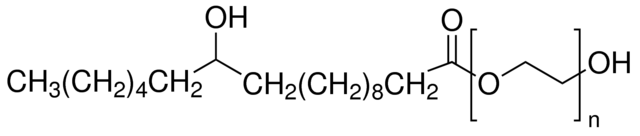
Polyoxyl 15 hydroxystearate (Solutol HS 15; poly-oxyethylene esters of 12-hydroxystearic acid) is a novel non-ionic surfactant and emulsifier used as a solubilizer in formulation of compounds with low water solubility. Essentially, it is used to enhance the water/aqueous solubility of Class 2 and 4 [Biopharmaceutical Classification System (BCS)] lipophilic molecules. It can also increase the permeability of medium sized biological molecules/drugs across epithelia.
Physicochemical Properties
| Molecular Formula | C₁₈H₃₆O₃(C₂H₄O)N |
| Molecular Weight | 963.237860000001 |
| CAS # | 70142-34-6 |
| Related CAS # | 61909-81-7 |
| PubChem CID | 121596032 |
| Appearance | Ointment |
| Density | 1.048 g/cm3 at 20 °C |
| Melting Point | 25-30 °C |
| Flash Point | 272 ℃ |
| LogP | 4.134 |
| Hydrogen Bond Donor Count | 3 |
| Hydrogen Bond Acceptor Count | 19 |
| Rotatable Bond Count | 60 |
| Heavy Atom Count | 65 |
| Complexity | 881 |
| Defined Atom Stereocenter Count | 0 |
| SMILES | C(CCCCC(CCCCCCOCCOCCOCCOCCOCCOCCOCCOCCOCCOCCOCCOCCOCCOCCOCCO)O)CCCCC(=O)O |
| InChi Key | CYAMZYIUAHNTBO-UHFFFAOYSA-N |
| InChi Code | 1S/C47H94O19/c48-15-17-53-19-21-55-23-25-57-27-29-59-31-33-61-35-37-63-39-41-65-43-45-66-44-42-64-40-38-62-36-34-60-32-30-58-28-26-56-24-22-54-20-18-52-16-11-7-6-9-13-46(49)12-8-4-2-1-3-5-10-14-47(50)51/h46,48-49H,1-45H2,(H,50,51) |
| Chemical Name | Polyoxyethylated 12-hydroxystearic acid |
| Synonyms | solutol HS 15; Polyoxyl 15 hydroxystearate ;Polyoxyl 15 hydroxystearate; Polyethylene glycol 12-hydroxystearate; Polyoxyethylated 12-hydroxystearic acid |
| HS Tariff Code | 2934.99.9001 |
| Storage |
Powder-20°C 3 years 4°C 2 years In solvent -80°C 6 months -20°C 1 month |
| Shipping Condition | Room temperature (This product is stable at ambient temperature for a few days during ordinary shipping and time spent in Customs) |
Biological Activity
| Targets | Surfactant; emulsifier; solubilizer |
| ln Vitro | This work initially confirms surfactant-like behaviour of Solutol® HS15 in aqueous media, while subsequent experiments demonstrate that the effect of Solutol® HS15 on epithelial tight junctions is different from a 'classical' tight junction opening agent and illustrate the effect of Solutol® HS15 on the cell membrane (endocytosis rate) and F-actin cytoskeleton. Conclusion: Solutol® HS15 is the principle component of CriticalSorb™ that has shown an enhancement in permeability of medium sized biological drugs across epithelia. This study suggests that its mechanism of action arises primarily from effects on the cell membrane and consequent impacts on the cell cytoskeleton in terms of actin organisation and tight junction opening[1]. |
| Cell Assay | Micelle size and CMC of Solutol® HS15 were determined in biologically relevant media. Polarised airway Calu-3 cell layers were used to measure the permeability of a panel of biological drugs, and to assess changes in TEER, tight junction and F-actin morphology. The rate of cell endocytosis was measured in vitro in the presence of Solutol® HS15 using a membrane probe, FM 2-10[1]. |
| References | Mechanism of mucosal permeability enhancement of CriticalSorb (Solutol HS15) investigated in vitro in cell cultures. Pharm Res. 2015 Feb;32(2):516-27. |
| Additional Infomation | CriticalSorb™, with the principal component Solutol® HS15, is a novel mucosal drug delivery system demonstrated to improve the bioavailability of selected biotherapeutics. The intention of this study is to elucidate mechanism(s) responsible for the enhancement of trans-mucosal absorption of biological drugs by Solutol® HS15. |
Solubility Data
| Solubility (In Vitro) | May dissolve in DMSO (in most cases), if not, try other solvents such as H2O, Ethanol, or DMF with a minute amount of products to avoid loss of samples |
| Solubility (In Vivo) |
Note: Listed below are some common formulations that may be used to formulate products with low water solubility (e.g. < 1 mg/mL), you may test these formulations using a minute amount of products to avoid loss of samples. Injection Formulations (e.g. IP/IV/IM/SC) Injection Formulation 1: DMSO : Tween 80: Saline = 10 : 5 : 85 (i.e. 100 μL DMSO stock solution → 50 μL Tween 80 → 850 μL Saline) *Preparation of saline: Dissolve 0.9 g of sodium chloride in 100 mL ddH ₂ O to obtain a clear solution. Injection Formulation 2: DMSO : PEG300 :Tween 80 : Saline = 10 : 40 : 5 : 45 (i.e. 100 μL DMSO → 400 μLPEG300 → 50 μL Tween 80 → 450 μL Saline) Injection Formulation 3: DMSO : Corn oil = 10 : 90 (i.e. 100 μL DMSO → 900 μL Corn oil) Example: Take the Injection Formulation 3 (DMSO : Corn oil = 10 : 90) as an example, if 1 mL of 2.5 mg/mL working solution is to be prepared, you can take 100 μL 25 mg/mL DMSO stock solution and add to 900 μL corn oil, mix well to obtain a clear or suspension solution (2.5 mg/mL, ready for use in animals). Injection Formulation 4: DMSO : 20% SBE-β-CD in saline = 10 : 90 [i.e. 100 μL DMSO → 900 μL (20% SBE-β-CD in saline)] *Preparation of 20% SBE-β-CD in Saline (4°C,1 week): Dissolve 2 g SBE-β-CD in 10 mL saline to obtain a clear solution. Injection Formulation 5: 2-Hydroxypropyl-β-cyclodextrin : Saline = 50 : 50 (i.e. 500 μL 2-Hydroxypropyl-β-cyclodextrin → 500 μL Saline) Injection Formulation 6: DMSO : PEG300 : castor oil : Saline = 5 : 10 : 20 : 65 (i.e. 50 μL DMSO → 100 μLPEG300 → 200 μL castor oil → 650 μL Saline) Injection Formulation 7: Ethanol : Cremophor : Saline = 10: 10 : 80 (i.e. 100 μL Ethanol → 100 μL Cremophor → 800 μL Saline) Injection Formulation 8: Dissolve in Cremophor/Ethanol (50 : 50), then diluted by Saline Injection Formulation 9: EtOH : Corn oil = 10 : 90 (i.e. 100 μL EtOH → 900 μL Corn oil) Injection Formulation 10: EtOH : PEG300:Tween 80 : Saline = 10 : 40 : 5 : 45 (i.e. 100 μL EtOH → 400 μLPEG300 → 50 μL Tween 80 → 450 μL Saline) Oral Formulations Oral Formulation 1: Suspend in 0.5% CMC Na (carboxymethylcellulose sodium) Oral Formulation 2: Suspend in 0.5% Carboxymethyl cellulose Example: Take the Oral Formulation 1 (Suspend in 0.5% CMC Na) as an example, if 100 mL of 2.5 mg/mL working solution is to be prepared, you can first prepare 0.5% CMC Na solution by measuring 0.5 g CMC Na and dissolve it in 100 mL ddH2O to obtain a clear solution; then add 250 mg of the product to 100 mL 0.5% CMC Na solution, to make the suspension solution (2.5 mg/mL, ready for use in animals). Oral Formulation 3: Dissolved in PEG400 Oral Formulation 4: Suspend in 0.2% Carboxymethyl cellulose Oral Formulation 5: Dissolve in 0.25% Tween 80 and 0.5% Carboxymethyl cellulose Oral Formulation 6: Mixing with food powders Note: Please be aware that the above formulations are for reference only. InvivoChem strongly recommends customers to read literature methods/protocols carefully before determining which formulation you should use for in vivo studies, as different compounds have different solubility properties and have to be formulated differently. (Please use freshly prepared in vivo formulations for optimal results.) |
| Preparing Stock Solutions | 1 mg | 5 mg | 10 mg | |
| 1 mM | 1.0382 mL | 5.1908 mL | 10.3816 mL | |
| 5 mM | 0.2076 mL | 1.0382 mL | 2.0763 mL | |
| 10 mM | 0.1038 mL | 0.5191 mL | 1.0382 mL |