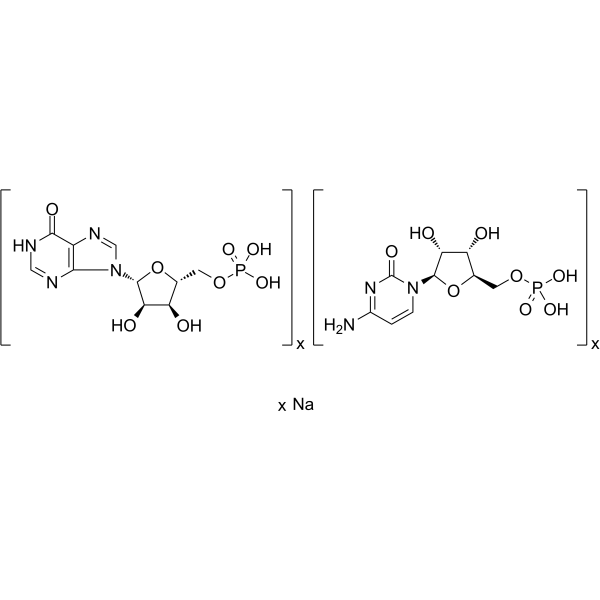
Polyinosinic-polycytidylic acid sodium (Poly(I:C) sodium) is an analog of double-stranded RNA and an agonist of toll-like receptor 3 (TLR3) and retinoic acid inducible gene I (RIG-I)-like receptors with the potential to be used as a vaccine adjuvant to enhance innate and adaptive immune responses, and to alter the tumor microenvironment. It can directly trigger cancer cells to undergo apoptosis.
Physicochemical Properties
| Molecular Formula | C19H27N7NAO16P2 |
| Molecular Weight | 694.392277002335 |
| Exact Mass | 694.088 |
| CAS # | 42424-50-0 |
| Related CAS # | Polyinosinic-polycytidylic acid;24939-03-5;Poly (I:C):Kanamycin (1:1) (sodium);Polyinosinic-polycytidylic acid potassium;31852-29-6 |
| PubChem CID | 137229713 |
| Appearance | White to off-white solid powder |
| Hydrogen Bond Donor Count | 10 |
| Hydrogen Bond Acceptor Count | 18 |
| Rotatable Bond Count | 8 |
| Heavy Atom Count | 45 |
| Complexity | 1090 |
| Defined Atom Stereocenter Count | 8 |
| SMILES | P(=O)(O)(O)OCC1C(C(C(N2C=NC3C(NC=NC2=3)=O)O1)O)O.P(=O)(O)(O)OCC1C(C(C(N2C(N=C(C=C2)N)=O)O1)O)O.[Na] |
| InChi Key | GETQKWBYQAUFQM-VRQAYDGLSA-N |
| InChi Code | InChI=1S/C10H13N4O8P.C9H14N3O8P.Na/c15-6-4(1-21-23(18,19)20)22-10(7(6)16)14-3-13-5-8(14)11-2-12-9(5)17;10-5-1-2-12(9(15)11-5)8-7(14)6(13)4(20-8)3-19-21(16,17)18;/h2-4,6-7,10,15-16H,1H2,(H,11,12,17)(H2,18,19,20);1-2,4,6-8,13-14H,3H2,(H2,10,11,15)(H2,16,17,18);/t4-,6-,7-,10-;4-,6-,7-,8-;/m11./s1 |
| HS Tariff Code | 2934.99.9001 |
| Storage |
Powder-20°C 3 years 4°C 2 years In solvent -80°C 6 months -20°C 1 month Note: Please store this product in a sealed and protected environment, avoid exposure to moisture. |
| Shipping Condition | Room temperature (This product is stable at ambient temperature for a few days during ordinary shipping and time spent in Customs) |
Biological Activity
| ln Vitro |
Polyinosinic-polycytidylic acid (20 ng/mL; 24 hours; WM793, WM278, WM239A, WM9, and 1205Lu cells) treatment dramatically decreased cell viability in a day, going from 100% of control to 20%–50%. %[1]. Treatment of 1205Lu cells with 200 ng/mL of polyinosinic-polycytidylic acid for 24 hours causes apoptosis in these cells.[1]. Melanoma cells treated with polyinosinic-polycytidylic acid (3 ng/mL; 24 hours; 1205Lu cells) express IFN-β. The stimulation of IFN-β by polyinosinic-polycytidylic acid requires IPS-1 and RIG-I and MDA-5, respectively, as demonstrated by the silencing of these two proteins [1]. In melanoma cells, treatment with polyinosinic-polycytidylic acid (5 ng/mL) for 24 hours revealed the presence of caspase-9 and caspase-8 active subunits [1]. Polyinosinic-polycytidylic acid sodium salt, ready for injection by resuspension in sterile saline at a concentration of 2 mg/mL, heated to 50 °C to guarantee total dissolution and allowed to naturally cool to room temperature to guarantee correct dissolution of double-stranded RNA annealing. Until used, polyinosinic-polycytidylic acid should be kept refrigerated at -20 °C [3]. |
| ln Vivo | When injected with 1205Lu cells, polyinosinic-polycytidylic acid prevents the formation of tumors in immunodeficient NOD/SCID animals. Mice treated with Polyinosinic-polycytidylic acid showed a 50% reduction in human DNA levels [1]. |
| Cell Assay |
Cell Viability Assay[1] Cell Types: WM793, WM278, WM239A, WM9 and 1205Lu cells Tested Concentrations: 20 ng/mL Incubation Duration: 24 hrs (hours) Experimental Results: Strongly decreased viability from 100% in controls to 20%–50% within 24 hrs (hours). Apoptosis Analysis[1] Cell Types: 1205Lu cells Tested Concentrations: 200 ng/mL Incubation Duration: 24 hrs (hours) Experimental Results: Induced apoptosis in 1205Lu cells. RT-PCR[1] Cell Types: 1205Lu cells Tested Concentrations: 3 ng/mL Incubation Duration: 24 hrs (hours) Experimental Results: Induced IFN-β expression in melanoma cells. Western Blot Analysis[1] Cell Types: 1205Lu cells Tested Concentrations: 5 ng/mL Incubation Duration: 24 hrs (hours) Experimental Results: Revealed active subunits of caspase-9 and caspase-8 in melanoma cells . |
| References |
[1]. Proapoptotic signaling induced by RIG-I and MDA-5 results in type I interferon-independent apoptosis in human melanoma cells. J Clin Invest. 2009 Aug;119(8):2399-411. [2]. Anticancer function of polyinosinic-polycytidylic acid. Cancer Biol Ther. 2010 Dec 15;10(12):1219-23. [3]. Systemic challenge with the TLR3 agonist poly I:C induces amplified IFNalpha/beta and IL-1beta responses in the diseased brain and exacerbates chronic neurodegeneration. Brain Behav Immun. 2010 Aug;24(6):996-1007. |
Solubility Data
| Solubility (In Vitro) | H2O : ~10 mg/mL |
| Solubility (In Vivo) |
Solubility in Formulation 1: 6.67 mg/mL (Infinity mM) in PBS (add these co-solvents sequentially from left to right, and one by one), clear solution; with sonication (<60°C). (Please use freshly prepared in vivo formulations for optimal results.) |
| Preparing Stock Solutions | 1 mg | 5 mg | 10 mg | |
| 1 mM | 1.4401 mL | 7.2006 mL | 14.4011 mL | |
| 5 mM | 0.2880 mL | 1.4401 mL | 2.8802 mL | |
| 10 mM | 0.1440 mL | 0.7201 mL | 1.4401 mL |