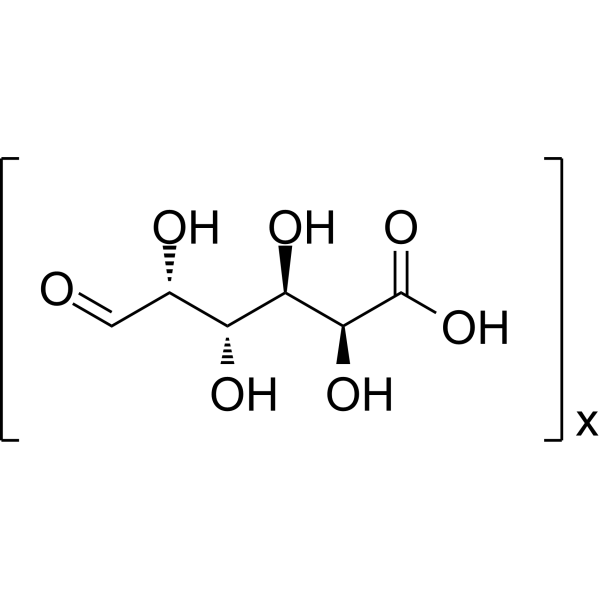
Physicochemical Properties
| Molecular Formula | C6H10O7 |
| Molecular Weight | 194.1394 |
| Exact Mass | 194.042 |
| CAS # | 25990-10-7 |
| Related CAS # | 25990-10-7 (homopolymer);9046-38-2 (Parent) |
| PubChem CID | 445929 |
| Appearance | Off-white to light yellow solid powder |
| Density | 1.7±0.1 g/cm3 |
| Boiling Point | 553.4±50.0 °C at 760 mmHg |
| Flash Point | 302.6±26.6 °C |
| Vapour Pressure | 0.0±3.4 mmHg at 25°C |
| Index of Refraction | 1.592 |
| LogP | -1.49 |
| Hydrogen Bond Donor Count | 5 |
| Hydrogen Bond Acceptor Count | 7 |
| Rotatable Bond Count | 1 |
| Heavy Atom Count | 13 |
| Complexity | 205 |
| Defined Atom Stereocenter Count | 5 |
| SMILES | [C@@H]1([C@H]([C@H](O[C@@H]([C@@H]1O)O)C(=O)O)O)O |
| InChi Key | AEMOLEFTQBMNLQ-BKBMJHBISA-N |
| InChi Code | InChI=1S/C6H10O7/c7-1-2(8)4(5(10)11)13-6(12)3(1)9/h1-4,6-9,12H,(H,10,11)/t1-,2+,3+,4-,6-/m0/s1 |
| Chemical Name | (2S,3R,4S,5R,6S)-3,4,5,6-tetrahydroxyoxane-2-carboxylic acid |
| HS Tariff Code | 2934.99.9001 |
| Storage |
Powder-20°C 3 years 4°C 2 years In solvent -80°C 6 months -20°C 1 month Note: This product requires protection from light (avoid light exposure) during transportation and storage. |
| Shipping Condition | Room temperature (This product is stable at ambient temperature for a few days during ordinary shipping and time spent in Customs) |
Biological Activity
| ln Vitro | Drug effects can be extended by forming long-lasting hydrogels with polygalacturonic acid. In laminectomized male adult rats, polygalacturonic acid hydrogel/hyaluronate, for example, coupled with ibuprofen, lowers tissue adhesion, inhibits epidural fibrosis, and enhances the effectiveness of local inflammation control. consequences of Profen [1]. L929 fibroblasts were not significantly affected by 2%, 200 μL, or 24 hours of polygalacturonic acid hydrogel/hyaluronate (PGA-HA) [1]. Polygalacturonic acid (PGA) (Ag-PGA/HA)-PVA nanoparticles were prepared, and they demonstrated antibacterial activity against Gram-negative strains of Escherichia coli as well as Gram-positive strains of Bacillus subtilis and Staphylococcus aureus [2]. |
| ln Vivo | Polygalacturonic acid (topical; 14 days) promotes rapid healing of wound infections in albino rats [2]. |
| Animal Protocol |
Animal/Disease Models: Albino rat full-thickness wound model (60 days old, 180 grams) [2] Usage and Doses: Silver polygalacturonic acid/hyaluronic acid nanoparticles Route of Administration: Apply to dorsal myofascia; use alcohol every day Clean the wound; 14-day Experimental Results: No signs of abscess formation or hypertrophic scarring in the early stages; Day 5 or final stage; Day 14 respectively. Treatment with (Ag-PGA/HA)-PVA nanofibers and blank (PGA/HA)-PVA nanofibers demonstrated significant wound healing from day 8 and induced epithelialization at day 14. |
| References |
[1]. Ibuprofen-conjugated hyaluronate/polygalacturonic acid hydrogel for the prevention of epidural fibrosis. J Biomater Appl. 2016 May;30(10):1589-600. [2]. Wound healing of nanofiber comprising Polygalacturonic/Hyaluronic acid embedded silver nanoparticles: In-vitro and in-vivo studies. Carbohydr Polym. 2020 Jun 15;238:116175. |
| Additional Infomation |
Pectin is any mixture of complex, colloidal, macromolecular plant galacturonans containing a large proportion of D-galactopyranosyluronic acid residues in alpha-(1->4) linkage, the carboxy groups of which may be esterified to varying degrees by methyl groups or be partially or completely converted into salts. The structure shown is that of the parent polygalacturonan. It has a role as an antidiarrhoeal drug, a food stabiliser, a food emulsifier, a food thickening agent, a food gelling agent, a plant metabolite and a Saccharomyces cerevisiae metabolite. It is a mixture and a galacturonan. It is a conjugate acid of a pectate. The α-anomer of D-galacturonic acid. alpha-D-galactopyranuronic acid has been reported in Primula veris and Caenorhabditis elegans with data available. alpha-D-galactopyranuronic acid has been reported in Primula veris and Caenorhabditis elegans with data available. See also: Biosaccharide GUM-1 (monomer of); Belapectin (monomer of); Polygalacturonic acid (monomer of) ... View More ... |
Solubility Data
| Solubility (In Vitro) | H2O : ~5 mg/mL |
| Solubility (In Vivo) |
Note: Listed below are some common formulations that may be used to formulate products with low water solubility (e.g. < 1 mg/mL), you may test these formulations using a minute amount of products to avoid loss of samples. Injection Formulations (e.g. IP/IV/IM/SC) Injection Formulation 1: DMSO : Tween 80: Saline = 10 : 5 : 85 (i.e. 100 μL DMSO stock solution → 50 μL Tween 80 → 850 μL Saline) *Preparation of saline: Dissolve 0.9 g of sodium chloride in 100 mL ddH ₂ O to obtain a clear solution. Injection Formulation 2: DMSO : PEG300 :Tween 80 : Saline = 10 : 40 : 5 : 45 (i.e. 100 μL DMSO → 400 μLPEG300 → 50 μL Tween 80 → 450 μL Saline) Injection Formulation 3: DMSO : Corn oil = 10 : 90 (i.e. 100 μL DMSO → 900 μL Corn oil) Example: Take the Injection Formulation 3 (DMSO : Corn oil = 10 : 90) as an example, if 1 mL of 2.5 mg/mL working solution is to be prepared, you can take 100 μL 25 mg/mL DMSO stock solution and add to 900 μL corn oil, mix well to obtain a clear or suspension solution (2.5 mg/mL, ready for use in animals). Injection Formulation 4: DMSO : 20% SBE-β-CD in saline = 10 : 90 [i.e. 100 μL DMSO → 900 μL (20% SBE-β-CD in saline)] *Preparation of 20% SBE-β-CD in Saline (4°C,1 week): Dissolve 2 g SBE-β-CD in 10 mL saline to obtain a clear solution. Injection Formulation 5: 2-Hydroxypropyl-β-cyclodextrin : Saline = 50 : 50 (i.e. 500 μL 2-Hydroxypropyl-β-cyclodextrin → 500 μL Saline) Injection Formulation 6: DMSO : PEG300 : castor oil : Saline = 5 : 10 : 20 : 65 (i.e. 50 μL DMSO → 100 μLPEG300 → 200 μL castor oil → 650 μL Saline) Injection Formulation 7: Ethanol : Cremophor : Saline = 10: 10 : 80 (i.e. 100 μL Ethanol → 100 μL Cremophor → 800 μL Saline) Injection Formulation 8: Dissolve in Cremophor/Ethanol (50 : 50), then diluted by Saline Injection Formulation 9: EtOH : Corn oil = 10 : 90 (i.e. 100 μL EtOH → 900 μL Corn oil) Injection Formulation 10: EtOH : PEG300:Tween 80 : Saline = 10 : 40 : 5 : 45 (i.e. 100 μL EtOH → 400 μLPEG300 → 50 μL Tween 80 → 450 μL Saline) Oral Formulations Oral Formulation 1: Suspend in 0.5% CMC Na (carboxymethylcellulose sodium) Oral Formulation 2: Suspend in 0.5% Carboxymethyl cellulose Example: Take the Oral Formulation 1 (Suspend in 0.5% CMC Na) as an example, if 100 mL of 2.5 mg/mL working solution is to be prepared, you can first prepare 0.5% CMC Na solution by measuring 0.5 g CMC Na and dissolve it in 100 mL ddH2O to obtain a clear solution; then add 250 mg of the product to 100 mL 0.5% CMC Na solution, to make the suspension solution (2.5 mg/mL, ready for use in animals). Oral Formulation 3: Dissolved in PEG400 Oral Formulation 4: Suspend in 0.2% Carboxymethyl cellulose Oral Formulation 5: Dissolve in 0.25% Tween 80 and 0.5% Carboxymethyl cellulose Oral Formulation 6: Mixing with food powders Note: Please be aware that the above formulations are for reference only. InvivoChem strongly recommends customers to read literature methods/protocols carefully before determining which formulation you should use for in vivo studies, as different compounds have different solubility properties and have to be formulated differently. (Please use freshly prepared in vivo formulations for optimal results.) |
| Preparing Stock Solutions | 1 mg | 5 mg | 10 mg | |
| 1 mM | 5.1509 mL | 25.7546 mL | 51.5092 mL | |
| 5 mM | 1.0302 mL | 5.1509 mL | 10.3018 mL | |
| 10 mM | 0.5151 mL | 2.5755 mL | 5.1509 mL |