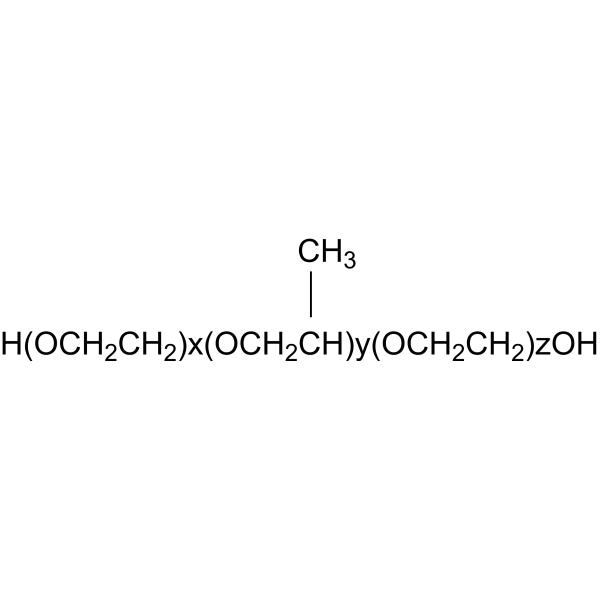
Physicochemical Properties
| Molecular Formula | C3H6O.C2H4O |
| Molecular Weight | 102.132 |
| Exact Mass | 102.0680 |
| CAS # | 691397-13-4 |
| Related CAS # | 691397-13-4;126925-06-2;697765-47-2;9003-11-6;106392-12-5 |
| PubChem CID | 24751 |
| Appearance | Typically exists as solid at room temperature |
| Hydrogen Bond Donor Count | 0 |
| Hydrogen Bond Acceptor Count | 2 |
| Rotatable Bond Count | 0 |
| Heavy Atom Count | 7 |
| Complexity | 36.7 |
| Defined Atom Stereocenter Count | 0 |
| SMILES | CC1CO1.C1CO1 |
| InChi Key | RVGRUAULSDPKGF-UHFFFAOYSA-N |
| InChi Code | InChI=1S/C3H6O.C2H4O/c1-3-2-4-3;1-2-3-1/h3H,2H2,1H3;1-2H2 |
| Chemical Name | 2-methyloxirane;oxirane |
| Synonyms | Poloxalene; Poloxamer 188; POLOXAMER; Poloxamer 407; 106392-12-5; Pluronic F-68; TERGITOL(TM)XH(NONIONIC); ...; 691397-13-4; |
| HS Tariff Code | 2934.99.9001 |
| Storage |
Powder-20°C 3 years 4°C 2 years In solvent -80°C 6 months -20°C 1 month |
| Shipping Condition | Room temperature (This product is stable at ambient temperature for a few days during ordinary shipping and time spent in Customs) |
Biological Activity
| Targets | Surfactant |
| ln Vitro | Poloxamer is an epoxide. Poloxamer is a non-ionic triblock copolymer comprised of a hydrophobic core of polyoxypropylene flanked by two hydrophilic side chains of polyoxyethylene, that may be used as a fixative and as solubilizer, emulsifier and stabilizer in drug delivery systems. A nonionic polyoxyethylene-polyoxypropylene block co-polymer with the general formula HO(C2H4O)a(-C3H6O)b(C2H4O)aH. It is available in different grades which vary from liquids to solids. It is used as an emulsifying agent, solubilizing agent, surfactant, and wetting agent for antibiotics. Poloxamer is also used in ointment and suppository bases and as a tablet binder or coater. |
| References | [1]. Pharmaceutical excipients - quality, regulatory and biopharmaceutical considerations. Eur J Pharm Sci. 2016 May 25;87:88-99. |
| Additional Infomation |
Poloxamer is an epoxide. Poloxamer is a non-ionic triblock copolymer comprised of a hydrophobic core of polyoxypropylene flanked by two hydrophilic side chains of polyoxyethylene, that may be used as a fixative and as solubilizer, emulsifier and stabilizer in drug delivery systems. See also: Poloxalene (annotation moved to); Poloxamer 188 (annotation moved to); Poloxamer 331 (annotation moved to) ... Surface-Active Agents Agents that modify interfacial tension of water; usually substances that have one lipophilic and one hydrophilic group in the molecule; includes soaps, detergents, emulsifiers, dispersing and wetting agents, and several groups of antiseptics. Excipients Usually inert substances added to a prescription in order to provide suitable consistency to the dosage form. These include binders, matrix, base or diluent in pills, tablets, creams, salves, etc. |
Solubility Data
| Solubility (In Vitro) | May dissolve in DMSO (in most cases), if not, try other solvents such as H2O, Ethanol, or DMF with a minute amount of products to avoid loss of samples |
| Solubility (In Vivo) |
Note: Listed below are some common formulations that may be used to formulate products with low water solubility (e.g. < 1 mg/mL), you may test these formulations using a minute amount of products to avoid loss of samples. Injection Formulations (e.g. IP/IV/IM/SC) Injection Formulation 1: DMSO : Tween 80: Saline = 10 : 5 : 85 (i.e. 100 μL DMSO stock solution → 50 μL Tween 80 → 850 μL Saline) *Preparation of saline: Dissolve 0.9 g of sodium chloride in 100 mL ddH ₂ O to obtain a clear solution. Injection Formulation 2: DMSO : PEG300 :Tween 80 : Saline = 10 : 40 : 5 : 45 (i.e. 100 μL DMSO → 400 μLPEG300 → 50 μL Tween 80 → 450 μL Saline) Injection Formulation 3: DMSO : Corn oil = 10 : 90 (i.e. 100 μL DMSO → 900 μL Corn oil) Example: Take the Injection Formulation 3 (DMSO : Corn oil = 10 : 90) as an example, if 1 mL of 2.5 mg/mL working solution is to be prepared, you can take 100 μL 25 mg/mL DMSO stock solution and add to 900 μL corn oil, mix well to obtain a clear or suspension solution (2.5 mg/mL, ready for use in animals). Injection Formulation 4: DMSO : 20% SBE-β-CD in saline = 10 : 90 [i.e. 100 μL DMSO → 900 μL (20% SBE-β-CD in saline)] *Preparation of 20% SBE-β-CD in Saline (4°C,1 week): Dissolve 2 g SBE-β-CD in 10 mL saline to obtain a clear solution. Injection Formulation 5: 2-Hydroxypropyl-β-cyclodextrin : Saline = 50 : 50 (i.e. 500 μL 2-Hydroxypropyl-β-cyclodextrin → 500 μL Saline) Injection Formulation 6: DMSO : PEG300 : castor oil : Saline = 5 : 10 : 20 : 65 (i.e. 50 μL DMSO → 100 μLPEG300 → 200 μL castor oil → 650 μL Saline) Injection Formulation 7: Ethanol : Cremophor : Saline = 10: 10 : 80 (i.e. 100 μL Ethanol → 100 μL Cremophor → 800 μL Saline) Injection Formulation 8: Dissolve in Cremophor/Ethanol (50 : 50), then diluted by Saline Injection Formulation 9: EtOH : Corn oil = 10 : 90 (i.e. 100 μL EtOH → 900 μL Corn oil) Injection Formulation 10: EtOH : PEG300:Tween 80 : Saline = 10 : 40 : 5 : 45 (i.e. 100 μL EtOH → 400 μLPEG300 → 50 μL Tween 80 → 450 μL Saline) Oral Formulations Oral Formulation 1: Suspend in 0.5% CMC Na (carboxymethylcellulose sodium) Oral Formulation 2: Suspend in 0.5% Carboxymethyl cellulose Example: Take the Oral Formulation 1 (Suspend in 0.5% CMC Na) as an example, if 100 mL of 2.5 mg/mL working solution is to be prepared, you can first prepare 0.5% CMC Na solution by measuring 0.5 g CMC Na and dissolve it in 100 mL ddH2O to obtain a clear solution; then add 250 mg of the product to 100 mL 0.5% CMC Na solution, to make the suspension solution (2.5 mg/mL, ready for use in animals). Oral Formulation 3: Dissolved in PEG400 Oral Formulation 4: Suspend in 0.2% Carboxymethyl cellulose Oral Formulation 5: Dissolve in 0.25% Tween 80 and 0.5% Carboxymethyl cellulose Oral Formulation 6: Mixing with food powders Note: Please be aware that the above formulations are for reference only. InvivoChem strongly recommends customers to read literature methods/protocols carefully before determining which formulation you should use for in vivo studies, as different compounds have different solubility properties and have to be formulated differently. (Please use freshly prepared in vivo formulations for optimal results.) |
| Preparing Stock Solutions | 1 mg | 5 mg | 10 mg | |
| 1 mM | 9.7914 mL | 48.9572 mL | 97.9144 mL | |
| 5 mM | 1.9583 mL | 9.7914 mL | 19.5829 mL | |
| 10 mM | 0.9791 mL | 4.8957 mL | 9.7914 mL |