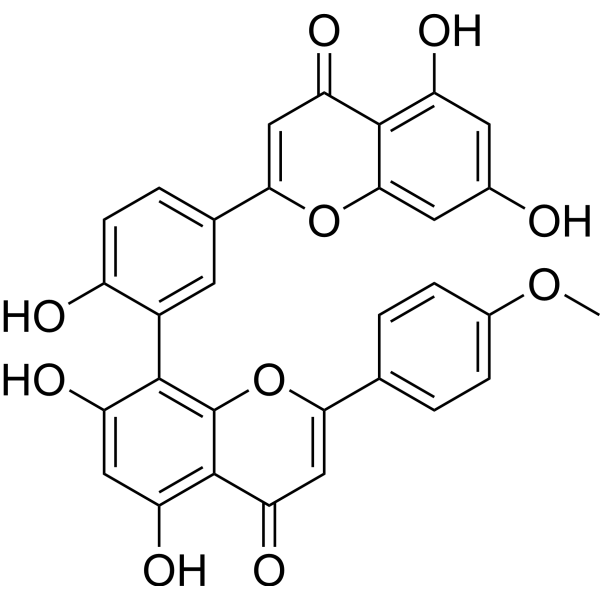
Physicochemical Properties
| Molecular Formula | C31H20O10 |
| Molecular Weight | 552.4845 |
| Exact Mass | 552.105 |
| Elemental Analysis | C, 67.39; H, 3.65; O, 28.96 |
| CAS # | 22136-74-9 |
| PubChem CID | 5320644 |
| Appearance | Light yellow to green yellow solid powder |
| Density | 1.6±0.1 g/cm3 |
| Boiling Point | 879.3±65.0 °C at 760 mmHg |
| Flash Point | 295.2±27.8 °C |
| Vapour Pressure | 0.0±0.3 mmHg at 25°C |
| Index of Refraction | 1.750 |
| LogP | 4.15 |
| Hydrogen Bond Donor Count | 5 |
| Hydrogen Bond Acceptor Count | 10 |
| Rotatable Bond Count | 4 |
| Heavy Atom Count | 41 |
| Complexity | 1060 |
| Defined Atom Stereocenter Count | 0 |
| InChi Key | RBTRUVNXLDXHBJ-UHFFFAOYSA-N |
| InChi Code | InChI=1S/C31H20O10/c1-39-17-5-2-14(3-6-17)25-13-24(38)30-22(36)11-21(35)28(31(30)41-25)18-8-15(4-7-19(18)33)26-12-23(37)29-20(34)9-16(32)10-27(29)40-26/h2-13,32-36H,1H3 |
| Chemical Name | 8-[5-(5,7-dihydroxy-4-oxochromen-2-yl)-2-hydroxyphenyl]-5,7-dihydroxy-2-(4-methoxyphenyl)chromen-4-one |
| Synonyms | Podocarpusflavone A; 22136-74-9; 41583-83-9; 8-[5-(5,7-dihydroxy-4-oxochromen-2-yl)-2-hydroxyphenyl]-5,7-dihydroxy-2-(4-methoxyphenyl)chromen-4-one; 8-(5-(5,7-dihydroxy-4-oxo-4H-chromen-2-yl)-2-hydroxyphenyl)-5,7-dihydroxy-2-(4-methoxyphenyl)-4H-chromen-4-one; 8-[5-(5,7-dihydroxy-4-oxo-chromen-2-yl)-2-hydroxy-phenyl]-5,7-dihydroxy-2-(4-methoxyphenyl)chromen-4-one; Podocarpusflavonea; 8-[5-(5,7-dihydroxy-4-oxo-4H-chromen-2-yl)-2-hydroxyphenyl]-5,7-dihydroxy-2-(4-methoxyphenyl)-4H-chromen-4-one; |
| HS Tariff Code | 2934.99.9001 |
| Storage |
Powder-20°C 3 years 4°C 2 years In solvent -80°C 6 months -20°C 1 month Note: This product requires protection from light (avoid light exposure) during transportation and storage. |
| Shipping Condition | Room temperature (This product is stable at ambient temperature for a few days during ordinary shipping and time spent in Customs) |
Biological Activity
| Targets | Natural biflavonoid; antioxidative; anti-inflammatory; anti-viral; anti-tumor; Topoisomerase I (IC50 = 119.425 μM) |
| ln Vitro |
Bioassay-guided fractionation of the EtOH extract of the dried twigs of Podocarpus nakaii Hayata (Podocarpaceae), endemic plant in Taiwan has resulted in isolation of four [3'→8″]-biflavonoid derivatives, amenotoflavone (AF), podocarpusflavone-A (PF), II-4″,I-7-dimethoxyamentoflavone (DAF), and heveaflavone (HF). Their structures were determined by physical and extensive spectroscopic analyses such as (1)H, (13)C, (1)H-(1)H COSY, HMQC, and HMBC, as well as comparison with literature values. Compounds PF and DAF showed significant inhibitions against DLD, KB, MCF-7, HEp-2 tumor cell lines (ED50 ca. 4.56-16.24 μg/mL) and induced cell apoptosis in MCF-7 via mainly sub-G1/S phase arrest. Furthermore, these compounds exhibited moderate Topoisomerase I inhibitory activity[1]. Podocarpusflavone A (2.5 μM–40 μM) exhibited dose-dependent cytotoxicity against multiple human cancer cell lines. It showed the highest potency against HepG2 (human hepatocellular carcinoma) cells with an IC50 of 12.5 ± 1.3 μM; moderate activity against A549 (human lung adenocarcinoma, IC50 = 15.8 ± 1.5 μM), HT-29 (human colorectal carcinoma, IC50 = 14.3 ± 1.4 μM), and MCF-7 (human breast adenocarcinoma, IC50 = 18.2 ± 1.7 μM) cells after 72 hours of treatment [1] At the concentration of 40 μM, Podocarpusflavone A inhibited the proliferation of HepG2, A549, HT-29, and MCF-7 cells by 89.6% ± 3.2%, 82.3% ± 2.8%, 85.7% ± 3.0%, and 79.5% ± 2.6% respectively [1] |
| Cell Assay |
Human cancer cell proliferation inhibition assay: Four human cancer cell lines (HepG2, A549, HT-29, MCF-7) were separately seeded in 96-well plates at a density of 5 × 10³ cells/well and incubated for 24 hours to allow cell attachment. Podocarpusflavone A was dissolved in dimethyl sulfoxide (DMSO) and diluted with culture medium to prepare serial concentrations (2.5 μM–40 μM) with a final DMSO concentration <0.1%. The cells were treated with the compound solutions or vehicle control (culture medium + 0.1% DMSO) for 72 hours at 37°C in a 5% CO₂ incubator. After incubation, a colorimetric reagent was added to each well, and the plates were incubated for another 4 hours. The absorbance was measured at 570 nm, and cell viability was calculated relative to the control group. IC50 values were determined by fitting the dose-response curves [1] |
| References |
[1]. Naturally Occurring Cytotoxic [3′→8″]-Biflavonoids from Podocarpus nakaii J Tradit Complement Med. 2012 Jul;2(3):220-6. |
| Additional Infomation |
Podocarpusflavone a is a flavonoid oligomer. Podocarpusflavone A has been reported in Garcinia intermedia, Garcinia subelliptica, and other organisms with data available. Podocarpusflavone A is a naturally occurring [3′→8″]-biflavonoid isolated from the plant Podocarpus nakaii (Taiwan podocarp) [1] As a biflavonoid derivative, it possesses inherent cytotoxic activity against various human cancer cell lines, indicating potential application in the development of anticancer agents [1] The compound’s cytotoxic mechanism its structure belongs to the biflavonoid class, which is known to exert anticancer effects through multiple pathways such as inducing apoptosis, inhibiting cell cycle progression, or modulating signal transduction pathways [1] |
Solubility Data
| Solubility (In Vitro) | May dissolve in DMSO (in most cases), if not, try other solvents such as H2O, Ethanol, or DMF with a minute amount of products to avoid loss of samples |
| Solubility (In Vivo) |
Note: Listed below are some common formulations that may be used to formulate products with low water solubility (e.g. < 1 mg/mL), you may test these formulations using a minute amount of products to avoid loss of samples. Injection Formulations (e.g. IP/IV/IM/SC) Injection Formulation 1: DMSO : Tween 80: Saline = 10 : 5 : 85 (i.e. 100 μL DMSO stock solution → 50 μL Tween 80 → 850 μL Saline) *Preparation of saline: Dissolve 0.9 g of sodium chloride in 100 mL ddH ₂ O to obtain a clear solution. Injection Formulation 2: DMSO : PEG300 :Tween 80 : Saline = 10 : 40 : 5 : 45 (i.e. 100 μL DMSO → 400 μLPEG300 → 50 μL Tween 80 → 450 μL Saline) Injection Formulation 3: DMSO : Corn oil = 10 : 90 (i.e. 100 μL DMSO → 900 μL Corn oil) Example: Take the Injection Formulation 3 (DMSO : Corn oil = 10 : 90) as an example, if 1 mL of 2.5 mg/mL working solution is to be prepared, you can take 100 μL 25 mg/mL DMSO stock solution and add to 900 μL corn oil, mix well to obtain a clear or suspension solution (2.5 mg/mL, ready for use in animals). Injection Formulation 4: DMSO : 20% SBE-β-CD in saline = 10 : 90 [i.e. 100 μL DMSO → 900 μL (20% SBE-β-CD in saline)] *Preparation of 20% SBE-β-CD in Saline (4°C,1 week): Dissolve 2 g SBE-β-CD in 10 mL saline to obtain a clear solution. Injection Formulation 5: 2-Hydroxypropyl-β-cyclodextrin : Saline = 50 : 50 (i.e. 500 μL 2-Hydroxypropyl-β-cyclodextrin → 500 μL Saline) Injection Formulation 6: DMSO : PEG300 : castor oil : Saline = 5 : 10 : 20 : 65 (i.e. 50 μL DMSO → 100 μLPEG300 → 200 μL castor oil → 650 μL Saline) Injection Formulation 7: Ethanol : Cremophor : Saline = 10: 10 : 80 (i.e. 100 μL Ethanol → 100 μL Cremophor → 800 μL Saline) Injection Formulation 8: Dissolve in Cremophor/Ethanol (50 : 50), then diluted by Saline Injection Formulation 9: EtOH : Corn oil = 10 : 90 (i.e. 100 μL EtOH → 900 μL Corn oil) Injection Formulation 10: EtOH : PEG300:Tween 80 : Saline = 10 : 40 : 5 : 45 (i.e. 100 μL EtOH → 400 μLPEG300 → 50 μL Tween 80 → 450 μL Saline) Oral Formulations Oral Formulation 1: Suspend in 0.5% CMC Na (carboxymethylcellulose sodium) Oral Formulation 2: Suspend in 0.5% Carboxymethyl cellulose Example: Take the Oral Formulation 1 (Suspend in 0.5% CMC Na) as an example, if 100 mL of 2.5 mg/mL working solution is to be prepared, you can first prepare 0.5% CMC Na solution by measuring 0.5 g CMC Na and dissolve it in 100 mL ddH2O to obtain a clear solution; then add 250 mg of the product to 100 mL 0.5% CMC Na solution, to make the suspension solution (2.5 mg/mL, ready for use in animals). Oral Formulation 3: Dissolved in PEG400 Oral Formulation 4: Suspend in 0.2% Carboxymethyl cellulose Oral Formulation 5: Dissolve in 0.25% Tween 80 and 0.5% Carboxymethyl cellulose Oral Formulation 6: Mixing with food powders Note: Please be aware that the above formulations are for reference only. InvivoChem strongly recommends customers to read literature methods/protocols carefully before determining which formulation you should use for in vivo studies, as different compounds have different solubility properties and have to be formulated differently. (Please use freshly prepared in vivo formulations for optimal results.) |
| Preparing Stock Solutions | 1 mg | 5 mg | 10 mg | |
| 1 mM | 1.8100 mL | 9.0501 mL | 18.1002 mL | |
| 5 mM | 0.3620 mL | 1.8100 mL | 3.6200 mL | |
| 10 mM | 0.1810 mL | 0.9050 mL | 1.8100 mL |