Physicochemical Properties
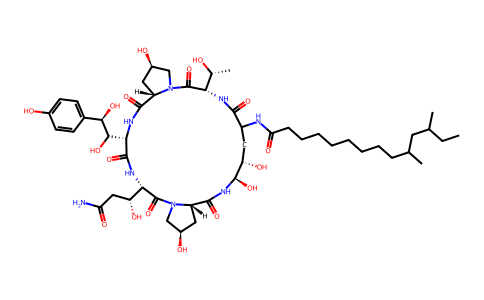
| Molecular Formula | C50H80N8O17 |
| Molecular Weight | 1065.2 |
| Exact Mass | 1064.5641 |
| CAS # | 144074-96-4 |
| PubChem CID | 72974 |
| Appearance | Typically exists as solids at room temperature |
| Density | 1.41g/cm3 |
| Boiling Point | 1442.9ºC at 760mmHg |
| Flash Point | 826.5ºC |
| Vapour Pressure | 0mmHg at 25°C |
| Index of Refraction | 1.629 |
| LogP | 0.5 |
| Hydrogen Bond Donor Count | 15 |
| Hydrogen Bond Acceptor Count | 17 |
| Rotatable Bond Count | 20 |
| Heavy Atom Count | 75 |
| Complexity | 1930 |
| Defined Atom Stereocenter Count | 12 |
| SMILES | CCC(C)CC(C)CCCCCCCCC(=O)NC1C[C@@H]([C@H](NC(=O)[C@@H]2C[C@H](CN2C(=O)[C@@H](NC(=O)[C@@H](NC(=O)[C@@H]3C[C@H](CN3C(=O)[C@@H](NC1=O)[C@@H](C)O)O)C([C@@H](C4=CC=C(C=C4)O)O)O)[C@@H](CC(=O)N)O)O)O)O |
| InChi Key | IPMHTGKXJQHTQV-YWVCOZMLSA-N |
| InChi Code | InChI=1S/C50H80N8O17/c1-5-25(2)18-26(3)12-10-8-6-7-9-11-13-38(66)52-32-21-36(64)47(72)56-46(71)34-20-31(62)24-58(34)50(75)40(35(63)22-37(51)65)54-48(73)41(43(68)42(67)28-14-16-29(60)17-15-28)55-45(70)33-19-30(61)23-57(33)49(74)39(27(4)59)53-44(32)69/h14-17,25-27,30-36,39-43,47,59-64,67-68,72H,5-13,18-24H2,1-4H3,(H2,51,65)(H,52,66)(H,53,69)(H,54,73)(H,55,70)(H,56,71)/t25?,26?,27-,30-,31-,32?,33+,34+,35-,36+,39+,40+,41+,42-,43?,47-/m1/s1 |
| Chemical Name | N-[(3S,6S,9S,11R,15S,20S,21R,24S,26R)-3-[(1R)-3-amino-1-hydroxy-3-oxopropyl]-6-[(2R)-1,2-dihydroxy-2-(4-hydroxyphenyl)ethyl]-11,20,21,26-tetrahydroxy-15-[(1R)-1-hydroxyethyl]-2,5,8,14,17,23-hexaoxo-1,4,7,13,16,22-hexazatricyclo[22.3.0.09,13]heptacosan-18-yl]-10,12-dimethyltetradecanamide |
| Synonyms | Pneumocandin C(0); Pneumocandin C0; 144074-96-4; N-[(3S,6S,9S,11R,15S,20S,21R,24S,26R)-3-[(1R)-3-amino-1-hydroxy-3-oxopropyl]-6-[(2R)-1,2-dihydroxy-2-(4-hydroxyphenyl)ethyl]-11,20,21,26-tetrahydroxy-15-[(1R)-1-hydroxyethyl]-2,5,8,14,17,23-hexaoxo-1,4,7,13,16,22-hexazatricyclo[22.3.0.09,13]heptacosan-18-yl]-10,12-dimethyltetradecanamide; Pneumocandin Bo, 6-(trans-4-hydroxy-L-proline)-; Pneumocandin Co; SCHEMBL1162942; |
| HS Tariff Code | 2934.99.9001 |
| Storage |
Powder-20°C 3 years 4°C 2 years In solvent -80°C 6 months -20°C 1 month |
| Shipping Condition | Room temperature (This product is stable at ambient temperature for a few days during ordinary shipping and time spent in Customs) |
Biological Activity
| Targets | Natural antifungal agent |
| ln Vitro | A high total pneumocandin titer (B0 + C0) with a low percentage of the structural isomer pneumocandin C0 was achieved by carrying out fermentations of Glarea lozoyensis at a high residual fructose concentration (125 g/l initial). When the fermentation was carried out at a low residual fructose concentration (40 g/l initial), pneumocandin production increased by 34%. However, a disproportionate increase in the level of pneumocandin C0 synthesized (250% increase vs 30% increase for pneumocandin B0) was observed. Midcycle addition of 150 mM NaCl or 116 mM Na2SO4 to low residual fructose fermentations returned the titer and isomer levels to those seen for the high residual fructose fermentation. The increase in pneumocandin C0 synthesis under low residual fructose conditions appears to be linked to the increase in the synthesis of trans-4 hydroxyproline, with the synthesis of trans-3 hydroxyproline remaining unaffected. This suggests that the formation of pneumocandin C0 is the result of a misincorporation of trans-4 hydroxyproline instead of trans-3 hydroxyproline by the pneumocandin peptide synthetase, and that the amount of trans-4 hydroxyproline formed dictates the frequency of this misincorporation [1]. |
| Enzyme Assay |
Analysis of Pneumocandin Production [2] Pneumocandins were detected according to the following procedures. For the determination of the PB0+PC0/pneumocandin C0 titer by RP-HPLC, an aliquot of whole broth was mixed with four volumes of ethanol and placed in an ultrasonic for 30 min. The mixtures were centrifuged at 12 000 rpm for 10 min, and the supernatants were directly analyzed by HPLC using an ODS C18 column (4.6 × 250 mm, 5 μm, Elite, Dalian). For RP-HPLC detection, a mixture of 55% water and 45% acetonitrile (v/v) was used as the mobile phase, with a flow rate of 1.0 mL/min and a retention time of 10 min. The eluate was monitored at 210 nm. For the determination of the PC0 (pneumocandin C0)/(PB0+PC0) titer by NP-HPLC, the fermentation samples were centrifuged at 12 000 rpm for 10 min to remove the supernatants and collect the wet cells. Then, the wet cells were mixed with four volumes of ethanol (the volume of ethanol was calculated with the whole borth) and placed in an ultrasonic for 30 min. Then, the mixtures were centrifuged at 12 000 rpm for 10 min. In order to concentrate the products and remove water from the samples, the liquid in supernatants was evaporated under reduced pressure to dryness. Subsequently, the products were collected by dissolving the paste in bottle with the mobile phase used for NP-HPLC, and it can be used for detection. NP-HPLC was performed using a SiO2 column (4.6 × 250 mm, 5 μm) and a mobile phase of 80% dichloromethane, 20% methanol, and 1.5% water with a flow rate of 1.0 mL/min. The product was detected at 276 nm. |
| References |
[1]. Residual fructose and osmolality affect the levels of pneumocandins B0 and C0 produced by Glarea lozoyensis. Appl Microbiol Biotechnol. 2000 Dec;54(6):814-8. [2]. CRISPR/Cas9-Based Genome Editing in the Filamentous Fungus Glarea lozoyensis and Its Application in Manipulating gloF. ACS Synth Biol. 2020 Aug 21;9(8):1968-1977 |
| Additional Infomation |
Glarea lozoyensis is an important industrial fungus that produces the pneumocandin B0, which is used for the synthesis of antifungal drug caspofungin. However, because of the limitations and complications of traditional genetic tools, G. lozoyensis strain engineering has been hindered. In this study, we established an efficient CRISPR/Cas9-based gene editing tool in G. lozoyensis SIPI1208. With this method, gene mutagenesis efficiency in the target locus can be up to 80%, which enables the rapid gene knockout. According to the reports, GloF and Ap-HtyE, proline hydroxylases involved in pneumocandin and Echinocandin B biosynthesis, respectively, can catalyze the proline to generate different ratios of trans-3-hydroxy-l-proline to trans-4-hydroxy-l-proline. Heterologous expression of Ap-HtyE in G. lozoyensis decreased the ratio of pneumocandin C0 to (pneumocandin B0 + pneumocandin C0) from 33.5% to 11% without the addition of proline to the fermentation medium. Furthermore, the gloF was replaced by ap-htyE to study the production of pneumocandin C0. However, the gene replacement has been hampered by traditional gene tools since gloF and gloG, two contiguous genes indispensable in the biosynthesis of pneumocandins, are cotranscribed into one mRNA. With the CRISPR/Cas9 strategy, ap-htyE was knocked in and successfully replaced gloF, and results showed that the knock-in strain retained the ability to produce pneumocandin B0, but the production of pneumocandin C0 was abolished. Thus, this strain displayed a competitive advantage in the industrial production of pneumocandin B0. In summary, this study showed that the CRISPR/Cas9-based gene editing tool is efficient for manipulating genes in G. lozoyensis. [2]
In addition to the identification of genomic DNA in the knock-in strain, the transcription of ap-htyE was also investigated; this was done by RT-PCR. The mycelium of Gl(PC)-ap-htyE cultured in fermentation medium for approximately 6 days was harvested to extract the total RNA, and it was reverse transcribed to generate cDNA. As shown in Figure 5e, ap-htyE was transcribed in Gl(PC)-ap-htyE, and no gloF was detected. For the investigation of the stability of ap-htyE gene in Gl(PC)-ap-htyE, the strain was cultured consecutively. The genetic stability of consecutive subcultures was detected by PCR. From the results shown in Figure S2, the gene ap-htyE in Gl(PC)-ap-htyE was stable in subcultures. In addition, the knock-in strain Gl(PC)-ap-htyE and the cas9 expression strain G. lozoyensis were fermented, and the fermentation broths were extracted with ethanol for pneumocandin product analysis. RP-HPLC analysis of the fermentation extracts showed that the total titer of PB0 and pneumocandin C0/PC0 was 2299 mg/L in G. lozoyensis (PC), and the total titer of PB0 and PC0 was 2350 mg/L in Gl(PC)-ap-htyE, which indicated that the knock-in strain still had the ability to produce pneumocandins in vivo. NP-HPLC results showed that no PC0 was produced in Gl(PC)-ap-htyE, while 33.5% and 33.7% PC0 were produced in G. lozoyensis and G. lozoyensis (PC), respectively. By enzyme replacement, we successfully constructed a strain that no longer produces PC0, which presents a huge value in industrial applications. Taken together, these data demonstrate that the proline hydroxylase GloF is related to the production of pneumocandin C0/PC0. Replacement of GloF with Ap-HtyE or the introduction of Ap-HtyE can reduce the levels of PC0. These results can be explained by the characteristics of GloF and Ap-htyE in vitro. According to the reported research, the 4-Hyp/3-Hyp product ratio is approximately 8:1 for GloF and 2:1 for Ap-HtyE. Although they both present a region-selectivity preference for 4-Hyp, Ap-HtyE can catalyze proline to generate 3-Hyp in a higher proportion than GloF. Therefore, the introduction of Ap-HtyE is helpful to increase the ratio of 3-Hyp to 4-Hyp. The increase in the 3-Hyp ratio will lead to increased chances that 3-Hyp will be recognized by A6 domain in GloA.[2] |
Solubility Data
| Solubility (In Vitro) | May dissolve in DMSO (in most cases), if not, try other solvents such as H2O, Ethanol, or DMF with a minute amount of products to avoid loss of samples |
| Solubility (In Vivo) |
Note: Listed below are some common formulations that may be used to formulate products with low water solubility (e.g. < 1 mg/mL), you may test these formulations using a minute amount of products to avoid loss of samples. Injection Formulations (e.g. IP/IV/IM/SC) Injection Formulation 1: DMSO : Tween 80: Saline = 10 : 5 : 85 (i.e. 100 μL DMSO stock solution → 50 μL Tween 80 → 850 μL Saline) *Preparation of saline: Dissolve 0.9 g of sodium chloride in 100 mL ddH ₂ O to obtain a clear solution. Injection Formulation 2: DMSO : PEG300 :Tween 80 : Saline = 10 : 40 : 5 : 45 (i.e. 100 μL DMSO → 400 μLPEG300 → 50 μL Tween 80 → 450 μL Saline) Injection Formulation 3: DMSO : Corn oil = 10 : 90 (i.e. 100 μL DMSO → 900 μL Corn oil) Example: Take the Injection Formulation 3 (DMSO : Corn oil = 10 : 90) as an example, if 1 mL of 2.5 mg/mL working solution is to be prepared, you can take 100 μL 25 mg/mL DMSO stock solution and add to 900 μL corn oil, mix well to obtain a clear or suspension solution (2.5 mg/mL, ready for use in animals). Injection Formulation 4: DMSO : 20% SBE-β-CD in saline = 10 : 90 [i.e. 100 μL DMSO → 900 μL (20% SBE-β-CD in saline)] *Preparation of 20% SBE-β-CD in Saline (4°C,1 week): Dissolve 2 g SBE-β-CD in 10 mL saline to obtain a clear solution. Injection Formulation 5: 2-Hydroxypropyl-β-cyclodextrin : Saline = 50 : 50 (i.e. 500 μL 2-Hydroxypropyl-β-cyclodextrin → 500 μL Saline) Injection Formulation 6: DMSO : PEG300 : castor oil : Saline = 5 : 10 : 20 : 65 (i.e. 50 μL DMSO → 100 μLPEG300 → 200 μL castor oil → 650 μL Saline) Injection Formulation 7: Ethanol : Cremophor : Saline = 10: 10 : 80 (i.e. 100 μL Ethanol → 100 μL Cremophor → 800 μL Saline) Injection Formulation 8: Dissolve in Cremophor/Ethanol (50 : 50), then diluted by Saline Injection Formulation 9: EtOH : Corn oil = 10 : 90 (i.e. 100 μL EtOH → 900 μL Corn oil) Injection Formulation 10: EtOH : PEG300:Tween 80 : Saline = 10 : 40 : 5 : 45 (i.e. 100 μL EtOH → 400 μLPEG300 → 50 μL Tween 80 → 450 μL Saline) Oral Formulations Oral Formulation 1: Suspend in 0.5% CMC Na (carboxymethylcellulose sodium) Oral Formulation 2: Suspend in 0.5% Carboxymethyl cellulose Example: Take the Oral Formulation 1 (Suspend in 0.5% CMC Na) as an example, if 100 mL of 2.5 mg/mL working solution is to be prepared, you can first prepare 0.5% CMC Na solution by measuring 0.5 g CMC Na and dissolve it in 100 mL ddH2O to obtain a clear solution; then add 250 mg of the product to 100 mL 0.5% CMC Na solution, to make the suspension solution (2.5 mg/mL, ready for use in animals). Oral Formulation 3: Dissolved in PEG400 Oral Formulation 4: Suspend in 0.2% Carboxymethyl cellulose Oral Formulation 5: Dissolve in 0.25% Tween 80 and 0.5% Carboxymethyl cellulose Oral Formulation 6: Mixing with food powders Note: Please be aware that the above formulations are for reference only. InvivoChem strongly recommends customers to read literature methods/protocols carefully before determining which formulation you should use for in vivo studies, as different compounds have different solubility properties and have to be formulated differently. (Please use freshly prepared in vivo formulations for optimal results.) |
| Preparing Stock Solutions | 1 mg | 5 mg | 10 mg | |
| 1 mM | 0.9388 mL | 4.6940 mL | 9.3879 mL | |
| 5 mM | 0.1878 mL | 0.9388 mL | 1.8776 mL | |
| 10 mM | 0.0939 mL | 0.4694 mL | 0.9388 mL |