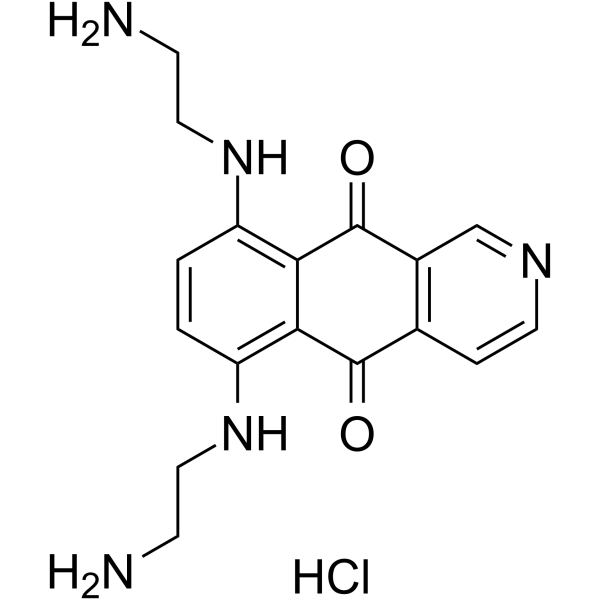
Physicochemical Properties
| Molecular Formula | C17H19N5O2.HCL |
| Molecular Weight | 361.826 |
| Exact Mass | 325.154 |
| CAS # | 175989-38-5 |
| Related CAS # | Pixantrone;144675-97-8;Pixantrone free base;144510-96-3 |
| PubChem CID | 45262985 |
| Appearance | Typically exists as solid at room temperature |
| LogP | 2.144 |
| Hydrogen Bond Donor Count | 5 |
| Hydrogen Bond Acceptor Count | 7 |
| Rotatable Bond Count | 6 |
| Heavy Atom Count | 25 |
| Complexity | 472 |
| Defined Atom Stereocenter Count | 0 |
| SMILES | C1=CC(=C2C(=C1NCCN)C(=O)C3=CC=NC=C3C2=O)NCCN.Cl |
| InChi Key | NXSHYUUREPUCRN-UHFFFAOYSA-N |
| InChi Code | InChI=1S/C17H19N5O2.ClH/c18-4-7-21-12-1-2-13(22-8-5-19)15-14(12)16(23)10-3-6-20-9-11(10)17(15)24;/h1-3,6,9,21-22H,4-5,7-8,18-19H2;1H |
| Chemical Name | 6,9-bis(2-aminoethylamino)benzo[g]isoquinoline-5,10-dione;hydrochloride |
| HS Tariff Code | 2934.99.9001 |
| Storage |
Powder-20°C 3 years 4°C 2 years In solvent -80°C 6 months -20°C 1 month |
| Shipping Condition | Room temperature (This product is stable at ambient temperature for a few days during ordinary shipping and time spent in Customs) |
Biological Activity
| ln Vitro | Regardless of cell cycle disruption, pixantrone hydrochloride (0–10 μM, 72 h) causes cell death in a range of cancer cell lines [1]. Pixantrone hydrochloride (25–500 nM, 24 h) can cause significant chromosomal abnormalities, disrupt chromosome segregation, and cause mitotic disaster in PANC1 cells [1]. With an IC50 of 0.10 μM and 0.56 μM, pazantrone (0-100 μM, 72 h) HCl efficiently suppresses the proliferation of human leukemia K562 cells, etoposide-resistant K/VP.5 cells, MDCK, and ABCB1-transfected MDCK/MDR cells. 0.058 μM are, in turn, 4.5 μM and 4.5 μM[2]. Pixantrone (0.01-0.2 μM) hydrochloride acts on topoisomerase IIα to construct linear DNA in a concentration-dependent manner. It also generates semiquinone radicals in enzymatic reduction systems, but not in cellular systems—presumably because cellular absorption is minimal [2]. Pixantrone hydrochloride (0.01–10 μM) exerts strong inhibitory effects on T cell proliferation specific to the rat 97–116 peptide [4]. |
| ln Vivo | Pyridoxantrone hydrochloride (IV, 27 mg/kg 3 times every 7 days) did not worsen pre-existing moderate degenerative cardiomyopathy, generates modest cardiotoxicity in mice following repeated treatment cycles, and In animals pretreated with doxorubicin, mortality was lower than that with mitoxantrone [3]. Pixantrone hydrochloride (16.25 mg/kg intravenously, 3 times weekly) modulates lymph node cell (LNC) responses, affects T-cell subsets in TAChR-immune Lewis rats, and is effective in experimental autoimmune severe disease Myasthenia gravis (EAMG) has also shown preventive and therapeutic effects in rats [4]. |
| Cell Assay |
Cell proliferation assay [4] Cell Types: Lewis rat T cell line Tested Concentrations: 0.01-10 μM Incubation Duration: Experimental Results: 39.3% inhibition of rat 97-116 peptide-specific T cell proliferation at 0.01 μM, complete inhibition of T cells at high concentrations Cell Proliferation. |
| References |
[1]. Pixantrone induces cell death through mitotic perturbations and subsequent aberrant cell divisions. Cancer Biol Ther. 2015;16(9):1397-406. [2]. Mechanisms of Action and Reduced Cardiotoxicity of Pixantrone; a Topoisomerase II Targeting Agent with Cellular Selectivity for the Topoisomerase IIα Isoform. J Pharmacol Exp Ther. 2016 Feb;356(2):397-409. [3]. Pixantrone (BBR 2778) has reduced cardiotoxic potential in mice pretreated with doxorubicin: comparative studies against doxorubicin and mitoxantrone. Invest New Drugs. 2007 Jun;25(3):187-95. [4]. Pixantrone (BBR2778) reduces the severity of experimental autoimmune myasthenia gravis in Lewis rats. J Immunol. 2008 Feb 15;180(4):2696-703. |
Solubility Data
| Solubility (In Vitro) | May dissolve in DMSO (in most cases), if not, try other solvents such as H2O, Ethanol, or DMF with a minute amount of products to avoid loss of samples |
| Solubility (In Vivo) |
Note: Listed below are some common formulations that may be used to formulate products with low water solubility (e.g. < 1 mg/mL), you may test these formulations using a minute amount of products to avoid loss of samples. Injection Formulations (e.g. IP/IV/IM/SC) Injection Formulation 1: DMSO : Tween 80: Saline = 10 : 5 : 85 (i.e. 100 μL DMSO stock solution → 50 μL Tween 80 → 850 μL Saline) *Preparation of saline: Dissolve 0.9 g of sodium chloride in 100 mL ddH ₂ O to obtain a clear solution. Injection Formulation 2: DMSO : PEG300 :Tween 80 : Saline = 10 : 40 : 5 : 45 (i.e. 100 μL DMSO → 400 μLPEG300 → 50 μL Tween 80 → 450 μL Saline) Injection Formulation 3: DMSO : Corn oil = 10 : 90 (i.e. 100 μL DMSO → 900 μL Corn oil) Example: Take the Injection Formulation 3 (DMSO : Corn oil = 10 : 90) as an example, if 1 mL of 2.5 mg/mL working solution is to be prepared, you can take 100 μL 25 mg/mL DMSO stock solution and add to 900 μL corn oil, mix well to obtain a clear or suspension solution (2.5 mg/mL, ready for use in animals). Injection Formulation 4: DMSO : 20% SBE-β-CD in saline = 10 : 90 [i.e. 100 μL DMSO → 900 μL (20% SBE-β-CD in saline)] *Preparation of 20% SBE-β-CD in Saline (4°C,1 week): Dissolve 2 g SBE-β-CD in 10 mL saline to obtain a clear solution. Injection Formulation 5: 2-Hydroxypropyl-β-cyclodextrin : Saline = 50 : 50 (i.e. 500 μL 2-Hydroxypropyl-β-cyclodextrin → 500 μL Saline) Injection Formulation 6: DMSO : PEG300 : castor oil : Saline = 5 : 10 : 20 : 65 (i.e. 50 μL DMSO → 100 μLPEG300 → 200 μL castor oil → 650 μL Saline) Injection Formulation 7: Ethanol : Cremophor : Saline = 10: 10 : 80 (i.e. 100 μL Ethanol → 100 μL Cremophor → 800 μL Saline) Injection Formulation 8: Dissolve in Cremophor/Ethanol (50 : 50), then diluted by Saline Injection Formulation 9: EtOH : Corn oil = 10 : 90 (i.e. 100 μL EtOH → 900 μL Corn oil) Injection Formulation 10: EtOH : PEG300:Tween 80 : Saline = 10 : 40 : 5 : 45 (i.e. 100 μL EtOH → 400 μLPEG300 → 50 μL Tween 80 → 450 μL Saline) Oral Formulations Oral Formulation 1: Suspend in 0.5% CMC Na (carboxymethylcellulose sodium) Oral Formulation 2: Suspend in 0.5% Carboxymethyl cellulose Example: Take the Oral Formulation 1 (Suspend in 0.5% CMC Na) as an example, if 100 mL of 2.5 mg/mL working solution is to be prepared, you can first prepare 0.5% CMC Na solution by measuring 0.5 g CMC Na and dissolve it in 100 mL ddH2O to obtain a clear solution; then add 250 mg of the product to 100 mL 0.5% CMC Na solution, to make the suspension solution (2.5 mg/mL, ready for use in animals). Oral Formulation 3: Dissolved in PEG400 Oral Formulation 4: Suspend in 0.2% Carboxymethyl cellulose Oral Formulation 5: Dissolve in 0.25% Tween 80 and 0.5% Carboxymethyl cellulose Oral Formulation 6: Mixing with food powders Note: Please be aware that the above formulations are for reference only. InvivoChem strongly recommends customers to read literature methods/protocols carefully before determining which formulation you should use for in vivo studies, as different compounds have different solubility properties and have to be formulated differently. (Please use freshly prepared in vivo formulations for optimal results.) |
| Preparing Stock Solutions | 1 mg | 5 mg | 10 mg | |
| 1 mM | 2.7637 mL | 13.8186 mL | 27.6373 mL | |
| 5 mM | 0.5527 mL | 2.7637 mL | 5.5275 mL | |
| 10 mM | 0.2764 mL | 1.3819 mL | 2.7637 mL |