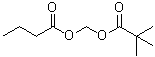
Pivanex (AN-9; AN 9; AN9; pivaloyloxymethyl butyrate; Titan) is a novel and potent histone deacetylase/HDAC inhibitor with anticancer and antiangiogenic properties. It is an analog of butyric acid that signals cellular differentiation to cause cancer cells to undergo apoptosis.
Physicochemical Properties
| Molecular Formula | C10H18O4 |
| Molecular Weight | 202.2475 |
| Exact Mass | 202.121 |
| Elemental Analysis | C, 59.39; H, 8.97; O, 31.64 |
| CAS # | 122110-53-6 |
| Related CAS # | 122110-53-6 |
| PubChem CID | 60748 |
| Appearance | Colorless to light yellow liquid |
| Density | 1.008g/cm3 |
| Boiling Point | 249.3ºC at 760mmHg |
| Flash Point | 113ºC |
| Vapour Pressure | 0.0231mmHg at 25°C |
| Index of Refraction | 1.43 |
| LogP | 1.876 |
| Hydrogen Bond Donor Count | 0 |
| Hydrogen Bond Acceptor Count | 4 |
| Rotatable Bond Count | 7 |
| Heavy Atom Count | 14 |
| Complexity | 203 |
| Defined Atom Stereocenter Count | 0 |
| SMILES | O(C([H])([H])OC(C([H])([H])C([H])([H])C([H])([H])[H])=O)C(C(C([H])([H])[H])(C([H])([H])[H])C([H])([H])[H])=O |
| InChi Key | GYKLFBYWXZYSOW-UHFFFAOYSA-N |
| InChi Code | InChI=1S/C10H18O4/c1-5-6-8(11)13-7-14-9(12)10(2,3)4/h5-7H2,1-4H3 |
| Chemical Name | butanoyloxymethyl 2,2-dimethylpropanoate |
| Synonyms | pivaloyloxymethyl butyrate; AN9; Pivanex; Titan |
| HS Tariff Code | 2934.99.9001 |
| Storage |
Powder-20°C 3 years 4°C 2 years In solvent -80°C 6 months -20°C 1 month |
| Shipping Condition | Room temperature (This product is stable at ambient temperature for a few days during ordinary shipping and time spent in Customs) |
Biological Activity
| Targets | HDAC; Bcr-Abl |
| ln Vitro |
Pivanex (100-500 μM) shows notable anti-proliferation activity in K562 cells[1]. Pivanex (100-500 μM) also increases caspase activity and apoptosis in K562 cells[1]. Pivanex (200 μM) causes a small reduction in G0-G1 and a moderate enhancement in the S and G2-M phases of the cell cycle[1]. Pivanex (AN-9) possesses specific toxicity to drug-resistant primary leukemia, acute leukemia, and cancer cell lines[2]. |
| ln Vivo | Pivanex (AN9, 200 mg/kg, b.i.d, daily) increases the SMN7 SMA mice's survival rate considerably. The end stage of the disease, which is indicated by the start of body mass loss, is also markedly delayed by pivanex (AN9) treatment[3]. |
| Cell Assay |
Cell Line: K562 cells. Concentration: 100-500 μM. Incubation Time: 24 hours. Result: Reduced the number of K562 viable cells significantly. 100 μM Pivanex with 0.125 or 0.25 μM STI571 reduced the number of viable cells synergistically. |
| Animal Protocol |
SMN7 SMA mice (SMN2+/+; SMN7+/+; mSmn−/−). 200 mg/kg. Oral administration, b.i.d, at 09.00 and 17.00 daily. |
| References |
[1]. WO2017180389A1. |
| Additional Infomation |
Pivaloyloxymethyl butyrate (AN-9), an acyloxyalkyl ester prodrug of butyric acid (BA), exhibited low toxicity and significant anticancer activity in vitro and in vivo. It shows greater potency than BA at inducing malignant cell differentiation and tumor growth inhibition and has demonstrated more favorable toxicological, pharmacological, and pharmaceutical properties than BA in preclinical studies. Pivaloyloxymethylbutyrate is an acyloxyalkyl ester prodrug of butyric acid. Pivaloyloxymethylbutyrate inhibits histone deacetylase, resulting in cell differentiation, cell growth inhibition, and apoptosis. (NCI04) Drug Indication Investigated for use/treatment in liver cancer, lung cancer, melanoma, and leukemia (lymphoid). Mechanism of Action Pivaloyloxymethyl butyrate is a histone deacetylase inhibitor analog of butyric acid that causes apoptosis of cancer cells through signaling cellular differentiation. It is rapidly and extensively transported intracellularly because of its high lipophilicity, where it undergoes esterase-mediated hydrolysis to form pivalic acid, formaldehyde, and BA. |
Solubility Data
| Solubility (In Vitro) | DMSO: ≥ 100 mg/mL (~494.4 mM) |
| Solubility (In Vivo) |
Solubility in Formulation 1: ≥ 2.5 mg/mL (12.36 mM) (saturation unknown) in 10% DMSO + 40% PEG300 + 5% Tween80 + 45% Saline (add these co-solvents sequentially from left to right, and one by one), clear solution. For example, if 1 mL of working solution is to be prepared, you can add 100 μL of 25.0 mg/mL clear DMSO stock solution to 400 μL PEG300 and mix evenly; then add 50 μL Tween-80 to the above solution and mix evenly; then add 450 μL normal saline to adjust the volume to 1 mL. Preparation of saline: Dissolve 0.9 g of sodium chloride in 100 mL ddH₂ O to obtain a clear solution. Solubility in Formulation 2: ≥ 2.5 mg/mL (12.36 mM) (saturation unknown) in 10% DMSO + 90% (20% SBE-β-CD in Saline) (add these co-solvents sequentially from left to right, and one by one), clear solution. For example, if 1 mL of working solution is to be prepared, you can add 100 μL of 25.0 mg/mL clear DMSO stock solution to 900 μL of 20% SBE-β-CD physiological saline solution and mix evenly. Preparation of 20% SBE-β-CD in Saline (4°C,1 week): Dissolve 2 g SBE-β-CD in 10 mL saline to obtain a clear solution. Solubility in Formulation 3: ≥ 2.5 mg/mL (12.36 mM) (saturation unknown) in 10% DMSO + 90% Corn Oil (add these co-solvents sequentially from left to right, and one by one), clear solution. For example, if 1 mL of working solution is to be prepared, you can add 100 μL of 25.0 mg/mL clear DMSO stock solution to 900 μL of corn oil and mix evenly. (Please use freshly prepared in vivo formulations for optimal results.) |
| Preparing Stock Solutions | 1 mg | 5 mg | 10 mg | |
| 1 mM | 4.9444 mL | 24.7219 mL | 49.4438 mL | |
| 5 mM | 0.9889 mL | 4.9444 mL | 9.8888 mL | |
| 10 mM | 0.4944 mL | 2.4722 mL | 4.9444 mL |