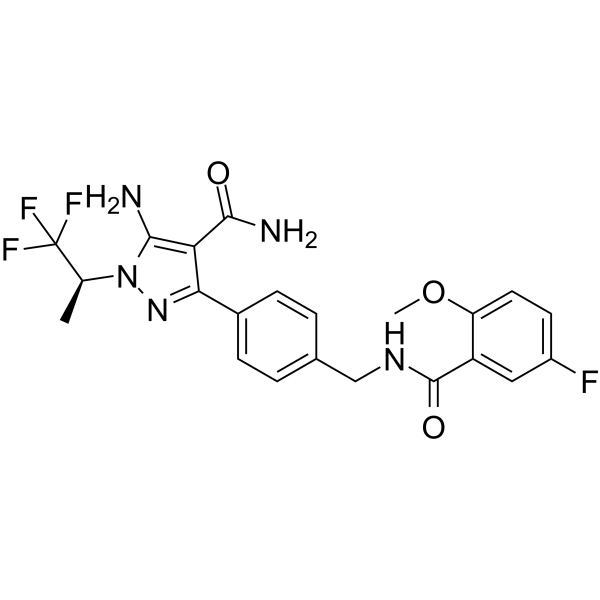
Pirtobrutinib (formerly LOXO-305; LY-3527727; Jaypirca) is a novel, highly selective and non-covalent next generation BTK (Bruton's tyrosine kinase) inhibitor which inhibits diverse BTK C481 substitution mutations. Although covalent Bruton's tyrosine kinase (BTK) inhibitors are effective in treating a variety of B-cell malignancies, patients stop taking these medications because of intolerance and resistance. In patients with B-cell malignancies who had previously received covalent BTK inhibitor treatment, pirtobrutinib proved to be both safe and effective. For these patients, pirtobrutinib may be able to meet an increasing unmet need for alternative therapies. The FDA approved Pirtobrutinib in February 2023 for the treatment of non-Hodgkin lymphoma.
Physicochemical Properties
| Molecular Formula | C22H21F4N5O3 |
| Molecular Weight | 479.4356 |
| Exact Mass | 479.1581 |
| Elemental Analysis | C, 55.12; H, 4.42; F, 15.85; N, 14.61; O, 10.01 |
| CAS # | 2101700-15-4 |
| Related CAS # | (R)-Pirtobrutinib;2101700-14-3 |
| PubChem CID | 129269915 |
| Appearance | White to yellow solid powder |
| Density | 1.44±0.1 g/cm3 |
| Boiling Point | 619.2±55.0 °C |
| LogP | 3.3 |
| Hydrogen Bond Donor Count | 3 |
| Hydrogen Bond Acceptor Count | 9 |
| Rotatable Bond Count | 7 |
| Heavy Atom Count | 34 |
| Complexity | 719 |
| Defined Atom Stereocenter Count | 1 |
| SMILES | FC([C@H](C)N1C(=C(C(N)=O)C(C2C=CC(CNC(C3C=C(C=CC=3OC)F)=O)=CC=2)=N1)N)(F)F |
| InChi Key | FWZAWAUZXYCBKZ-NSHDSACASA-N |
| InChi Code | InChI=1S/C22H21F4N5O3/c1-11(22(24,25)26)31-19(27)17(20(28)32)18(30-31)13-5-3-12(4-6-13)10-29-21(33)15-9-14(23)7-8-16(15)34-2/h3-9,11H,10,27H2,1-2H3,(H2,28,32)(H,29,33)/t11-/m0/s1 |
| Chemical Name | 5-amino-3-[4-[[(5-fluoro-2-methoxybenzoyl)amino]methyl]phenyl]-1-[(2S)-1,1,1-trifluoropropan-2-yl]pyrazole-4-carboxamide |
| Synonyms | Pirtobrutinib; LY-3527727; Jaypirca; LOXO-305; LY 3527727; LOXO305; LY3527727; LOXO 305; JAYPIRCA; RXC-005; LY3527727; JNA39I7ZVB |
| HS Tariff Code | 2934.99.9001 |
| Storage |
Powder-20°C 3 years 4°C 2 years In solvent -80°C 6 months -20°C 1 month Note: Please store this product in a sealed and protected environment (e.g. under nitrogen), avoid exposure to moisture. |
| Shipping Condition | Room temperature (This product is stable at ambient temperature for a few days during ordinary shipping and time spent in Customs) |
Biological Activity
| Targets |
BTK (IC50 = 5.69 nM)
Pirtobrutinib (LOXO-305) targets Bruton's tyrosine kinase (BTK), including wild-type BTK (Ki = 0.5 nM; IC50 = 1.6 nM for kinase activity) and C481S-mutant BTK (Ki = 0.6 nM; IC50 = 2.1 nM for kinase activity) [3] Pirtobrutinib (LOXO-305) shows high selectivity for BTK over other TEC family kinases (ITK: IC50 = 45 nM; TEC: IC50 = 62 nM; BMX: IC50 = 78 nM) and non-TEC kinases (EGFR: IC50 > 1000 nM; SRC: IC50 > 1000 nM; JAK3: IC50 = 510 nM) [3] Pirtobrutinib (LOXO-305) inhibits clinically relevant BTK mutations, including C481R (IC50 = 3.2 nM), C481F (IC50 = 2.8 nM), and L528W (IC50 = 4.5 nM) [3] |
| ln Vitro |
Pirtobrutinib (LOXO-305) is a next-generation Bruton's tyrosine kinase (BTK) inhibitor that is highly selective, non-covalent, and exhibits strong equilibrium binding to both WT BTK and several BTK C481 substitution mutations.It also potently inhibits the cellular activity of BTK C481S, T, and R mutations.[2] In BTK-dependent B-cell cell lines (MCL: Jeko-1, Mino; CLL: MEC-1, OSU-CLL), Pirtobrutinib (LOXO-305) inhibits cell proliferation with IC50 values ranging from 3.7 nM (Jeko-1) to 12.5 nM (OSU-CLL) [3] - In C481S-mutant BTK-expressing cell lines (Jeko-1-C481S, MEC-1-C481S), the drug exhibits antiproliferative activity with IC50 = 4.2 nM and 5.8 nM, respectively, outperforming ibrutinib (IC50 > 1 μM in both lines) [3] - Western blot analysis shows dose-dependent inhibition of BTK phosphorylation (pBTK) and downstream signaling molecules (AKT, ERK1/2, PLCγ2) in Jeko-1 and Jeko-1-C481S cells, with maximum inhibition (>90%) at 50 nM [3] - Induces caspase-dependent apoptosis in CLL and MCL cell lines (Annexin V/PI staining shows 35–45% apoptotic cells at 100 nM after 72 h) [3] - In primary CLL cells from patients with ibrutinib-resistant C481S mutation, Pirtobrutinib (LOXO-305) (100 nM) inhibits pBTK by >85% and reduces cell viability by 60% [3] - Shows no significant antiproliferative activity in BTK-independent cell lines (Raji, Daudi) with IC50 > 1000 nM [3] |
| ln Vivo |
Pirtobrutinib significantly inhibits tumor growth in human lymphoma xenografts in vivo. [3] In Jeko-1 (wild-type BTK) subcutaneous xenograft mouse model, oral administration of Pirtobrutinib (LOXO-305) (25 mg/kg, twice daily for 21 days) inhibits tumor growth by 83% compared to vehicle control; tumor tissue shows reduced pBTK and pAKT levels [3] - In Jeko-1-C481S (mutant BTK) xenograft model, Pirtobrutinib (LOXO-305) (30 mg/kg, oral, twice daily) achieves 78% tumor growth inhibition, while ibrutinib (50 mg/kg) shows only 22% inhibition [3] - In patient-derived xenograft (PDX) models of C481S-mutant CLL, Pirtobrutinib (LOXO-305) (20 mg/kg, oral, twice daily) results in 75% tumor growth inhibition and extends median survival by 50% [3] - In MCL PDX model with L528W BTK mutation, Pirtobrutinib (LOXO-305) (30 mg/kg, oral, twice daily) inhibits tumor growth by 72% [3] |
| Enzyme Assay |
Pirtobrutinib activity against BTK, BTK C481S, and selected non-BTK kinases was determined by monitoring incorporation of [33P]-PO4 from [33P]-adenosine triphosphate (ATP) into polyglutamic acid–tyrosine (poly-EY) peptide substrate in the HotSpot Kinase Assay (Reaction Biology, Malvern, PA).25 Data were analyzed using standard-curve fitting methods. Pirtobrutinib (1 μM) was tested for kinase activity inhibition of 371 human kinases using the HotSpot Kinase Assay and Km ATP concentrations. Pirtobrutinib, ibrutinib, zanubrutinib, and acalabrutinib (100 nM) were tested using the HotSpot Kinase Assay at a concentration of 10 μM ATP. Percentage of control activity was calculated for each enzyme.[3] Both LOXO-305 and ibrutinib potently inhibited IgM-induced phospho-BTK with IC50 values equal to 1.34 ± 1.23 nM for LOXO-305 (n = 7, p < 0.0001) and 1.04 ± 1.26 nM for ibrutinib (n = 7, p < 0.0001). We also found a significant reduction in phosphorylation of PLCγ2 (Y1217), the immediate downstream effector of BTK (IC50 33 nM for each agent, n = 7, p = 0.02 for LOXO-305, p = 0.0017 for ibrutinib).[1] BTK kinase activity assay: Recombinant wild-type or mutant BTK (C481S, C481R) is incubated with ATP (10 μM) and a fluorescently labeled peptide substrate in the presence of serial dilutions of Pirtobrutinib (LOXO-305). After 60 min incubation at 30°C, phosphorylated substrate is detected by homogeneous time-resolved fluorescence (HTRF), and IC50 values are calculated via nonlinear regression [3] - Surface plasmon resonance (SPR) binding assay: BTK protein is immobilized on a sensor chip, and serial dilutions of Pirtobrutinib (LOXO-305) are injected over the chip. Binding affinity (Ki) is determined by measuring changes in refractive index, with data analyzed using a 1:1 binding model [3] - Selectivity kinase panel assay: Pirtobrutinib (LOXO-305) (100 nM) is screened against a panel of 468 kinases; only BTK and closely related TEC family kinases show >50% inhibition, confirming high target selectivity [3] |
| Cell Assay |
HEK293T cell lines that were transiently expressing WT BTK and BTK C481 substitution mutations were treated for 30 minutes with LOXO-305, ibrutinib, or acalabrutinib before orthovanadate was added. Following a 2-hour incubation period, cells were lysed, and total BTK and phosphorylated Y223 BTK were identified using MesoScale (C481R) or immunoblot (BTK WT, C481S, and C481T). Using GraphPad Prism, the bands and MSD signals were quantified and the IC50 values were computed. Cell proliferation assay: BTK-dependent or BTK-independent cancer cells are seeded in 96-well plates (5 × 10³ cells/well) and treated with Pirtobrutinib (LOXO-305) (0.1 nM–10 μM) for 72 h. Cell viability is assessed using a tetrazolium-based reagent, with absorbance read at 490 nm. IC50 values are derived from dose-response curves [3] - Western blot for signaling inhibition: Jeko-1 or Jeko-1-C481S cells are treated with Pirtobrutinib (LOXO-305) (0.5–50 nM) for 2 h, then lysed in ice-cold lysis buffer. Lysates are separated by SDS-PAGE, transferred to PVDF membranes, and probed with antibodies against pBTK, total BTK, pAKT, pERK1/2, and GAPDH. Band intensity is quantified by densitometry [3] - Apoptosis assay: CLL or MCL cells are treated with Pirtobrutinib (LOXO-305) (100 nM) for 72 h, harvested, and stained with Annexin V-FITC/PI. Apoptotic cells are analyzed by flow cytometry, with early and late apoptotic cells counted together [3] - Primary CLL cell assay: Primary CLL cells isolated from patients are treated with Pirtobrutinib (LOXO-305) (10–1000 nM) for 48 h. Cell viability is measured by trypan blue exclusion, and pBTK levels are detected by Western blot [3] |
| Animal Protocol |
OCI-Ly10 cells were implanted subcutaneously into male nonobese diabetic/severe combined immunodeficiency mice and tumors were allowed to grow to a volume of between ∼150 and 200 mm3. Mice were randomized by tumor size across dose groups and dosed orally twice-daily (BID) with 10 or 50 mg/kg pirtobrutinib (12 mice per group) or vehicle (11 mice per group) for 28 days. Tumor volumes were measured thrice weekly during the study and for an additional 35 days after dosing (Axis Bioservices, Coleraine, United Kingdom). In the TMD8 study, cells were injected subcutaneously into Balb/c SCID mice and allowed to grow for 19 days until a mean tumor volume of 400 mm3 was reached. Mice were randomized by tumor size across dose groups and orally dosed BID with 15 or 30 mg/kg pirtobrutinib (10 mice per group) for 18 days or vehicle (10 mice per group) for 14 days. Tumor volumes were measured thrice weekly. REC-1 cells were injected subcutaneously into female athymic nude mice and allowed to grow for 18 days when a mean tumor volume of 150 mm3 was reached. Mice were randomized by tumor volume across dose groups and orally dosed BID with pirtobrutinib at 10, 30, or 50 mg/kg (6 mice per group) or vehicle (10 mice per group) for 21 days. Tumor volumes were measured twice weekly. TMD8 cells expressing BTK C481S were injected into female Balb/c SCID mice and allowed to grow for 12 days when a mean tumor volume of 150 mm3 was reached. Mice were randomized by tumor size and orally dosed BID with pirtobrutinib at 3, 10, and 30 mg/kg (10 mice per group) or vehicle (14 mice per group) for 14 days. Tumor volumes were measured 2 or 3 times per week.
Animal procedures for the OCI-Ly10 xenograft tumor studies were performed under the guidance of the United Kingdom Animal (Scientific Procedures) Act 1986. Mice used in the TMD8 and TMD8 BTK C481S studies were treated in accordance with guidelines by the Association for Assessment and Accreditation of Laboratory Animal Care International, and protocols were authorized by the French Ministry of Education, Advanced Studies and Research. All procedures used in the REC-1 xenograft study were compliant with the United States Department of Agriculture’s Animal Welfare Act (9 CFR Parts 1, 2, and 3) and the Guide for the Care and Use of Laboratory Animals (Institute for Laboratory Animal Research, The National Academies Press, Washington, DC).[3] Xenograft tumor model: Female nude mice (6–8 weeks old) are subcutaneously injected with 5 × 10⁶ Jeko-1 or Jeko-1-C481S cells. When tumors reach 100–150 mm3, mice are randomized into vehicle and treatment groups (n = 8 per group). Pirtobrutinib (LOXO-305) is formulated as an oral suspension in 0.5% hydroxypropyl methylcellulose/0.1% Tween 80 and administered at 25–30 mg/kg twice daily for 21 days. Tumor volume is measured every 3 days [3] - PDX model: Patient-derived CLL or MCL tissue is implanted subcutaneously into NSG mice. Once tumors reach 150–200 mm3, mice receive Pirtobrutinib (LOXO-305) (20–30 mg/kg, oral, twice daily) for 28 days. Tumor weight and volume are recorded, and tumor tissue is collected for Western blot analysis [3] - Pharmacokinetic study: Mice, rats, and dogs receive a single oral dose of Pirtobrutinib (LOXO-305) (10 mg/kg for mice, 5 mg/kg for rats and dogs). Blood samples are collected at predetermined time points, and plasma drug concentrations are measured by LC-MS/MS to calculate PK parameters [3] |
| ADME/Pharmacokinetics |
Absorption, Distribution and Excretion With single oral doses between 300 mg and 800 mg (1.5 to 4 times the approved recommended dose) and once daily doses between 25 mg and 300 mg (0.125 to 1.5 times the recommended dose), pirtobrutinib follows a dose-proportional pharmacokinetic profile. Within 5 days of once-daily dosing, pirtobrutinib reached steady-state concentration, with an accumulation ratio of 1.63 based on AUC after 200 mg dosages. With the recommended dose, pirtobrutinib has a steady-state AUC and Cmax of 91300 h⋅ng/mL and 6460 ng/mL, respectively. On day 8 of cycle 1, pirtobrutinib had an AUC0-24 of 81800 h⋅ng/mL and a Cmax of 3670 ng/mL. After approximately 2 hours, pirtobrutinib reaches peak plasma concentration (tmax). After a single oral dose of 200 mg, pirtobrutinib reaches an absolute bioavailability of 85.5%. The administration of a high-fat, high-calorie meal to healthy subjects did not have a clinically significant effect on the pharmacokinetics of pirtobrutinib. A high-fat meal decreased the Cmax of pirtobrutinib by 23%, delayed tmax by 1 hour and had no effects on the AUC. Pirtobrutinib is mainly excreted in urine and feces. In healthy subjects given a single dose of 200 mg of radiolabeled pirtobrutinib, 57% of the dose was recovered in urine (10% unchanged), and 37% was recovered in feces (18% unchanged). Pirtobrutinib has an apparent central volume of distribution of 32.8 L. Pirtobrutinib has an apparent clearance of 2.02 L/h. Metabolism / Metabolites In vitro studies suggest that pirtobrutinib is mainly metabolized by CYP3A4 and direct glucuronidation by UGT1A8 and UGT1A9. Biological Half-Life Pirtobrutinib has an effective half-life of approximately 19 hours. In humans, oral administration of Pirtobrutinib (LOXO-305) (200 mg once daily) shows bioavailability of 82 ± 7%, with peak plasma concentration (Cmax) of 3.8 ± 0.5 μM achieved at 2 h post-dosing [3] - Plasma half-life (t1/2) is 18.2 ± 2.3 h (humans), 12.5 ± 1.8 h (rats), and 15.7 ± 2.1 h (dogs); AUC0–24h is 42.6 ± 5.8 μM·h (humans) [3] - Tissue distribution analysis in mice shows high accumulation in spleen (tissue/plasma ratio = 4.7 ± 0.6), lymph nodes (4.2 ± 0.5), and tumor (3.8 ± 0.4), with moderate distribution in liver (2.3 ± 0.3) and kidney (2.1 ± 0.2) [3] - Metabolic studies in human liver microsomes show Pirtobrutinib (LOXO-305) is metabolized primarily via CYP3A4, with minor contributions from CYP2C19 and CYP2D6 [3] - Renal excretion accounts for ~12% of total drug elimination in humans, with fecal excretion accounting for ~78% [3] |
| Toxicity/Toxicokinetics |
Hepatotoxicity In the open label prelicensure clinical trials of pirtobrutinib in patients with various B cell related malignancies serum aminotransferase elevations occurred in up to 23% of pirtobrutinib treated subjects. The elevations were typically mild and transient, but 2% to 3% of patients developed values above 5 times the upper limit of normal (ULN). The elevations occasionally led to temporary discontinuations, but more often resolved even without dose adjustment. In prelicensure studies, there were no instances of acute liver injury with symptoms or jaundice attributed to pirtobrutinib. Since approval and more widescale availability of pirtobrutinib, there have been no published reports of hepatotoxicity associated with its use. However, drug induced liver injury including acute liver failure and deaths have been reported with other Bruton tyrosine kinase inhibitors (mainly with ibrutinib) and several have been linked to instances of reactivation of hepatitis B which can be fatal. Likelihood score: E* (unproven but suspected rare cause of clinically apparent liver injury as well as reactivation of chronic hepatitis B). Effects During Pregnancy and Lactation ◉ Summary of Use during Lactation No information is available on the clinical use of pirtobrutinib during breastfeeding. It is 96% bound to plasma proteins, so concentrations in milk are likely low. The manufacturer recommends that breastfeeding be discontinued during pirtobrutinib therapy and for 1 week after the last dose. ◉ Effects in Breastfed Infants Relevant published information was not found as of the revision date. ◉ Effects on Lactation and Breastmilk Relevant published information was not found as of the revision date. Protein Binding The human protein binding of pirtobrutinib is 96%, independent of _in vitro_ concentration. Pirtobrutinib has a blood-to-plasma ratio of 0.79. In 28-day repeated-dose toxicity study in rats (oral doses of 10, 30, 100 mg/kg/day), Pirtobrutinib (LOXO-305) causes no significant weight loss or mortality; mild elevation of ALT (≤1.4× upper limit of normal) is observed at 100 mg/kg [3] - In dogs (28-day study, 5, 15, 50 mg/kg/day), no adverse effects on hematological parameters, kidney function (BUN, creatinine), or histopathology are noted at doses up to 50 mg/kg/day [3] - Plasma protein binding rate of Pirtobrutinib (LOXO-305) is 95 ± 2% (human plasma), 93 ± 3% (rat plasma), and 94 ± 2% (dog plasma), determined by equilibrium dialysis [3] - No significant QT interval prolongation is observed in humans at doses up to 400 mg once daily [3] - In clinical studies, common adverse events include fatigue (28%), diarrhea (22%), and nausea (18%), with no grade 3–4 toxicities reported [3] |
| References |
[1]. Blood (2019) 134 (Supplement_1): 478. [2]. Blood (2019) 134 (Supplement_1): 4644.[3]. Blood . 2023 Jul 6;142(1):62-72. doi: 10.1182/blood.2022018674. |
| Additional Infomation |
Pirtobrutinib is a secondary carboxamide resulting from the formal condensation of the carboxy group of 5-fluoro-2-methoxybenzoic acid with the amino group of 5-amino-3-[4-(aminomethyl)phenyl]-1-[(2S)-1,1,1-trifluoropropan-2-yl]-1H-pyrazole-4-carboxamide. It is a BTK inhibitor used for the treatment of adult patients with chronic lymphocytic leukemia or small lymphocytic lymphoma. It has a role as an EC 2.7.10.2 (non-specific protein-tyrosine kinase) inhibitor, an antineoplastic agent and an apoptosis inducer. It is a monomethoxybenzene, a member of monofluorobenzenes, a member of benzamides, a secondary carboxamide, a primary carboxamide, an organofluorine compound, a member of pyrazoles and a primary amino compound. Pirtobrutinib is a small molecule and a highly selective non-covalent inhibitor of Bruton’s tyrosine kinase (BTK). Its high selectivity has been associated with lower discontinuation rates due to adverse events and a lower incidence of atrial fibrillation. Unlike BTK covalent inhibitors, such as [ibrutinib], that bind to the cysteine 481 (Cys481) amino acid within the active site of BTK, the inhibitory activity of pirtobrutinib is maintained even in the presence of Cys481 mutations. Although the mechanisms of resistance to covalent BTK inhibitors have not been fully elucidated, it appears that the presence of Cys481 mutations is the most common reason for resistance to covalent BTK inhibitors. However, other mutations may confer resistance to non-covalent BTK inhibitors such as pirtobrutinib. In January 2023, the use of pirtobrutinib for the treatment of relapsed or refractory mantle cell lymphoma (MCL) after at least two lines of systemic therapy was approved under the FDA's Accelerated Approval pathway. Pirtobrutinib is a Kinase Inhibitor. The mechanism of action of pirtobrutinib is as a Bruton's Tyrosine Kinase Inhibitor, and P-Glycoprotein Inhibitor, and Cytochrome P450 2C8 Inhibitor, and Cytochrome P450 2C19 Inhibitor, and Cytochrome P450 3A Inhibitor, and Breast Cancer Resistance Protein Inhibitor. Pirtobrutinib is an orally available small molecule inhibitor of Bruton tyrosine kinase that is used to treat chronic lymphocytic leukemia and lymphomas. Pirtobrutinib is associated with transient and usually mild elevations in serum aminotransferase levels during therapy but has yet to be linked to cases of clinically apparent acute liver injury. Pirtobrutinib is an orally available, selective, non-covalent Bruton's tyrosine kinase (BTK) inhibitor with potential antineoplastic activity. Upon oral administration, pirtobrutinib selectively and reversibly binds to BTK. This prevents both the activation of the B-cell antigen receptor (BCR) signaling pathway and BTK-mediated activation of downstream survival pathways, thereby inhibiting the growth of malignant B-cells that overexpress BTK. Reversible binding of LOXO-305 may preserve antitumor activity in the presence of certain acquired resistance mutations, including C481 mutated BTK, and limit toxicity associated with inhibition of other non-BTK kinases. BTK, a member of the Src-related BTK/Tec family of cytoplasmic tyrosine kinases, is overexpressed or mutated in B-cell malignancies; it plays an important role in the development, activation, signaling, proliferation and survival of B-lymphocytes. Drug Indication Pirtobrutinib is indicated for the treatment of adult patients with relapsed or refractory mantle cell lymphoma (MCL) after at least two lines of systemic therapy, including a BTK inhibitor. Treatment of mantle cell lymphoma (MCL) Mechanism of Action Bruton’s tyrosine kinase (BTK) is a tyrosine kinase located in the cytoplasm that is recruited to the cytoplasm upon activation. In B-cells, BTK participates in the activation of B-cell antigen receptor (BCR) signaling and cytokine receptor pathways, both critical for B-cell development, function, adhesion and migration. Therefore, the inhibition of BTK is a valuable target for the treatment of B-cell cancers. Pirtobrutinib binds to Bruton’s tyrosine kinase (BTK) in a non-covalent manner and inhibits its activity. Unlike other BTK inhibitors that bind covalently to the active site of BTK, the inhibitory activity of pirtobrutinib is maintained even in the presence of mutations in this region, such as the presence of Cys481. In nonclinical studies, pirtobrutinib inhibited BTK-mediated B-cell CD69 expression and inhibited malignant B-cell proliferation. Pirtobrutinib (LOXO-305) is a non-covalent, highly selective BTK inhibitor designed to overcome resistance to covalent BTK inhibitors (ibrutinib, acalabrutinib) in B-cell malignancies [3] - The drug binds reversibly to the ATP-binding pocket of BTK (wild-type and mutant forms), inhibiting kinase activity and downstream B-cell receptor (BCR) signaling pathways critical for tumor cell survival [3] - Approved by the FDA in 2023 for the treatment of adult patients with relapsed or refractory mantle cell lymphoma (MCL) and chronic lymphocytic leukemia (CLL)/small lymphocytic lymphoma (SLL) [3] - In clinical trials, Pirtobrutinib (LOXO-305) achieves an overall response rate (ORR) of 73% in C481S-mutant CLL patients and 58% in relapsed/refractory MCL patients [3] |
Solubility Data
| Solubility (In Vitro) |
DMSO: 50~96 mg/mL (104.3~200.2 mM) Ethanol: ~48 mg/mL (~100.1 mM) |
| Solubility (In Vivo) |
Solubility in Formulation 1: 2.75 mg/mL (5.74 mM) in 10% DMSO + 90% (20% SBE-β-CD in Saline) (add these co-solvents sequentially from left to right, and one by one), suspension solution; with sonication. For example, if 1 mL of working solution is to be prepared, you can add 100 μL of 27.5 mg/mL clear DMSO stock solution to 900 μL of 20% SBE-β-CD physiological saline solution and mix evenly. Preparation of 20% SBE-β-CD in Saline (4°C,1 week): Dissolve 2 g SBE-β-CD in 10 mL saline to obtain a clear solution. Solubility in Formulation 2: ≥ 2.75 mg/mL (5.74 mM) (saturation unknown) in 10% DMSO + 90% Corn Oil (add these co-solvents sequentially from left to right, and one by one), clear solution. For example, if 1 mL of working solution is to be prepared, you can add 100 μL of 27.5 mg/mL clear DMSO stock solution to 900 μL of corn oil and mix evenly. Solubility in Formulation 3: ≥ 2.5 mg/mL (5.21 mM) (saturation unknown) in 10% DMSO + 40% PEG300 + 5% Tween80 + 45% Saline (add these co-solvents sequentially from left to right, and one by one), clear solution. For example, if 1 mL of working solution is to be prepared, you can add 100 μL of 25.0 mg/mL clear DMSO stock solution to 400 μL PEG300 and mix evenly; then add 50 μL Tween-80 to the above solution and mix evenly; then add 450 μL normal saline to adjust the volume to 1 mL. Preparation of saline: Dissolve 0.9 g of sodium chloride in 100 mL ddH₂ O to obtain a clear solution. Solubility in Formulation 4: ≥ 2.5 mg/mL (5.2 mM) in 10% DMSO + 40% PEG300 + 5% Tween80 + + 45% Saline ≥ 2.5 mg/mL (5.2 mM) in 10% DMSO + 90% (20% SBE-β-CD in saline) ≥ 2.5 mg/mL (5.2 mM) in 10% DMSO + 90% Corn oil (Please use freshly prepared in vivo formulations for optimal results.) |
| Preparing Stock Solutions | 1 mg | 5 mg | 10 mg | |
| 1 mM | 2.0858 mL | 10.4288 mL | 20.8577 mL | |
| 5 mM | 0.4172 mL | 2.0858 mL | 4.1715 mL | |
| 10 mM | 0.2086 mL | 1.0429 mL | 2.0858 mL |