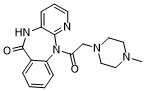
Physicochemical Properties
| Molecular Formula | C19H21N5O2 |
| Molecular Weight | 351.41 |
| Exact Mass | 351.169 |
| Elemental Analysis | C, 64.94; H, 6.02; N, 19.93; O, 9.11 |
| CAS # | 28797-61-7 |
| Related CAS # | Pirenzepine dihydrochloride;29868-97-1;Pirenzepine-d8 dihydrochloride;Pirenzepine-d8 |
| PubChem CID | 4848 |
| Appearance | Light yellow to yellow solid powder |
| Density | 1.3±0.1 g/cm3 |
| Boiling Point | 541.7±50.0 °C at 760 mmHg |
| Melting Point | 226 - 230ºC |
| Flash Point | 281.4±30.1 °C |
| Vapour Pressure | 0.0±1.4 mmHg at 25°C |
| Index of Refraction | 1.615 |
| LogP | -0.08 |
| Hydrogen Bond Donor Count | 1 |
| Hydrogen Bond Acceptor Count | 5 |
| Rotatable Bond Count | 2 |
| Heavy Atom Count | 26 |
| Complexity | 534 |
| Defined Atom Stereocenter Count | 0 |
| SMILES | CN1CCN(CC(N2C3=CC=CC=C3C(NC4=C2N=CC=C4)=O)=O)CC1 |
| InChi Key | RMHMFHUVIITRHF-UHFFFAOYSA-N |
| InChi Code | InChI=1S/C19H21N5O2/c1-22-9-11-23(12-10-22)13-17(25)24-16-7-3-2-5-14(16)19(26)21-15-6-4-8-20-18(15)24/h2-8H,9-13H2,1H3,(H,21,26) |
| Chemical Name | 6H-Pyrido(2,3-b)(1,4)benzodiazepin-6-one, 5,11-dihydro-11-((4-methyl-1-piperazinyl)acetyl)- |
| Synonyms | Pirenzepine free base; Pirenzepin; |
| HS Tariff Code | 2934.99.9001 |
| Storage |
Powder-20°C 3 years 4°C 2 years In solvent -80°C 6 months -20°C 1 month |
| Shipping Condition | Room temperature (This product is stable at ambient temperature for a few days during ordinary shipping and time spent in Customs) |
Biological Activity
| ln Vitro | The proliferative activity of PC-3 cells is inhibited by pinenepine (100-140 μg/mL; 24 hours)]. Lung and prostate cancer cells migrate less when exposed to penerepine (110 μg/mL for 24 hours) [2]. GLI1 expression is inhibited in PC-3 cells by pinenepine (100–130 μg/mL; 0–24 hours) [2]. |
| ln Vivo | In lipopolysaccharide-induced septic shock, pirenzepine treatment (intraperitoneal injection; 0.3 mg/kg; once) has demonstrated positive results [3]. |
| Cell Assay |
Cell proliferation assay [2] Cell Types: PC-3 Cell Tested Concentrations: 100-140 μg/mL Incubation Duration: 24 hrs (hours) Experimental Results: Inhibited PC-3 cell proliferation in a concentration-dependent manner. Cell migration experiment [2] Cell Types: PC-3 and A549 cells Tested Concentrations: 110 μg/mL Incubation Duration: 24 hrs (hours) Experimental Results: Inhibited the migration of PC-3 and A549 cell lines (P=0.014). Western Blot Analysis [2] Cell Types: PC-3 cells Tested Concentrations: 110 μg/mL Incubation Duration: 0-24 hrs (hours) Experimental Results: Inhibition of the expression of GLI1 and PTCH1. RT-PCR[2] Cell Types: PC-3 cells Tested Concentrations: 100-130 μg/mL Incubation Duration: 24 hrs (hours) Experimental Results: GLI1 mRNA expression was inhibited in PC-3 cells. PTCH1 mRNA levels were increased but did not reach statistical significance. SHH mRNA expression levels did not change. |
| Animal Protocol |
Animal/Disease Models: Experimental endotoxemia male C57BL/6 mice [3] Doses: 0.3 mg/kg Route of Administration: intraperitoneal (ip) injection; 0.3 mg/kg; one-time Experimental Results:improve the survival rate of septic shock caused by LPS. Alleviates LPS-induced lung and liver damage. diminished SOCS3 expression at the mRNA level. |
| References |
[1]. Pirenzepine. A review of its pharmacodynamic and pharmacokinetic properties and therapeutic efficacy in peptic ulcer disease and other allied diseases. Drugs. 1985 Aug;30(2):85-126. [2]. Muscarinic acetylcholine receptor M1 mediates prostate cancer cell migration and invasion through hedgehog signaling. Asian J Androl. 2018 Nov-Dec;20(6):608-614. [3]. The T-type calcium channel enhancer SAK3 inhibits neuronal death following transient brain ischemia via nicotinic acetylcholine receptor stimulation. Neurochem Int. 2017 Sep;108:272-281. |
| Additional Infomation |
Pirenzepine is a pyridobenzodiazepine. It has a role as an anti-ulcer drug, a muscarinic antagonist and an antispasmodic drug. An antimuscarinic agent that inhibits gastric secretion at lower doses than are required to affect gastrointestinal motility, salivary, central nervous system, cardiovascular, ocular, and urinary function. It promotes the healing of duodenal ulcers and due to its cytoprotective action is beneficial in the prevention of duodenal ulcer recurrence. It also potentiates the effect of other antiulcer agents such as cimetidine and ranitidine. It is generally well tolerated by patients. An antimuscarinic agent that inhibits gastric secretion at lower doses than are required to affect gastrointestinal motility, salivary, central nervous system, cardiovascular, ocular, and urinary function. It promotes the healing of duodenal ulcers and due to its cytoprotective action is beneficial in the prevention of duodenal ulcer recurrence. It also potentiates the effect of other antiulcer agents such as CIMETIDINE and RANITIDINE. It is generally well tolerated by patients. Drug Indication For the treatment of peptic ulcer, gastric ulcer, and duodenal ulcer. Mechanism of Action Pirenzepine is a muscarinic receptor antagonist and binds to the muscarinic acetylcholine receptor. The muscarinic acetylcholine receptor mediates various cellular responses, including inhibition of adenylate cyclase, breakdown of phosphoinositides and modulation of potassium channels through the action of G proteins. Pharmacodynamics Pirenzepine belongs to a group of medications called antispasmodics/anticholinergics. These medications are used to relieve cramps or spasms of the stomach, intestines, and bladder. Pirenzepine is used to treat duodenal or stomach ulcers or intestine problems. It can be used together with antacids or other medicine in the treatment of peptic ulcer. It may also be used to prevent nausea, vomiting, and motion sickness. |
Solubility Data
| Solubility (In Vitro) | May dissolve in DMSO (in most cases), if not, try other solvents such as H2O, Ethanol, or DMF with a minute amount of products to avoid loss of samples |
| Solubility (In Vivo) |
Note: Listed below are some common formulations that may be used to formulate products with low water solubility (e.g. < 1 mg/mL), you may test these formulations using a minute amount of products to avoid loss of samples. Injection Formulations (e.g. IP/IV/IM/SC) Injection Formulation 1: DMSO : Tween 80: Saline = 10 : 5 : 85 (i.e. 100 μL DMSO stock solution → 50 μL Tween 80 → 850 μL Saline) *Preparation of saline: Dissolve 0.9 g of sodium chloride in 100 mL ddH ₂ O to obtain a clear solution. Injection Formulation 2: DMSO : PEG300 :Tween 80 : Saline = 10 : 40 : 5 : 45 (i.e. 100 μL DMSO → 400 μLPEG300 → 50 μL Tween 80 → 450 μL Saline) Injection Formulation 3: DMSO : Corn oil = 10 : 90 (i.e. 100 μL DMSO → 900 μL Corn oil) Example: Take the Injection Formulation 3 (DMSO : Corn oil = 10 : 90) as an example, if 1 mL of 2.5 mg/mL working solution is to be prepared, you can take 100 μL 25 mg/mL DMSO stock solution and add to 900 μL corn oil, mix well to obtain a clear or suspension solution (2.5 mg/mL, ready for use in animals). Injection Formulation 4: DMSO : 20% SBE-β-CD in saline = 10 : 90 [i.e. 100 μL DMSO → 900 μL (20% SBE-β-CD in saline)] *Preparation of 20% SBE-β-CD in Saline (4°C,1 week): Dissolve 2 g SBE-β-CD in 10 mL saline to obtain a clear solution. Injection Formulation 5: 2-Hydroxypropyl-β-cyclodextrin : Saline = 50 : 50 (i.e. 500 μL 2-Hydroxypropyl-β-cyclodextrin → 500 μL Saline) Injection Formulation 6: DMSO : PEG300 : castor oil : Saline = 5 : 10 : 20 : 65 (i.e. 50 μL DMSO → 100 μLPEG300 → 200 μL castor oil → 650 μL Saline) Injection Formulation 7: Ethanol : Cremophor : Saline = 10: 10 : 80 (i.e. 100 μL Ethanol → 100 μL Cremophor → 800 μL Saline) Injection Formulation 8: Dissolve in Cremophor/Ethanol (50 : 50), then diluted by Saline Injection Formulation 9: EtOH : Corn oil = 10 : 90 (i.e. 100 μL EtOH → 900 μL Corn oil) Injection Formulation 10: EtOH : PEG300:Tween 80 : Saline = 10 : 40 : 5 : 45 (i.e. 100 μL EtOH → 400 μLPEG300 → 50 μL Tween 80 → 450 μL Saline) Oral Formulations Oral Formulation 1: Suspend in 0.5% CMC Na (carboxymethylcellulose sodium) Oral Formulation 2: Suspend in 0.5% Carboxymethyl cellulose Example: Take the Oral Formulation 1 (Suspend in 0.5% CMC Na) as an example, if 100 mL of 2.5 mg/mL working solution is to be prepared, you can first prepare 0.5% CMC Na solution by measuring 0.5 g CMC Na and dissolve it in 100 mL ddH2O to obtain a clear solution; then add 250 mg of the product to 100 mL 0.5% CMC Na solution, to make the suspension solution (2.5 mg/mL, ready for use in animals). Oral Formulation 3: Dissolved in PEG400 Oral Formulation 4: Suspend in 0.2% Carboxymethyl cellulose Oral Formulation 5: Dissolve in 0.25% Tween 80 and 0.5% Carboxymethyl cellulose Oral Formulation 6: Mixing with food powders Note: Please be aware that the above formulations are for reference only. InvivoChem strongly recommends customers to read literature methods/protocols carefully before determining which formulation you should use for in vivo studies, as different compounds have different solubility properties and have to be formulated differently. (Please use freshly prepared in vivo formulations for optimal results.) |
| Preparing Stock Solutions | 1 mg | 5 mg | 10 mg | |
| 1 mM | 2.8457 mL | 14.2284 mL | 28.4568 mL | |
| 5 mM | 0.5691 mL | 2.8457 mL | 5.6914 mL | |
| 10 mM | 0.2846 mL | 1.4228 mL | 2.8457 mL |