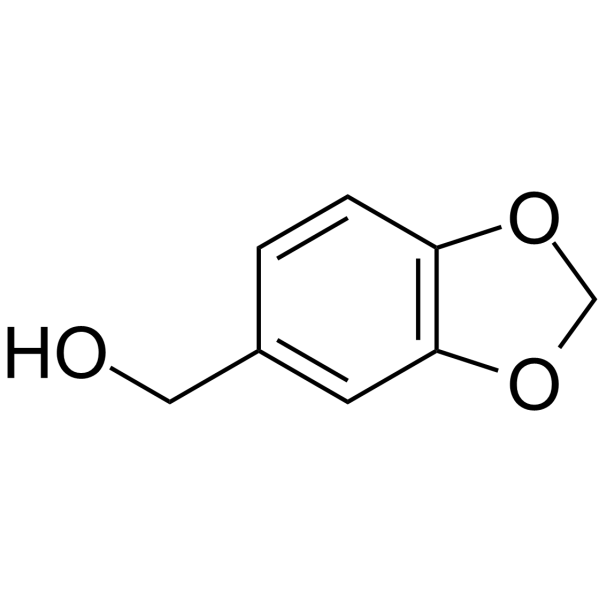
Physicochemical Properties
| Molecular Formula | C8H8O3 |
| Molecular Weight | 152.15 |
| Exact Mass | 152.047 |
| CAS # | 495-76-1 |
| PubChem CID | 10322 |
| Appearance |
Needles from petroleum ether White to yellow powder, crystals or chunks |
| Density | 1.3±0.1 g/cm3 |
| Boiling Point | 282.2±9.0 °C at 760 mmHg |
| Melting Point | 50-54 °C(lit.) |
| Flash Point | 124.5±18.7 °C |
| Vapour Pressure | 0.0±0.6 mmHg at 25°C |
| Index of Refraction | 1.595 |
| LogP | 0.9 |
| Hydrogen Bond Donor Count | 1 |
| Hydrogen Bond Acceptor Count | 3 |
| Rotatable Bond Count | 1 |
| Heavy Atom Count | 11 |
| Complexity | 137 |
| Defined Atom Stereocenter Count | 0 |
| SMILES | O1C([H])([H])OC2C([H])=C([H])C(C([H])([H])O[H])=C([H])C1=2 |
| InChi Key | BHUIUXNAPJIDOG-UHFFFAOYSA-N |
| InChi Code | InChI=1S/C8H8O3/c9-4-6-1-2-7-8(3-6)11-5-10-7/h1-3,9H,4-5H2 |
| Chemical Name | 1,3-benzodioxol-5-ylmethanol |
| HS Tariff Code | 2934.99.9001 |
| Storage |
Powder-20°C 3 years 4°C 2 years In solvent -80°C 6 months -20°C 1 month |
| Shipping Condition | Room temperature (This product is stable at ambient temperature for a few days during ordinary shipping and time spent in Customs) |
Biological Activity
| ADME/Pharmacokinetics |
Absorption, Distribution and Excretion ... Male Swiss-Webster-mice, Sprague-Dawley-rats, or hamsters were administered 13 carbon-14 labeled MDP compounds such as tropital, piperonal, piperonyl-alcohol, piperonylic-acid, safrole, dihydrosafrole, or piperonyl-butoxide. Urine, feces, and expired air were collected for 48 hours for carbon-14 assay. Carbon-14 activity in the intestine, liver, and carcass was determined. ... Carbon-dioxide was not an important route of elimination in the metabolism of piperonyl-alcohol, piperonal, piperonylic-acid, and tropital. Their metabolites were excreted primarily in the urine. ... Metabolism / Metabolites The metabolism of methylenedioxyphenyl (MDP) compounds was studied in mammals. The purpose of the study was to investigate the mechanism and significance of demethylation of MDP and similar compounds in relation to the metabolism and mode of action of commercial synergist chemicals such as piperonyl-butoxide and tropital. Male Swiss-Webster-mice, Sprague-Dawley-rats, or hamsters were administered 13 carbon-14 labeled MDP compounds such as tropital, piperonal, piperonyl-alcohol, piperonylic-acid, safrole, dihydrosafrole, or piperonyl-butoxide. Urine, feces, and expired air were collected for 48 hours for carbon-14 assay. Carbon-14 activity in the intestine, liver, and carcass was determined. Urine samples were analyzed for metabolites. Compounds such as dihydrosafrole, safrole, myristicin, and piperonyl-butoxide were largely metabolized by oxidation of the methylene group of the MDP moiety to yield radiolabeled carbon-dioxide. The radiolabel ultimately appearing as carbon-dioxide was first liberated as radioactive formate. Carbon-dioxide was not an important route of elimination in the metabolism of piperonyl-alcohol, piperonal, piperonylic-acid, and tropital. Their metabolites were excreted primarily in the urine. No marked species difference was noted in carbon-14 tissue distribution after dosing with tropital and piperonyl-butoxide. Oxidation or conjugation of the side chain was the major metabolic pathway for tropital, piperonal, piperonyl-alcohol, and piperonylic-acid. Urinary metabolites of piperonyl-butoxide included many compounds lacking the MDP moiety and small amounts of 6-propyl-piperonylic-acid and its glycine conjugate. Urinary metabolites of tropital included glycine and glucuronic-acid conjugates of piperonylic-acid. In an in-vitro experiment, radiolabeled piperonyl-butoxide, tropital, safrole, and other MDP compounds were incubated with mouse liver microsomes and were assayed for metabolites. Metabolites such as formate and catechols were detected. The authors conclude that demethylation of the MDP moiety is the major metabolic pathway in mammals given piperonyl-butoxide, safrole, dihydrosafrole and myristicin. After oral administration of piperine (170 mg/kg) to rats, the metabolites in bile and urine were examined by thin-layer chromatography, high-performance liquid chromatography and combined gas chromatography-mass spectrometry. Four metabolites of piperine, viz. piperonylic acid, piperonyl alcohol, piperonal and vanillic acid were identified in the free form in 0-96 hr urine whereas only piperic acid was detected in 0-6 hr bile. ... The neolignan, burchellin, a natural compound that reduces urine excretion in larvae of the bloodsucking bug, Rhodnius prolixus, a vector of Chagas' disease, is rapidly degraded in the hemolymph of the insect. The main product that accumulates in this tissue has been shown to be piperonyl alcohol. Other catabolites have been identified by GC-MS analysis. |
| Toxicity/Toxicokinetics |
Toxicity Summary IDENTIFICATION AND USE: Piperonyl alcohol is a benzodioxole derivative. It is biocompatible and can be used in chemical synthesis as an initiator. HUMAN STUDIES: There are no data available. ANIMAL STUDIES: Oxidation or conjugation of the side chain was the major metabolic pathway for piperonyl alcohol in mice, rats, or hamsters. |
| References | [1]. Lima GDS, et al. Long-term bonding efficacy of adhesives containing benzodioxioles as alternative co-initiators. Braz Oral Res. 2018;32:e104. Published 2018 Oct 11. |
| Additional Infomation | Piperonol is a member of benzodioxoles. |
Solubility Data
| Solubility (In Vitro) | DMSO: 100 mg/mL (657.25 mM) |
| Solubility (In Vivo) |
Solubility in Formulation 1: ≥ 2.5 mg/mL (16.43 mM) (saturation unknown) in 10% DMSO + 40% PEG300 + 5% Tween80 + 45% Saline (add these co-solvents sequentially from left to right, and one by one), clear solution. For example, if 1 mL of working solution is to be prepared, you can add 100 μL of 25.0 mg/mL clear DMSO stock solution to 400 μL PEG300 and mix evenly; then add 50 μL Tween-80 to the above solution and mix evenly; then add 450 μL normal saline to adjust the volume to 1 mL. Preparation of saline: Dissolve 0.9 g of sodium chloride in 100 mL ddH₂ O to obtain a clear solution. Solubility in Formulation 2: 2.5 mg/mL (16.43 mM) in 10% DMSO + 90% (20% SBE-β-CD in Saline) (add these co-solvents sequentially from left to right, and one by one), suspension solution; with ultrasonication. For example, if 1 mL of working solution is to be prepared, you can add 100 μL of 25.0 mg/mL clear DMSO stock solution to 900 μL of 20% SBE-β-CD physiological saline solution and mix evenly. Preparation of 20% SBE-β-CD in Saline (4°C,1 week): Dissolve 2 g SBE-β-CD in 10 mL saline to obtain a clear solution. Solubility in Formulation 3: ≥ 2.5 mg/mL (16.43 mM) (saturation unknown) in 10% DMSO + 90% Corn Oil (add these co-solvents sequentially from left to right, and one by one), clear solution. For example, if 1 mL of working solution is to be prepared, you can add 100 μL of 25.0 mg/mL clear DMSO stock solution to 900 μL of corn oil and mix evenly. (Please use freshly prepared in vivo formulations for optimal results.) |
| Preparing Stock Solutions | 1 mg | 5 mg | 10 mg | |
| 1 mM | 6.5725 mL | 32.8623 mL | 65.7246 mL | |
| 5 mM | 1.3145 mL | 6.5725 mL | 13.1449 mL | |
| 10 mM | 0.6572 mL | 3.2862 mL | 6.5725 mL |