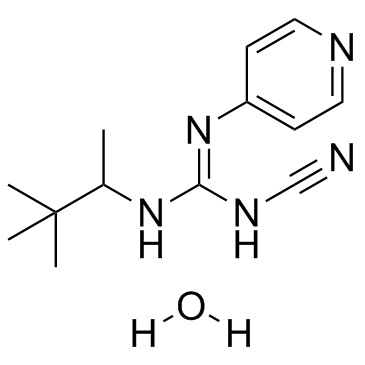
Physicochemical Properties
| Molecular Formula | C13H19N5.H2O |
| Molecular Weight | 263.33874 |
| Exact Mass | 263.174 |
| CAS # | 85371-64-8 |
| Related CAS # | Pinacidil;60560-33-0 |
| PubChem CID | 55329 |
| Appearance | White to off-white solid powder |
| Boiling Point | 356.7ºC at 760 mmHg |
| Melting Point | 164-165ºC |
| Flash Point | 169.5ºC |
| LogP | 2.945 |
| Hydrogen Bond Donor Count | 3 |
| Hydrogen Bond Acceptor Count | 4 |
| Rotatable Bond Count | 5 |
| Heavy Atom Count | 19 |
| Complexity | 327 |
| Defined Atom Stereocenter Count | 0 |
| InChi Key | AFJCNBBHEVLGCZ-UHFFFAOYSA-N |
| InChi Code | InChI=1S/C13H19N5.H2O/c1-10(13(2,3)4)17-12(16-9-14)18-11-5-7-15-8-6-11;/h5-8,10H,1-4H3,(H2,15,16,17,18);1H2 |
| Chemical Name | 1-cyano-2-(3,3-dimethylbutan-2-yl)-3-pyridin-4-ylguanidine;hydrate |
| HS Tariff Code | 2934.99.9001 |
| Storage |
Powder-20°C 3 years 4°C 2 years In solvent -80°C 6 months -20°C 1 month Note: Please store this product in a sealed and protected environment, avoid exposure to moisture. |
| Shipping Condition | Room temperature (This product is stable at ambient temperature for a few days during ordinary shipping and time spent in Customs) |
Biological Activity
| ln Vitro | Pinacidil monohydrate is a potassium channel activator [1]. Pinacidil hydrate is an antihypertensive medication classified as a "potassium channel opener" [2]. Pinacidil hydrate activates ATP-regulated potassium channels in the Guinea pig bladder and heart at Ki values of 104 and 251 nM, respectively [3]. |
| References |
[1]. Relaxant effects of the potassium channel activators BRL 38227 and pinacidil on guinea-pig and human airway smooth muscle, and blockade of their effects by glibenclamide and BRL 31660. Pulm Pharmacol. 1993 Mar;6(1):77-86. [2]. Pharmacodynamics and pharmacokinetics of pinacidil in normotensive volunteers after repeated doses of a new slow-release tablet formulation. Arzneimittelforschung. 1999 Jan;49(1):21-5. [3]. Pinacidil relaxes porcine and human coronary arteries by activating ATP-dependent potassium channels in smooth muscle cells. J Pharmacol Exp Ther. 1995 Nov;275(2):681-92. |
| Additional Infomation |
Pinacidil is an organic molecular entity. A guanidine that opens POTASSIUM CHANNELS producing direct peripheral vasodilatation of the ARTERIOLES. It reduces BLOOD PRESSURE and peripheral resistance and produces fluid retention. (Martindale The Extra Pharmacopoeia, 31st ed) See also: Pinacidil (annotation moved to). |
Solubility Data
| Solubility (In Vitro) |
DMSO : ~100 mg/mL (~379.74 mM) Ethanol : ~50 mg/mL (~189.87 mM) H2O : < 0.1 mg/mL |
| Solubility (In Vivo) |
Solubility in Formulation 1: ≥ 2.5 mg/mL (9.49 mM) (saturation unknown) in 10% EtOH + 40% PEG300 + 5% Tween80 + 45% Saline (add these co-solvents sequentially from left to right, and one by one), clear solution. For example, if 1 mL of working solution is to be prepared, you can add 100 μL of 25.0 mg/mL clear EtOH stock solution to 400 μL PEG300 and mix evenly; then add 50 μL Tween-80 to the above solution and mix evenly; then add 450 μL normal saline to adjust the volume to 1 mL. Preparation of saline: Dissolve 0.9 g of sodium chloride in 100 mL ddH₂ O to obtain a clear solution. Solubility in Formulation 2: ≥ 2.5 mg/mL (9.49 mM) (saturation unknown) in 10% EtOH + 90% (20% SBE-β-CD in Saline) (add these co-solvents sequentially from left to right, and one by one), clear solution. For example, if 1 mL of working solution is to be prepared, you can add 100 μL of 25.0 mg/mL clear EtOH stock solution to 900 μL of 20% SBE-β-CD physiological saline solution and mix evenly. Preparation of 20% SBE-β-CD in Saline (4°C,1 week): Dissolve 2 g SBE-β-CD in 10 mL saline to obtain a clear solution. Solubility in Formulation 3: ≥ 2.5 mg/mL (9.49 mM) (saturation unknown) in 10% EtOH + 90% Corn Oil (add these co-solvents sequentially from left to right, and one by one), clear solution. For example, if 1 mL of working solution is to be prepared, you can add 100 μL of 25.0 mg/mL clear EtOH stock solution to 900 μL of corn oil and mix evenly. Solubility in Formulation 4: ≥ 1.83 mg/mL (6.95 mM) (saturation unknown) in 10% DMSO + 40% PEG300 + 5% Tween80 + 45% Saline (add these co-solvents sequentially from left to right, and one by one), clear solution. For example, if 1 mL of working solution is to be prepared, you can add 100 μL of 18.3 mg/mL clear DMSO stock solution to 400 μL of PEG300 and mix evenly; then add 50 μL of Tween-80 to the above solution and mix evenly; then add 450 μL of normal saline to adjust the volume to 1 mL. Preparation of saline: Dissolve 0.9 g of sodium chloride in 100 mL ddH₂ O to obtain a clear solution. Solubility in Formulation 5: ≥ 1.83 mg/mL (6.95 mM) (saturation unknown) in 10% DMSO + 90% (20% SBE-β-CD in Saline) (add these co-solvents sequentially from left to right, and one by one), clear solution. For example, if 1 mL of working solution is to be prepared, you can add 100 μL of 18.3 mg/mL clear DMSO stock solution to 900 μL of 20% SBE-β-CD physiological saline solution and mix evenly. Preparation of 20% SBE-β-CD in Saline (4°C,1 week): Dissolve 2 g SBE-β-CD in 10 mL saline to obtain a clear solution. Solubility in Formulation 6: ≥ 1.83 mg/mL (6.95 mM) (saturation unknown) in 10% DMSO + 90% Corn Oil (add these co-solvents sequentially from left to right, and one by one), clear solution. For example, if 1 mL of working solution is to be prepared, you can add 100 μL of 18.3 mg/mL clear DMSO stock solution to 900 μL of corn oil and mix evenly. (Please use freshly prepared in vivo formulations for optimal results.) |
| Preparing Stock Solutions | 1 mg | 5 mg | 10 mg | |
| 1 mM | 3.7974 mL | 18.9869 mL | 37.9737 mL | |
| 5 mM | 0.7595 mL | 3.7974 mL | 7.5947 mL | |
| 10 mM | 0.3797 mL | 1.8987 mL | 3.7974 mL |