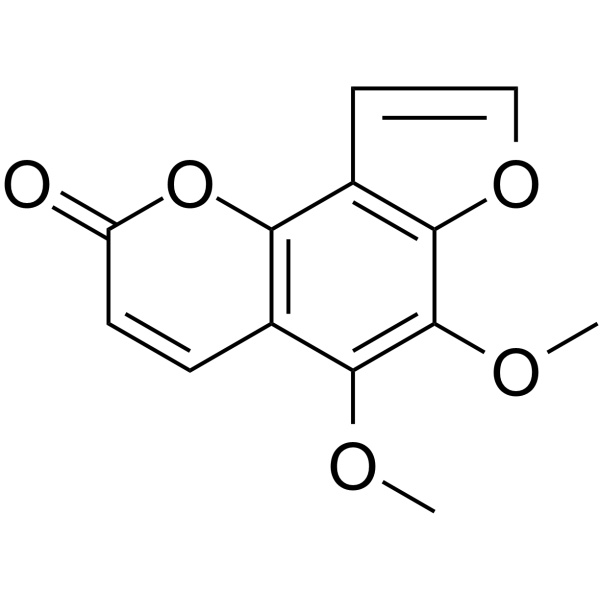
Physicochemical Properties
| Molecular Formula | C13H10O5 |
| Molecular Weight | 246.2155 |
| Exact Mass | 246.052 |
| CAS # | 131-12-4 |
| PubChem CID | 4825 |
| Appearance | White to off-white solid powder |
| Density | 1.4±0.1 g/cm3 |
| Boiling Point | 441.0±45.0 °C at 760 mmHg |
| Melting Point | 119° |
| Flash Point | 220.5±28.7 °C |
| Vapour Pressure | 0.0±1.1 mmHg at 25°C |
| Index of Refraction | 1.612 |
| LogP | 2.06 |
| Hydrogen Bond Donor Count | 0 |
| Hydrogen Bond Acceptor Count | 5 |
| Rotatable Bond Count | 2 |
| Heavy Atom Count | 18 |
| Complexity | 366 |
| Defined Atom Stereocenter Count | 0 |
| InChi Key | BQPRWZCEKZLBHL-UHFFFAOYSA-N |
| InChi Code | InChI=1S/C13H10O5/c1-15-11-7-3-4-9(14)18-10(7)8-5-6-17-12(8)13(11)16-2/h3-6H,1-2H3 |
| Chemical Name | 5,6-dimethoxyfuro[2,3-h]chromen-2-one |
| HS Tariff Code | 2934.99.9001 |
| Storage |
Powder-20°C 3 years 4°C 2 years In solvent -80°C 6 months -20°C 1 month Note: This product requires protection from light (avoid light exposure) during transportation and storage. |
| Shipping Condition | Room temperature (This product is stable at ambient temperature for a few days during ordinary shipping and time spent in Customs) |
Biological Activity
| ln Vitro |
Pimpinellin shows effective cytotoxic action against three tumor cells: MGC-803, PC3 and A375, with IC50 values of 14.4±0.3 μM, 20.4±0.5 μM and 29.2±0.6 μM respectively. Pimpinellin suppresses the growth of MGC-803 cells by causing tumor cell apoptosis, and the cell apoptosis rate was 27.44% after treatment at 20 μM for 72 hours [1]. Pimpinellin exhibited potent cytotoxic activities against human tumor cell lines MGC-803 (stomach cancer), PC3 (prostate cancer), and A375 (malignant melanoma) in vitro, with IC₅₀ values of 14.4 ± 0.3 µM, 20.4 ± 0.5 µM, and 29.2 ± 0.6 µM, respectively. It showed lower cytotoxicity against the normal mouse fibroblast cell line NIH3T3 (IC₅₀ > 100 µM). Pimpinellin (20 µM) induced apoptosis in MGC-803 cells, as evidenced by AO/EB staining, Hoechst 33258 staining, TUNEL assay, and flow cytometry analysis. The apoptosis ratio reached 27.44% after 72 hours of treatment. Treatment with pimpinellin caused morphological changes in MGC-803 cells, including nuclear condensation, membrane blebbing, and cell budding, characteristic of apoptosis. The inhibitory percentages of pimpinellin (20 µM, 72 h) on cell growth were 67.1% for MGC-803, 57.2% for PC3, 45.8% for A375, and 24.8% for NIH3T3. [1] |
| Cell Assay |
Cell viability was assessed using the MTT assay. Cells were seeded in 96-well plates, treated with various concentrations of pimpinellin or extracts for 72 hours, then incubated with MTT reagent. The formazan product was dissolved, and absorbance was measured at 595 nm. AO/EB staining was performed to assess apoptosis. Cells grown on coverslips were treated, stained with an AO/EB mixture, and observed under a fluorescence microscope to distinguish live, apoptotic, and dead cells based on nuclear fluorescence color. Hoechst 33258 staining was used to detect apoptotic nuclei. After treatment, cells were fixed, stained with Hoechst 33258, and observed under a fluorescence microscope. Apoptotic cells exhibited bright, condensed blue nuclei. TUNEL assay was conducted to detect DNA fragmentation, a hallmark of apoptosis. Cells were fixed, permeabilized, incubated with TdT enzyme and Biotin-dUTP, followed by streptavidin-HRP and DAB staining. Brown precipitate indicated apoptotic cells. Apoptosis was quantitatively analyzed by flow cytometry using Annexin V-FITC and propidium iodide (PI) double staining. Cells were harvested, resuspended in binding buffer, stained with Annexin V-FITC and PI, and analyzed to distinguish early apoptotic, late apoptotic, and necrotic cells. [1] |
| Toxicity/Toxicokinetics |
Toxicity Summary IDENTIFICATION AND USE: Pimpinellin is a component of Angelica dahurica roots which is a medicinal plant widely used in China for the treatment of symptoms related to allergic inflammation. HUMAN STUDIES: Photoepicutaneous testing showed phototoxic effects from pimpinellin. Action spectrum studies demonstrated peak photosensitivity in the range 330-335 nm. It inhibited growth of human carcinoma cells. Moreover, pimpinellin inhibited the growth of tumor cells via the induction of tumor cell apoptosis. ANIMAL STUDIES: Pimpinellin was phototoxic the in vitro Candida test. Pimpinellin acts as antagonist of proteins with GABA receptor activity (L579). The mechanism of action many furocoumarins is based on their ability to form photoadducts with DNA and other cellular components such as RNA, proteins, and several proteins found in the membrane such as phospholipases A2 and C, Ca-dependent and cAMPdependent protein-kinase and epidermal growth factor. Furocoumarins intercalate between base pairs of DNA and after ultraviolet-A irradiation, giving cycloadducts. (L579). Interactions Investigations on light reactions in a patient with vitiligo are presented. The minimal erythema dose (MED) in the UVB area was approximately 1/3 of that in persons of skin type II. The application of furocoumarins (psoralens) increased light tolerance by 1 MED at 300-310 nm. Action spectrum studies with furocoumarins from Heracleum laciniatum showed the following order of potency: bergapten, pimpinellin, angelicin and sphondin. The efficacy was highest at 325-350 nm, with maxima at 330-335 nm. Pimpinellin was recently found to be phototoxic, but an action spectrum of sphondin is reported for the first time. |
| References |
[1]. Discovery and antitumor activities of constituents from Cyrtomium fortumei (J.) Smith rhizomes. Chem Cent J. 2013 Feb 4;7(1):24. |
| Additional Infomation |
Pimpinellin is a furanocoumarin. Pimpinellin has been reported in Heracleum dissectum, Angelica dahurica var. formosana, and other organisms with data available. Pimpinellin is a furocoumarin. Furocoumarins, are phototoxic and photocarcinogenic. They intercalate DNA and photochemically induce mutations. Furocoumarins are botanical phytoalexins found to varying extents in a variety of vegetables and fruits, notably citrus fruits. The levels of furocoumarins present in our diets, while normally well below that causing evident acute phototoxicity, do cause pharmacologically relevant drug interactions. Some are particularly active against cytochrome P450s. For example, in humans, bergamottin and dihydroxybergamottin are responsible for the 'grapefruit juice effect', in which these furanocoumarins affect the metabolism of certain drugs. Therapeutic Uses /EXPL THER/ The presented work reports anticholinesterase and antioxidant activities of extracts, fractions from aerial parts, fruits, flowers, roots and isolated compounds of roots from Leiotulus dasyanthus (bergapten, pimpinellin, umbelliferone, quercetin, rutin and kaempferol). Phenolic contents, antioxidant activities of samples were carried out by Folin-Ciocalteu, DPPH, TBA methods. Anticholinesterase activity was evaluated by Ellman's method. The highest and lowest total phenolic content were detected in root MeOH extract (88.6 mg GAE/g DW) and aerial part (51.83 mg GAE/g DW), respectively. The highest antioxidant activity among isolated secondary metabolites got coumarins umbelliferone, bergapten and pimpinellin. Pimpinellin (66.55%) and umbelliferone (61.09%) demonstrated strong inhibition towards acetylcholinesterase and butyrylcholinesterase, respectively. Dichloromethane fraction of root demonstrated significant inhibition against AChE (49.66%) and BuChE (92.21%) at 20 ug/mL. Dichloromethane fractions of roots had a notableness antioxidant and anticholinesterase activities. The further studies on roots will be important for development use of this plant for pharmaceutical and food research needs. Pimpinellin is a compound isolated for the first time from the rhizomes of Cyrtomium fortunei (J.) Smith. It demonstrated significant antitumor activity in vitro, primarily through the induction of apoptosis in cancer cells. [1] |
Solubility Data
| Solubility (In Vitro) | DMSO : ~100 mg/mL (~406.14 mM) |
| Solubility (In Vivo) |
Solubility in Formulation 1: ≥ 2.5 mg/mL (10.15 mM) (saturation unknown) in 10% DMSO + 90% Corn Oil (add these co-solvents sequentially from left to right, and one by one), clear solution. For example, if 1 mL of working solution is to be prepared, you can add 100 μL of 25.0 mg/mL clear DMSO stock solution to 900 μL of corn oil and mix evenly. (Please use freshly prepared in vivo formulations for optimal results.) |
| Preparing Stock Solutions | 1 mg | 5 mg | 10 mg | |
| 1 mM | 4.0614 mL | 20.3070 mL | 40.6141 mL | |
| 5 mM | 0.8123 mL | 4.0614 mL | 8.1228 mL | |
| 10 mM | 0.4061 mL | 2.0307 mL | 4.0614 mL |