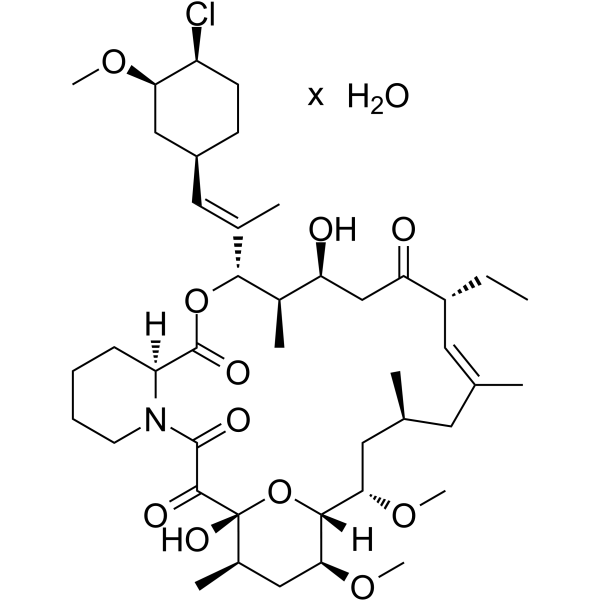
Physicochemical Properties
| Molecular Formula | C43H70CLNO12 |
| Molecular Weight | 828.47 |
| Exact Mass | 827.458 |
| CAS # | 1000802-56-1 |
| Related CAS # | Pimecrolimus;137071-32-0 |
| PubChem CID | 91886159 |
| Appearance | White to off-white solid powder |
| Hydrogen Bond Donor Count | 3 |
| Hydrogen Bond Acceptor Count | 12 |
| Rotatable Bond Count | 6 |
| Heavy Atom Count | 57 |
| Complexity | 1440 |
| Defined Atom Stereocenter Count | 14 |
| SMILES | O([C@H]1C[C@@H](C)[C@@]2(C(C(N3CCCC[C@@]3([H])C(O[C@@H]([C@H](C)[C@@H](O)CC(=O)[C@H](CC)C=C(C)C[C@H](C)C[C@H](OC)[C@@]1([H])O2)/C(/C)=C/[C@@H]1CC[C@H](Cl)[C@H](OC)C1)=O)=O)=O)O)C.O |t:29,&1:1,3,5,13,17,18,20,25,32,35,38,44,47,49| |
| InChi Key | NZIZEODSJUZSHZ-MNZFELGNSA-N |
| InChi Code | InChI=1S/C43H68ClNO11.H2O/c1-10-30-18-24(2)17-25(3)19-36(53-8)39-37(54-9)21-27(5)43(51,56-39)40(48)41(49)45-16-12-11-13-32(45)42(50)55-38(28(6)33(46)23-34(30)47)26(4)20-29-14-15-31(44)35(22-29)52-7;/h18,20,25,27-33,35-39,46,51H,10-17,19,21-23H2,1-9H3;1H2/b24-18+,26-20+;/t25-,27+,28+,29-,30+,31-,32-,33-,35+,36-,37-,38+,39+,43+;/m0./s1 |
| Chemical Name | (1R,9S,12S,13R,14S,17R,18E,21S,23S,24R,25S,27R)-12-[(E)-1-[(1R,3R,4S)-4-chloro-3-methoxycyclohexyl]prop-1-en-2-yl]-17-ethyl-1,14-dihydroxy-23,25-dimethoxy-13,19,21,27-tetramethyl-11,28-dioxa-4-azatricyclo[22.3.1.04,9]octacos-18-ene-2,3,10,16-tetrone;hydrate |
| Synonyms | 89GTE436P6; UNII-89GTE436P6; 1000802-56-1; 15,19-EPOXY-3H-PYRIDO(2,1-C)(1,4)OXAAZACYCLOTRICOSINE-1,7,20,21(4H,23H)-TETRONE, 3-((1E)-2-((1R,3R,4S)-4-CHLORO-3-METHOXYCYCLOHEXYL)-1-METHYLETHENYL)-8-ETHYL-5,6,8,11,12,13,14,15,16,17,18,19,24,25,26,26A-HEXADECAHYDRO-5,19-DIHYDROXY-14,16-DIMETHOXY-4,10,12,18-TETRAMETHYL-, HYDRATE, (3S,4R,5S,8R,9E,12S,14S,15R,16S,18R,19R,26AS)- |
| HS Tariff Code | 2934.99.9001 |
| Storage |
Powder-20°C 3 years 4°C 2 years In solvent -80°C 6 months -20°C 1 month Note: Please store this product in a sealed and protected environment, avoid exposure to moisture. |
| Shipping Condition | Room temperature (This product is stable at ambient temperature for a few days during ordinary shipping and time spent in Customs) |
Biological Activity
| Targets | calcineurin; anti-inflammatory |
| ln Vitro | Targeting mast cells and T cells, pipemecrolimus hydrate (100 nM) prevents the expression of signals required for the activation of inflammatory T lymphocytes as well as the synthesis and release of cytokines and other inflammatory mediators [1]. |
| ln Vivo | Pimecrolimus hydrate (10, 30 mg/kg; oral; once daily for 4 weeks) increased the absolute number of T cells in KLH-immunized rats compared with unimmunized animals [2]. |
| Cell Assay | Pimecrolimus is the most recent member of calcineurin inhibitors available for the therapy for inflammatory skin diseases. It targets T-cells and mast cells and inhibits the production and release of cytokines and other inflammatory mediators, as well as the expression of signals essential for the activation of inflammatory T-lymphocytes. Pimecrolimus has a cell-selective mode of action. In contrast to corticosteroids, it does not affect, e.g., Langerhans'cells/dendritic cells (LC/DC), as demonstrated in vitro with human monocyte-derived DC and in vivo with epidermal LC in mice, nor human primary fibroblasts. As shown in vitro with human skin and by comparison of clinical pharmacokinetic data from patients with atopic dermatitis, pimecrolimus permeates less through skin than tacrolimus and much less than corticosteroids. It, thus, has a lower potential for transcutaneous resorption after topical administration, resulting in a lower risk of systemic effects[1]. |
| Animal Protocol |
Pimecrolimus has high anti-inflammatory activity in animal models of skin inflammation, including a model reflecting neurogenic inflammation, but a more favourable balance of anti-inflammatory vs. immunosuppressive activity than tacrolimus. Pimecrolimus does not affect sensitization in a murine model of allergic contact dermatitis and has a lower potency in various models of immunosuppression after systemic administration, compared to tacrolimus. In conclusion, the results of preclinical studies show that pimecrolimus has a selective pharmacological profile, suited for effective and safe treatment for inflammatory skin diseases.[1] The calcineurin inhibitors cyclosporin A (CsA), tacrolimus (FK506) and pimecrolimus (ASM981) are on the market for the oral treatment of psoriasis and atopic dermatitis and topical treatment of atopic dermatitis, respectively. The effect of these treatments on the immune response was investigated in this study after immunisation of rats with keyhole limpet hemocyanin (KLH). Male rats (10 per group) were orally administered pimecrolimus at 10 or 30 mg/kg/day), tacrolimus at 3 mg/kg/day or CsA at 20 mg/kg/day for 4 weeks. Control animals similarly received the vehicle only. The last five animals per group were immunised and challenged with KLH on days 16 and 24, respectively. Eight days after the last injection, the immune function was investigated by detecting KLH-specific antibodies in the serum and by examination of cell infiltration at the site of the KLH-challenge. In addition, a correlation between functional and structural changes was established by quantification of lymphocyte sub-populations in the blood or residing in lymphatic tissue. In KLH-immunised rats, CsA caused complete suppression of the KLH-specific IgM and IgG production, whereas only IgG production was affected by pimecrolimus at 30 mg/kg/day and more so by tacrolimus at 3 mg/kg/day. Immunophenotyping of lymphocyte sub-populations in spleen and lymph node indicated a decrease in T lymphocytes with pimecrolimus at 30 mg/kg/day, tacrolimus and CsA, whereas these changes were marginal for pimecrolimus at 10 mg/kg/day. Immunophenotyping of peripheral white blood cells (WBC) revealed a decrease in the absolute number of T lymphocytes with all three test items. In comparison with non-immunised animals, a slight increase in absolute numbers of T lymphocytes was observed in KLH-immunised animals treated with pimecrolimus at 10 or 30 mg/kg/day. In conclusion, the ability of the immune system to respond to KLH was not affected by pimecrolimus at 10 mg/kg/day whereas a decrease in immune function was noted in the other groups as follows: pimecrolimus (30 mg/kg/day) < tacrolimus (3 mg/kg/day) < CsA (20 mg/kg/day).[2] |
| References |
[1]. Pimecrolimus -- an anti-inflammatory drug targeting the skin. Exp Dermatol. 2004 Dec;13(12):721-30. [2]. Determination of the effect of calcineurin inhibitors on the rat's immune system after KLH immunisation. Toxicol Lett. 2004 Apr 1;149(1-3):133-40. [3]. Treatment of oral erosive lichen planus with 1% pimecrolimus cream: a double-blind, randomized, prospective trial with measurement of pimecrolimus levels in the blood. Arch Dermatol. 2007 Apr;143(4):472-6. |
| Additional Infomation |
Objectives: To evaluate the efficacy of 1% pimecrolimus cream in treating oral erosive lichen planus and to assess its tolerance.[3] Design: Double-blind randomized trial with placebo control.[3] Setting: Outpatients of the Department of Dermatology, University Hospital of Nice, from December 21, 2004, to April 19, 2005.[3] Patients: Fourteen consecutive patients with oral erosive lichen planus confirmed by histological examination and with a clinical score superior to 3. Of the 14 patients, 2 did not meet the inclusion criteria and 12 were enrolled in the trial.[3] Intervention: The intervention was 1% pimecrolimus cream or its vehicle, which was applied on ulcerated lesions twice a day for 4 weeks.[3] Main outcome measures: The efficacy of the treatment was quantified using a 12-point clinical score. The blood level of pimecrolimus was analyzed on days 0 (baseline), 14, and 28.[3] Results: In the placebo group, the mean score was 4.67 on day 0 vs 3.33 on day 28 (P = .22). In the pimecrolimus group, the mean score was 6.83 on day 0 vs 3.33 on day 28 (P = .04). In the pimecrolimus group, blood concentrations of pimecrolimus were always above the threshold (mean value, 2.84 ng/mL; extreme values, 0-6.19 ng/mL). Pimecrolimus cream was well tolerated, and only transient burning sensations were reported by some subjects. Each of the patients in the pimecrolimus group whose condition improved subsequently relapsed when assessed 1 month after treatment.[3] Conclusions: The 1% pimecrolimus cream seems to be an effective and well-tolerated treatment for oral erosive lichen planus. The finding of systemic levels of pimecrolimus after mucosal applications necessitates long-term study because it seems that long-term application is required to maintain clinical improvement.[3] |
Solubility Data
| Solubility (In Vitro) | May dissolve in DMSO (in most cases), if not, try other solvents such as H2O, Ethanol, or DMF with a minute amount of products to avoid loss of samples |
| Solubility (In Vivo) |
Note: Listed below are some common formulations that may be used to formulate products with low water solubility (e.g. < 1 mg/mL), you may test these formulations using a minute amount of products to avoid loss of samples. Injection Formulations (e.g. IP/IV/IM/SC) Injection Formulation 1: DMSO : Tween 80: Saline = 10 : 5 : 85 (i.e. 100 μL DMSO stock solution → 50 μL Tween 80 → 850 μL Saline) *Preparation of saline: Dissolve 0.9 g of sodium chloride in 100 mL ddH ₂ O to obtain a clear solution. Injection Formulation 2: DMSO : PEG300 :Tween 80 : Saline = 10 : 40 : 5 : 45 (i.e. 100 μL DMSO → 400 μLPEG300 → 50 μL Tween 80 → 450 μL Saline) Injection Formulation 3: DMSO : Corn oil = 10 : 90 (i.e. 100 μL DMSO → 900 μL Corn oil) Example: Take the Injection Formulation 3 (DMSO : Corn oil = 10 : 90) as an example, if 1 mL of 2.5 mg/mL working solution is to be prepared, you can take 100 μL 25 mg/mL DMSO stock solution and add to 900 μL corn oil, mix well to obtain a clear or suspension solution (2.5 mg/mL, ready for use in animals). Injection Formulation 4: DMSO : 20% SBE-β-CD in saline = 10 : 90 [i.e. 100 μL DMSO → 900 μL (20% SBE-β-CD in saline)] *Preparation of 20% SBE-β-CD in Saline (4°C,1 week): Dissolve 2 g SBE-β-CD in 10 mL saline to obtain a clear solution. Injection Formulation 5: 2-Hydroxypropyl-β-cyclodextrin : Saline = 50 : 50 (i.e. 500 μL 2-Hydroxypropyl-β-cyclodextrin → 500 μL Saline) Injection Formulation 6: DMSO : PEG300 : castor oil : Saline = 5 : 10 : 20 : 65 (i.e. 50 μL DMSO → 100 μLPEG300 → 200 μL castor oil → 650 μL Saline) Injection Formulation 7: Ethanol : Cremophor : Saline = 10: 10 : 80 (i.e. 100 μL Ethanol → 100 μL Cremophor → 800 μL Saline) Injection Formulation 8: Dissolve in Cremophor/Ethanol (50 : 50), then diluted by Saline Injection Formulation 9: EtOH : Corn oil = 10 : 90 (i.e. 100 μL EtOH → 900 μL Corn oil) Injection Formulation 10: EtOH : PEG300:Tween 80 : Saline = 10 : 40 : 5 : 45 (i.e. 100 μL EtOH → 400 μLPEG300 → 50 μL Tween 80 → 450 μL Saline) Oral Formulations Oral Formulation 1: Suspend in 0.5% CMC Na (carboxymethylcellulose sodium) Oral Formulation 2: Suspend in 0.5% Carboxymethyl cellulose Example: Take the Oral Formulation 1 (Suspend in 0.5% CMC Na) as an example, if 100 mL of 2.5 mg/mL working solution is to be prepared, you can first prepare 0.5% CMC Na solution by measuring 0.5 g CMC Na and dissolve it in 100 mL ddH2O to obtain a clear solution; then add 250 mg of the product to 100 mL 0.5% CMC Na solution, to make the suspension solution (2.5 mg/mL, ready for use in animals). Oral Formulation 3: Dissolved in PEG400 Oral Formulation 4: Suspend in 0.2% Carboxymethyl cellulose Oral Formulation 5: Dissolve in 0.25% Tween 80 and 0.5% Carboxymethyl cellulose Oral Formulation 6: Mixing with food powders Note: Please be aware that the above formulations are for reference only. InvivoChem strongly recommends customers to read literature methods/protocols carefully before determining which formulation you should use for in vivo studies, as different compounds have different solubility properties and have to be formulated differently. (Please use freshly prepared in vivo formulations for optimal results.) |
| Preparing Stock Solutions | 1 mg | 5 mg | 10 mg | |
| 1 mM | 1.2070 mL | 6.0352 mL | 12.0704 mL | |
| 5 mM | 0.2414 mL | 1.2070 mL | 2.4141 mL | |
| 10 mM | 0.1207 mL | 0.6035 mL | 1.2070 mL |