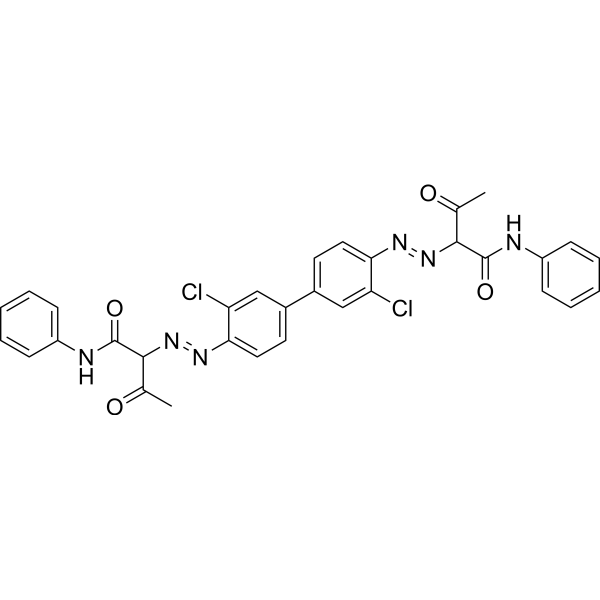
Physicochemical Properties
| Molecular Formula | C32H26CL2N6O4 |
| Molecular Weight | 629.49 |
| Exact Mass | 628.139 |
| CAS # | 6358-85-6 |
| PubChem CID | 186342 |
| Appearance | A yellow diazo pigment. |
| Density | 1.34 g/cm3 |
| Boiling Point | 805.4ºC at 760 mmHg |
| Melting Point | 312-320ºC |
| Flash Point | 440.9ºC |
| Vapour Pressure | 5.64E-26mmHg at 25°C |
| Index of Refraction | 1.65 |
| LogP | 8.166 |
| Hydrogen Bond Donor Count | 2 |
| Hydrogen Bond Acceptor Count | 8 |
| Rotatable Bond Count | 11 |
| Heavy Atom Count | 44 |
| Complexity | 979 |
| Defined Atom Stereocenter Count | 0 |
| InChi Key | GNCOVOVCHIHPHP-UHFFFAOYSA-N |
| InChi Code | InChI=1S/C32H26Cl2N6O4/c1-19(41)29(31(43)35-23-9-5-3-6-10-23)39-37-27-15-13-21(17-25(27)33)22-14-16-28(26(34)18-22)38-40-30(20(2)42)32(44)36-24-11-7-4-8-12-24/h3-18,29-30H,1-2H3,(H,35,43)(H,36,44) |
| Chemical Name | 2-[[4-[4-[(1-anilino-1,3-dioxobutan-2-yl)diazenyl]-3-chlorophenyl]-2-chlorophenyl]diazenyl]-3-oxo-N-phenylbutanamide |
| HS Tariff Code | 2934.99.9001 |
| Storage |
Powder-20°C 3 years 4°C 2 years In solvent -80°C 6 months -20°C 1 month |
| Shipping Condition | Room temperature (This product is stable at ambient temperature for a few days during ordinary shipping and time spent in Customs) |
Biological Activity
| ADME/Pharmacokinetics |
Absorption, Distribution and Excretion PIGMENTS /INCLUDING PIGMENT YELLOW 12/ WERE NOT ABSORBED AFTER CHRONIC ORAL INGESTION & DID NOT UNDERGO METABOLIC SPLITTING TO 3,3-DICHLOROBENZIDINE OR 3,3-DIMETHYLBENZIDINE /IN MICE OR RATS/. The average environmental exposure levels of four of the workers /in a dye manufacturing facility/ were 4.3, 5.2, 11.7, and 17.4 mg total particulate/cu m. The corresponding urinary concentrations of benzidine average 52, 11, 10, and 112 ppb, respectively /SRP: from the precursor during manufacturing/. /Benzidine-based dyes/ The oral and dermal absorption and distribution of water insoluble (WI) 3,3'-dichlorobenzidine (DCB) based pigments were evaluated in Fischer 344 rats. Chlorodiane blue (CDB) and pigment yellow 12 (PY-12) ... were synthesized from DCB and labeled with (14)C. Rats were given oral doses of ... 1.11 mg/kg labeled WI PY-12 for absorption studies or 0.99 mg/kg for a 24 hour balance study. ... In an 8 hour oral study of CDB, blood samples taken from 10 min to 8 hr showed radioactivity at background levels. Dermal application resulted in background levels, as well. After the oral dose, all of the administered dose was accounted for in feces. For PY-12, radioactivity in blood at background levels after oral or dermal application. The entire dose was accounted for in feces after the oral dose. ... Metabolism / Metabolites Various bacteria and yeast normally found in the small and large intestine can reduce the azo bond in /some/ benzidine-based dyes and release benzidine. /Benzidine-based dyes/ Humans as well as other mammals can change (metabolize) /some/ benzidine-based dyes back to benzidine. The major organ in which /some/ benzidine-based dyes are metabolized to benzidine is the liver, but other organs also can do this to a greater or lesser degree. /Benzidine-based dyes/ |
| References |
[1]. Plötner J, Dreuw A. Solid state fluorescence of Pigment Yellow 101 and derivatives: a conserved property of the individual molecules[J]. Physical Chemistry Chemical Physics, 2006, 8(10): 1197-1204. |
| Additional Infomation | Diarylanilide yellow is an odorless fine yellow powder. (NTP, 1992) |
Solubility Data
| Solubility (In Vitro) | May dissolve in DMSO (in most cases), if not, try other solvents such as H2O, Ethanol, or DMF with a minute amount of products to avoid loss of samples |
| Solubility (In Vivo) |
Note: Listed below are some common formulations that may be used to formulate products with low water solubility (e.g. < 1 mg/mL), you may test these formulations using a minute amount of products to avoid loss of samples. Injection Formulations (e.g. IP/IV/IM/SC) Injection Formulation 1: DMSO : Tween 80: Saline = 10 : 5 : 85 (i.e. 100 μL DMSO stock solution → 50 μL Tween 80 → 850 μL Saline) *Preparation of saline: Dissolve 0.9 g of sodium chloride in 100 mL ddH ₂ O to obtain a clear solution. Injection Formulation 2: DMSO : PEG300 :Tween 80 : Saline = 10 : 40 : 5 : 45 (i.e. 100 μL DMSO → 400 μLPEG300 → 50 μL Tween 80 → 450 μL Saline) Injection Formulation 3: DMSO : Corn oil = 10 : 90 (i.e. 100 μL DMSO → 900 μL Corn oil) Example: Take the Injection Formulation 3 (DMSO : Corn oil = 10 : 90) as an example, if 1 mL of 2.5 mg/mL working solution is to be prepared, you can take 100 μL 25 mg/mL DMSO stock solution and add to 900 μL corn oil, mix well to obtain a clear or suspension solution (2.5 mg/mL, ready for use in animals). Injection Formulation 4: DMSO : 20% SBE-β-CD in saline = 10 : 90 [i.e. 100 μL DMSO → 900 μL (20% SBE-β-CD in saline)] *Preparation of 20% SBE-β-CD in Saline (4°C,1 week): Dissolve 2 g SBE-β-CD in 10 mL saline to obtain a clear solution. Injection Formulation 5: 2-Hydroxypropyl-β-cyclodextrin : Saline = 50 : 50 (i.e. 500 μL 2-Hydroxypropyl-β-cyclodextrin → 500 μL Saline) Injection Formulation 6: DMSO : PEG300 : castor oil : Saline = 5 : 10 : 20 : 65 (i.e. 50 μL DMSO → 100 μLPEG300 → 200 μL castor oil → 650 μL Saline) Injection Formulation 7: Ethanol : Cremophor : Saline = 10: 10 : 80 (i.e. 100 μL Ethanol → 100 μL Cremophor → 800 μL Saline) Injection Formulation 8: Dissolve in Cremophor/Ethanol (50 : 50), then diluted by Saline Injection Formulation 9: EtOH : Corn oil = 10 : 90 (i.e. 100 μL EtOH → 900 μL Corn oil) Injection Formulation 10: EtOH : PEG300:Tween 80 : Saline = 10 : 40 : 5 : 45 (i.e. 100 μL EtOH → 400 μLPEG300 → 50 μL Tween 80 → 450 μL Saline) Oral Formulations Oral Formulation 1: Suspend in 0.5% CMC Na (carboxymethylcellulose sodium) Oral Formulation 2: Suspend in 0.5% Carboxymethyl cellulose Example: Take the Oral Formulation 1 (Suspend in 0.5% CMC Na) as an example, if 100 mL of 2.5 mg/mL working solution is to be prepared, you can first prepare 0.5% CMC Na solution by measuring 0.5 g CMC Na and dissolve it in 100 mL ddH2O to obtain a clear solution; then add 250 mg of the product to 100 mL 0.5% CMC Na solution, to make the suspension solution (2.5 mg/mL, ready for use in animals). Oral Formulation 3: Dissolved in PEG400 Oral Formulation 4: Suspend in 0.2% Carboxymethyl cellulose Oral Formulation 5: Dissolve in 0.25% Tween 80 and 0.5% Carboxymethyl cellulose Oral Formulation 6: Mixing with food powders Note: Please be aware that the above formulations are for reference only. InvivoChem strongly recommends customers to read literature methods/protocols carefully before determining which formulation you should use for in vivo studies, as different compounds have different solubility properties and have to be formulated differently. (Please use freshly prepared in vivo formulations for optimal results.) |
| Preparing Stock Solutions | 1 mg | 5 mg | 10 mg | |
| 1 mM | 1.5886 mL | 7.9429 mL | 15.8859 mL | |
| 5 mM | 0.3177 mL | 1.5886 mL | 3.1772 mL | |
| 10 mM | 0.1589 mL | 0.7943 mL | 1.5886 mL |