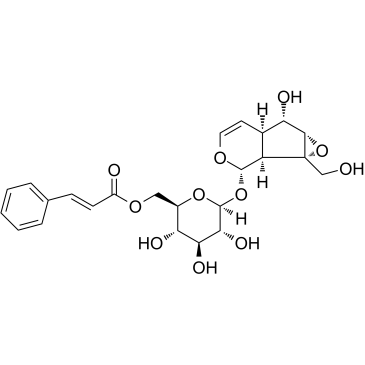
Physicochemical Properties
| Molecular Formula | C24H28O11 |
| Molecular Weight | 492.47252 |
| Exact Mass | 492.163 |
| CAS # | 27409-30-9 |
| PubChem CID | 6440892 |
| Appearance | White to off-white solid powder |
| Density | 1.6±0.1 g/cm3 |
| Boiling Point | 739.1±60.0 °C at 760 mmHg |
| Melting Point | 130 °C |
| Flash Point | 253.2±26.4 °C |
| Vapour Pressure | 0.0±2.6 mmHg at 25°C |
| Index of Refraction | 1.671 |
| LogP | -1.81 |
| Hydrogen Bond Donor Count | 5 |
| Hydrogen Bond Acceptor Count | 11 |
| Rotatable Bond Count | 8 |
| Heavy Atom Count | 35 |
| Complexity | 826 |
| Defined Atom Stereocenter Count | 11 |
| SMILES | C1=CC=C(C=C1)/C=C/C(=O)OC[C@@H]2[C@H]([C@@H]([C@H]([C@@H](O2)O[C@H]3[C@H]4[C@@H](C=CO3)[C@@H]([C@H]5[C@@]4(O5)CO)O)O)O)O |
| InChi Key | XZGPUOQGERGURE-LUVHZPKESA-N |
| InChi Code | InChI=1S/C24H28O11/c25-11-24-16-13(17(27)21(24)35-24)8-9-31-22(16)34-23-20(30)19(29)18(28)14(33-23)10-32-15(26)7-6-12-4-2-1-3-5-12/h1-9,13-14,16-23,25,27-30H,10-11H2/b7-6+/t13-,14-,16-,17+,18-,19+,20-,21+,22+,23+,24-/m1/s1 |
| Chemical Name | [(2R,3S,4S,5R,6S)-3,4,5-trihydroxy-6-[[(1S,2S,4S,5S,6R,10S)-5-hydroxy-2-(hydroxymethyl)-3,9-dioxatricyclo[4.4.0.02,4]dec-7-en-10-yl]oxy]oxan-2-yl]methyl (E)-3-phenylprop-2-enoate |
| HS Tariff Code | 2934.99.9001 |
| Storage |
Powder-20°C 3 years 4°C 2 years In solvent -80°C 6 months -20°C 1 month Note: This product requires protection from light (avoid light exposure) during transportation and storage. |
| Shipping Condition | Room temperature (This product is stable at ambient temperature for a few days during ordinary shipping and time spent in Customs) |
Biological Activity
| ln Vivo | In experimental animals, picroside I (20 mg/kg, po, 12 d) lowers OVA-associated IgE levels and AHR [2]. |
| Animal Protocol |
Animal/Disease Models: Ovalbumin (OVA) systemic sensitization BALB/c mouse model [2] Doses: 0.2, 2.0 and 20 mg/kg Route of Administration: po (po (oral gavage)) one time/day, day 20 to day 32 Experimental Results: Inhibit inflammatory cell infiltration triggered by allergens. |
| References |
[1]. Picroside I and Picroside II from Tissue Cultures of Picrorhiza kurroa. Pharmacognosy Res. 2017 Dec;9(Suppl 1):S53-S56. [2]. Picroside I inhibits asthma phenotypes by regulating Tbet/GATA-3 ratio and Th1/Th2 balance in a murine model of asthma. Tropical Journal of Pharmaceutical Research September 2018; 17 (9): 1777-1782. |
| Additional Infomation | Picroside I has been reported in Gentiana kurroo and Picrorhiza kurrooa with data available. |
Solubility Data
| Solubility (In Vitro) |
DMSO : ~250 mg/mL (~507.65 mM) H2O : ~125 mg/mL (~253.82 mM) |
| Solubility (In Vivo) |
Solubility in Formulation 1: 12.5 mg/mL (25.38 mM) in PBS (add these co-solvents sequentially from left to right, and one by one), clear solution; with sonication. (Please use freshly prepared in vivo formulations for optimal results.) |
| Preparing Stock Solutions | 1 mg | 5 mg | 10 mg | |
| 1 mM | 2.0306 mL | 10.1529 mL | 20.3058 mL | |
| 5 mM | 0.4061 mL | 2.0306 mL | 4.0612 mL | |
| 10 mM | 0.2031 mL | 1.0153 mL | 2.0306 mL |