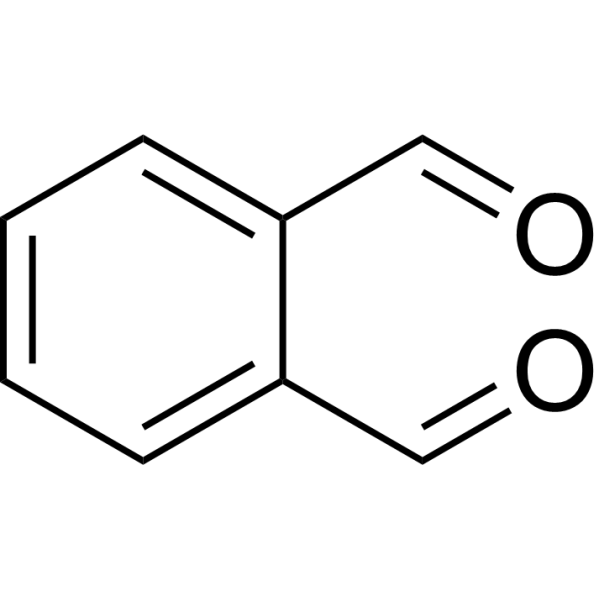
Physicochemical Properties
| Molecular Formula | C8H6O2 |
| Molecular Weight | 134.13 |
| Exact Mass | 134.036 |
| CAS # | 643-79-8 |
| Related CAS # | 25750-62-3 |
| PubChem CID | 4807 |
| Appearance |
Long, pale yellow needles from petroleum ether (MP 56-56.5 °C). Also reported as colorless powder (MP: 54 °C) Yellow needles or crystals from ligroin |
| Density | 1.2±0.1 g/cm3 |
| Boiling Point | 266.1±23.0 °C at 760 mmHg |
| Melting Point | 55-58 °C(lit.) |
| Flash Point | 98.5±19.6 °C |
| Vapour Pressure | 0.0±0.5 mmHg at 25°C |
| Index of Refraction | 1.623 |
| LogP | 0.51 |
| Hydrogen Bond Donor Count | 0 |
| Hydrogen Bond Acceptor Count | 2 |
| Rotatable Bond Count | 2 |
| Heavy Atom Count | 10 |
| Complexity | 115 |
| Defined Atom Stereocenter Count | 0 |
| SMILES | O=C([H])C1=C([H])C([H])=C([H])C([H])=C1C([H])=O |
| InChi Key | ZWLUXSQADUDCSB-UHFFFAOYSA-N |
| InChi Code | InChI=1S/C8H6O2/c9-5-7-3-1-2-4-8(7)6-10/h1-6H |
| Chemical Name | phthalaldehyde |
| Synonyms | Phthaldialdehyde |
| HS Tariff Code | 2934.99.9001 |
| Storage |
Powder-20°C 3 years 4°C 2 years In solvent -80°C 6 months -20°C 1 month Note: Please store this product in a sealed and protected environment (e.g. under nitrogen), avoid exposure to moisture. |
| Shipping Condition | Room temperature (This product is stable at ambient temperature for a few days during ordinary shipping and time spent in Customs) |
Biological Activity
| Toxicity/Toxicokinetics |
Toxicity Summary IDENTIFICATION AND USE: o-Phthalaldehyde (OPA) is used as disinfectant and reagent in fluorometric determination of primary amines and thiols. HUMAN STUDIES: OPA is a commonly used solution for rapid sterilization of medical equipment. Cases of anaphylaxis following cystoscopy with endoscopes sterilized with this agent have been reported. OPA-induced anaphylaxis following laryngoscopy have also been described. In these patients, OPA-specific IgE was detected in the serum. Contact dermatitis occurred in 4 workers of the endoscopy unit, one of whom also developed asthma. Among 80 female disinfection workers who used only antiseptic solutions containing OPA, the incidence of disinfection-related complaints were 10% skin, 9% eye, and 16% respiratory symptoms. ANIMAL STUDIES: In male mice, injected OPA induced specific IgE and IgG in the sera, suggesting that OPA acts as a hapten. Overall, OPA caused acute inflammation and acted as a haptenic allergen, although it caused only mild liver injury. In mice sensitized to ovalbumin (OVA), OPA enhanced the OVA-induced recruitment of neutrophils to the lung and the production of allergen-specific IgE, suggesting that OPA acts as an immunological adjuvant. The major targets from OPA exposure in rats and mice included the respiratory system (nasal cavity, larynx, trachea, and lung), skin, eye, testis, and epididymis. The most sensitive measure of OPA inhalation toxicity in male and female rats and mice was significantly increased incidences of nasal cavity lesions (lowest-observable-effect concentration = 0.44 ppm). OPA was mutagenic in Salmonella typhimurium strain TA100 in the absence of exogenous metabolic activation; no mutagenicity was seen in TA100 with metabolic activation or in TA98 or Escherichia coli WP2 uvrA/pKM101, with or without metabolic activation. |
| References |
[1]. Prostaglandin D2 and prostaglandin D synthetase in mast cell deficient mice. Prostaglandins. 1984 Jun;27(6):877-85. [2]. , Complete nucleotide sequence of cDNA and predicted amino acid sequence of rat acyl-CoA oxidase. J Biol Chem. 1987 Jun 15;262(17):8131-7. |
| Additional Infomation |
Phthalaldehyde is a dialdehyde in which two formyl groups are attached to adjacent carbon centres on a benzene ring. It has a role as an epitope. It is a dialdehyde and a member of benzaldehydes. A reagent that forms fluorescent conjugation products with primary amines. It is used for the detection of many biogenic amines, peptides, and proteins in nanogram quantities in body fluids. |
Solubility Data
| Solubility (In Vitro) | DMSO : 200 mg/mL (1491.09 mM; with sonication) |
| Solubility (In Vivo) |
Note: Listed below are some common formulations that may be used to formulate products with low water solubility (e.g. < 1 mg/mL), you may test these formulations using a minute amount of products to avoid loss of samples. Injection Formulations (e.g. IP/IV/IM/SC) Injection Formulation 1: DMSO : Tween 80: Saline = 10 : 5 : 85 (i.e. 100 μL DMSO stock solution → 50 μL Tween 80 → 850 μL Saline) *Preparation of saline: Dissolve 0.9 g of sodium chloride in 100 mL ddH ₂ O to obtain a clear solution. Injection Formulation 2: DMSO : PEG300 :Tween 80 : Saline = 10 : 40 : 5 : 45 (i.e. 100 μL DMSO → 400 μLPEG300 → 50 μL Tween 80 → 450 μL Saline) Injection Formulation 3: DMSO : Corn oil = 10 : 90 (i.e. 100 μL DMSO → 900 μL Corn oil) Example: Take the Injection Formulation 3 (DMSO : Corn oil = 10 : 90) as an example, if 1 mL of 2.5 mg/mL working solution is to be prepared, you can take 100 μL 25 mg/mL DMSO stock solution and add to 900 μL corn oil, mix well to obtain a clear or suspension solution (2.5 mg/mL, ready for use in animals). Injection Formulation 4: DMSO : 20% SBE-β-CD in saline = 10 : 90 [i.e. 100 μL DMSO → 900 μL (20% SBE-β-CD in saline)] *Preparation of 20% SBE-β-CD in Saline (4°C,1 week): Dissolve 2 g SBE-β-CD in 10 mL saline to obtain a clear solution. Injection Formulation 5: 2-Hydroxypropyl-β-cyclodextrin : Saline = 50 : 50 (i.e. 500 μL 2-Hydroxypropyl-β-cyclodextrin → 500 μL Saline) Injection Formulation 6: DMSO : PEG300 : castor oil : Saline = 5 : 10 : 20 : 65 (i.e. 50 μL DMSO → 100 μLPEG300 → 200 μL castor oil → 650 μL Saline) Injection Formulation 7: Ethanol : Cremophor : Saline = 10: 10 : 80 (i.e. 100 μL Ethanol → 100 μL Cremophor → 800 μL Saline) Injection Formulation 8: Dissolve in Cremophor/Ethanol (50 : 50), then diluted by Saline Injection Formulation 9: EtOH : Corn oil = 10 : 90 (i.e. 100 μL EtOH → 900 μL Corn oil) Injection Formulation 10: EtOH : PEG300:Tween 80 : Saline = 10 : 40 : 5 : 45 (i.e. 100 μL EtOH → 400 μLPEG300 → 50 μL Tween 80 → 450 μL Saline) Oral Formulations Oral Formulation 1: Suspend in 0.5% CMC Na (carboxymethylcellulose sodium) Oral Formulation 2: Suspend in 0.5% Carboxymethyl cellulose Example: Take the Oral Formulation 1 (Suspend in 0.5% CMC Na) as an example, if 100 mL of 2.5 mg/mL working solution is to be prepared, you can first prepare 0.5% CMC Na solution by measuring 0.5 g CMC Na and dissolve it in 100 mL ddH2O to obtain a clear solution; then add 250 mg of the product to 100 mL 0.5% CMC Na solution, to make the suspension solution (2.5 mg/mL, ready for use in animals). Oral Formulation 3: Dissolved in PEG400 Oral Formulation 4: Suspend in 0.2% Carboxymethyl cellulose Oral Formulation 5: Dissolve in 0.25% Tween 80 and 0.5% Carboxymethyl cellulose Oral Formulation 6: Mixing with food powders Note: Please be aware that the above formulations are for reference only. InvivoChem strongly recommends customers to read literature methods/protocols carefully before determining which formulation you should use for in vivo studies, as different compounds have different solubility properties and have to be formulated differently. (Please use freshly prepared in vivo formulations for optimal results.) |
| Preparing Stock Solutions | 1 mg | 5 mg | 10 mg | |
| 1 mM | 7.4555 mL | 37.2773 mL | 74.5545 mL | |
| 5 mM | 1.4911 mL | 7.4555 mL | 14.9109 mL | |
| 10 mM | 0.7455 mL | 3.7277 mL | 7.4555 mL |