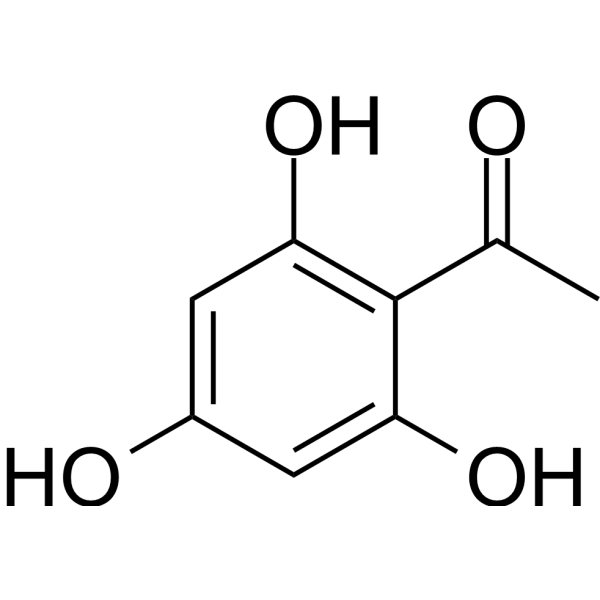
Physicochemical Properties
| Molecular Formula | C8H8O4 |
| Molecular Weight | 168.1467 |
| Exact Mass | 168.042 |
| CAS # | 480-66-0 |
| PubChem CID | 68073 |
| Appearance | White to yellow solid powder |
| Density | 1.4±0.1 g/cm3 |
| Boiling Point | 333.2±22.0 °C at 760 mmHg |
| Melting Point | 219-221 °C(lit.) |
| Flash Point | 169.5±18.8 °C |
| Vapour Pressure | 0.0±0.8 mmHg at 25°C |
| Index of Refraction | 1.641 |
| LogP | 2.07 |
| Hydrogen Bond Donor Count | 3 |
| Hydrogen Bond Acceptor Count | 4 |
| Rotatable Bond Count | 1 |
| Heavy Atom Count | 12 |
| Complexity | 168 |
| Defined Atom Stereocenter Count | 0 |
| InChi Key | XLEYFDVVXLMULC-UHFFFAOYSA-N |
| InChi Code | InChI=1S/C8H8O4/c1-4(9)8-6(11)2-5(10)3-7(8)12/h2-3,10-12H,1H3 |
| Chemical Name | 1-(2,4,6-trihydroxyphenyl)ethanone |
| HS Tariff Code | 2934.99.9001 |
| Storage |
Powder-20°C 3 years 4°C 2 years In solvent -80°C 6 months -20°C 1 month |
| Shipping Condition | Room temperature (This product is stable at ambient temperature for a few days during ordinary shipping and time spent in Customs) |
Biological Activity
| Targets |
- Phloracetophenone targets cholesterol 7α-hydroxylase (CYP7A1) (the rate-limiting enzyme in hepatic bile acid synthesis) to regulate cholesterol metabolism. [1] - Phloracetophenone targets pathways related to hepatic bile secretion (e.g., bile acid transporters or hepatocellular bile formation signaling) to exert choleretic activity. [2] |
| ln Vitro |
Phloracetophenone (2,4,6-trihydroxyacetophenone) is a cholesterol-lowering medication that raises CYP7A1 mRNA levels and improves cholesterol 7α-hydroxylase (CYP7A1) activity [1]. In isolated perfused rat livers, phenolacetophenone (1, 2 and 4 μmol/min) enhances bile acid-independent bile flow instantly and dose-dependently [2]. - Induction of Cholesterol 7α-Hydroxylase in HepG2 Cells: 1. mRNA and protein expression: HepG2 cells were treated with Phloracetophenone (10, 50, 100 μM) for 24 hours. RT-PCR showed 50 μM and 100 μM Phloracetophenone increased CYP7A1 mRNA levels by ~1.8-fold and ~2.5-fold, respectively; western blot showed corresponding increases in CYP7A1 protein levels by ~1.5-fold and ~2.0-fold vs. control. [1] 2. Enzyme activity and cholesterol metabolism: 100 μM Phloracetophenone increased cholesterol 7α-hydroxylase activity by ~2.2-fold (measured via [¹⁴C]-cholesterol conversion to bile acids) and reduced intracellular cholesterol concentration by ~30% (detected via cholesterol oxidase assay) vs. control. [1] |
| ln Vivo |
Multidrug resistance protein 2 (Mrp2) is required for phoracetophenone (2,4,6-trihydroxyacetophenone; 125 or 250 μmol/kg, intraduodenal injection) to exhibit choleretic action in rats. Cholestasis produced by E2-17G is somewhat prevented by phenacetophenone (40 μmol/min) [2]. - Choleretic Activity in Rats: 1. Bile flow promotion: Male Wistar rats (200–250 g) were administered Phloracetophenone via intraperitoneal injection at doses of 25 mg/kg, 50 mg/kg, and 100 mg/kg. Bile was collected via bile duct cannulation for 1 hour post-administration: 25 mg/kg increased bile flow by ~30%, 50 mg/kg by ~50%, and 100 mg/kg by ~70% vs. saline control. [2] 2. Bile component regulation: 100 mg/kg Phloracetophenone increased bile acid excretion by ~65% and cholesterol excretion by ~45% in bile, without altering bile phospholipid levels vs. control. [2] 3. Structure-function correlation: The study confirmed that the trihydroxyphenyl moiety (3 hydroxyl groups on the benzene ring) of Phloracetophenone is essential for its choleretic activity; analogs with fewer hydroxyl groups (e.g., dihydroxyacetophenone) showed no significant choleretic effect. [2] |
| Enzyme Assay |
- Cholesterol 7α-Hydroxylase Activity Assay: 1. HepG2 cells were treated with Phloracetophenone (10, 50, 100 μM) for 24 hours, then harvested and lysed to prepare microsomal fractions (enriched with CYP7A1). [1] 2. Microsomal fractions were incubated with [¹⁴C]-cholesterol (substrate), NADPH (cofactor), and reaction buffer at 37°C for 60 minutes. [1] 3. The reaction was terminated by adding chloroform-methanol (2:1, v/v), and the mixture was extracted to isolate bile acid products. Radioactivity of the bile acid fraction was measured via liquid scintillation counting to quantify enzyme activity. [1] |
| Cell Assay |
- HepG2 Cell CYP7A1 Regulation Assay: 1. HepG2 cells were seeded in 6-well plates (2×10⁵ cells/well) and cultured in DMEM medium (10% FBS) at 37°C (5% CO₂) for 24 hours until 80% confluence. [1] 2. Cells were treated with Phloracetophenone (10, 50, 100 μM) (vehicle: DMSO, ≤0.1% v/v) for 24 hours; control cells received DMSO alone. [1] 3. For mRNA detection: Total RNA was extracted, reverse-transcribed to cDNA, and RT-PCR was performed with CYP7A1-specific primers (GAPDH as internal control) to quantify mRNA levels. [1] 4. For protein detection: Cells were lysed, total protein was extracted, and western blot was performed with anti-CYP7A1 antibody (β-actin as internal control) to measure protein expression. [1] 5. For cholesterol detection: Intracellular cholesterol was extracted with isopropanol, and concentration was measured via cholesterol oxidase-peroxidase assay (absorbance at 500 nm). [1] |
| Animal Protocol |
- Rat Choleretic Activity Assay: 1. Animal preparation: Male Wistar rats (200–250 g) were fasted for 12 hours (free access to water) before the experiment, then anesthetized with sodium pentobarbital (intraperitoneal injection). [2] 2. Drug preparation: Phloracetophenone was dissolved in sterile saline (ultrasonic treatment to aid dissolution) to prepare doses of 25 mg/kg, 50 mg/kg, and 100 mg/kg (based on rat body weight). [2] 3. Bile duct cannulation: A polyethylene catheter was inserted into the common bile duct to collect bile, and baseline bile flow was measured for 30 minutes. [2] 4. Administration and sampling: Phloracetophenone was administered via intraperitoneal injection; bile was collected at 15-minute intervals for 1 hour post-administration. Bile volume was measured, and bile acid/cholesterol/phospholipid concentrations were analyzed via enzymatic assays. [2] 5. Control group: Rats received equal volume of sterile saline via intraperitoneal injection, with the same sampling protocol. [2] |
| References |
[1]. Induction of human cholesterol 7alpha-hydroxylase in HepG2 cells by 2,4,6-trihydroxyacetophenone. Eur J Pharmacol. 2005 May 16;515(1-3):43-6. [2]. Choleretic activity of phloracetophenone in rats: structure-function studies using acetophenone analogues. Eur J Pharmacol. 2000 Jan 10;387(2):221-7. |
| Additional Infomation |
2',4',6'-trihydroxyacetophenone is a benzenetriol that is acetophenone in which the hydrogens at positions 2, 4, and 6 on the phenyl group are replaced by hydroxy groups. It is used as a matrix in matrix-assisted laser desorption/ionization (MALDI) mass spectrometry for the analysis of acidic glycans and glycopeptides. It has a role as a MALDI matrix material and a plant metabolite. It is a methyl ketone, a benzenetriol and an aromatic ketone. 2',4',6'-Trihydroxyacetophenone has been reported in Daldinia eschscholtzii, Rhododendron ferrugineum, and other organisms with data available. - Natural Source and Chemical Feature: Phloracetophenone (2,4,6-trihydroxyacetophenone) is a natural phenol compound found in certain plant species (e.g., Hypericum spp.). Its chemical structure is characterized by an acetophenone moiety with three hydroxyl groups (-OH) at the 2, 4, and 6 positions of the benzene ring, which is critical for its biological activity. [1][2] - Mechanism of Action: 1. Cholesterol metabolism regulation: Phloracetophenone upregulates CYP7A1 expression in hepatocytes, accelerating the conversion of cholesterol to bile acids (the major pathway for hepatic cholesterol elimination), thereby reducing intracellular cholesterol levels. [1] 2. Choleretic effect: Phloracetophenone enhances bile flow by promoting the secretion of bile acids and cholesterol from hepatocytes into bile, possibly via activating bile acid transporters (e.g., BSEP) or modulating intracellular calcium signaling. [2] |
Solubility Data
| Solubility (In Vitro) |
DMSO : ~25 mg/mL (~148.68 mM) H2O : ~2 mg/mL (~11.89 mM) |
| Solubility (In Vivo) |
Solubility in Formulation 1: ≥ 1.25 mg/mL (7.43 mM) (saturation unknown) in 10% DMSO + 40% PEG300 + 5% Tween80 + 45% Saline (add these co-solvents sequentially from left to right, and one by one), clear solution. For example, if 1 mL of working solution is to be prepared, you can add 100 μL of 12.5 mg/mL clear DMSO stock solution to 400 μL PEG300 and mix evenly; then add 50 μL Tween-80 to the above solution and mix evenly; then add 450 μL normal saline to adjust the volume to 1 mL. Preparation of saline: Dissolve 0.9 g of sodium chloride in 100 mL ddH₂ O to obtain a clear solution. Solubility in Formulation 2: ≥ 1.25 mg/mL (7.43 mM) (saturation unknown) in 10% DMSO + 90% (20% SBE-β-CD in Saline) (add these co-solvents sequentially from left to right, and one by one), clear solution. For example, if 1 mL of working solution is to be prepared, you can add 100 μL of 12.5 mg/mL clear DMSO stock solution to 900 μL of 20% SBE-β-CD physiological saline solution and mix evenly. Preparation of 20% SBE-β-CD in Saline (4°C,1 week): Dissolve 2 g SBE-β-CD in 10 mL saline to obtain a clear solution. Solubility in Formulation 3: ≥ 1.25 mg/mL (7.43 mM) (saturation unknown) in 10% DMSO + 90% Corn Oil (add these co-solvents sequentially from left to right, and one by one), clear solution. For example, if 1 mL of working solution is to be prepared, you can add 100 μL of 12.5 mg/mL clear DMSO stock solution to 900 μL of corn oil and mix evenly. (Please use freshly prepared in vivo formulations for optimal results.) |
| Preparing Stock Solutions | 1 mg | 5 mg | 10 mg | |
| 1 mM | 5.9471 mL | 29.7354 mL | 59.4707 mL | |
| 5 mM | 1.1894 mL | 5.9471 mL | 11.8941 mL | |
| 10 mM | 0.5947 mL | 2.9735 mL | 5.9471 mL |