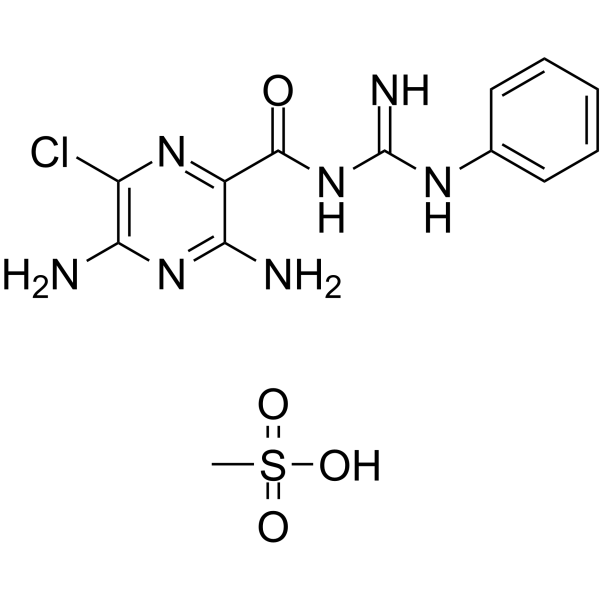
Physicochemical Properties
| Molecular Formula | C13H16CLN7O4S |
| Molecular Weight | 401.83 |
| Exact Mass | 401.067 |
| CAS # | 1161-94-0 |
| PubChem CID | 135419184 |
| Appearance | Light yellow to yellow solid powder |
| Boiling Point | 621.7ºC at 760 mmHg |
| Flash Point | 329.8ºC |
| Vapour Pressure | 2.22E-15mmHg at 25°C |
| LogP | 3.381 |
| Hydrogen Bond Donor Count | 5 |
| Hydrogen Bond Acceptor Count | 9 |
| Rotatable Bond Count | 3 |
| Heavy Atom Count | 26 |
| Complexity | 492 |
| Defined Atom Stereocenter Count | 0 |
| InChi Key | MHPIZTURFVSLTJ-UHFFFAOYSA-N |
| InChi Code | InChI=1S/C12H12ClN7O.CH4O3S/c13-8-10(15)19-9(14)7(18-8)11(21)20-12(16)17-6-4-2-1-3-5-6;1-5(2,3)4/h1-5H,(H4,14,15,19)(H3,16,17,20,21);1H3,(H,2,3,4) |
| Chemical Name | 3,5-diamino-6-chloro-N-(N'-phenylcarbamimidoyl)pyrazine-2-carboxamide;methanesulfonic acid |
| HS Tariff Code | 2934.99.9001 |
| Storage |
Powder-20°C 3 years 4°C 2 years In solvent -80°C 6 months -20°C 1 month Note: Please store this product in a sealed and protected environment (e.g. under nitrogen), avoid exposure to moisture. |
| Shipping Condition | Room temperature (This product is stable at ambient temperature for a few days during ordinary shipping and time spent in Customs) |
Biological Activity
| Targets | TRPC3 140 nM (IC50) |
| ln Vitro | TRPP3, a cation channel that belongs to the transient receptor potential (TRP) superfamily, is triggered by Ca2+ and permeable to Ca2+, Na+, and K+. In spinal cord neurons, TRPP3 is involved in the control of pH-sensitive action potentials. In radiotracer uptake experiment, phenamil methanesulfonate (1 μM) reduces 45Ca2+ absorption. With an IC50 value of 0.28 μM in oocytes expressing TRPP3 or oocytes injected with H2O, it inhibits TRPP3-mediated Ca2+ transport[1]. The epithelial sodium channel (ENaC) is inhibited by phenamil methanesulfonate, a more powerful ENaC blocker than amiloride, with an IC50 of 400 nM (vs 776 nM for amiloride)[2]. In both human and ovine bronchial epithelia cells, phenolmethyl methanesulfonate suppresses baseline short-circuit currents with IC50 values of 75 and 116 nM, respectively[3]. In C3H10T1/2 cells, phenamil methanesulfonate (0–20 μM; 14 days) controls adipogenesis and increases the expression of PPARγ, Fabp4, lipoprotein lipase, and adipogenic genes in a concentration-dependent manner[4]. Methanesulfonate (0–20 μM; 7 or 14 days) boosts concentration-dependently the activity of alkaline phosphatase (ALP) in MC3T3–E1 cells and modifies their osteoblastic differentiation[4]. |
| ln Vivo | PAH caused by chronic hypoxia is lessened by phenamil methanesulfonate (subcutaneous injection; 15 or 30 mg/kg; 21 days; infusion rate of 1 ml/h). Furthermore, Phenamil reduces the mRNA levels of SMA, SM22, Id3, and Trb3 in the lung sample in rats under hypoxia or normoxia. Phenamil, however, has minimal effects on the pulmonary vasculature in a physiological setting[5]. |
| Cell Assay |
RT-PCR[4] Cell Types: C3H10T1/2 cells Tested Concentrations: 0 μM and 20 μM Incubation Duration: 14 days Experimental Results: Increased PPARγ, Fabp4, and lipoprotein lipase (LPL) mRNA expression. |
| Animal Protocol |
Animal/Disease Models: Male SD (Sprague-Dawley) rats[5] Doses: 15 or 30 mg /kg Route of Administration: subcutaneous (sc) injection; 15 or 30 mg/kg; 21 days; infusion rate of 1 ml/h Experimental Results: decreased hypoxia-induced pulmonary hypertension and vascular remodeling. |
| References |
[1]. Inhibition of TRPP3 channel by amiloride and analogs. Mol Pharmacol. 2007 Dec;72(6):1576-85. [2]. Design, synthesis, and structure-activity relationships of novel 2-substituted pyrazinoylguanidine epithelial sodium channel blockers: drugs for cystic fibrosis and chronic bronchitis. J Med Chem. 2006 Jul 13;49(14):4098-115. [3]. Evaluation of second generation amiloride analogs as therapy for cystic fibrosis lung disease.J Pharmacol Exp Ther. 2004 Dec;311(3):929-38. [4]. The amiloride derivative phenamil attenuates pulmonary vascular remodeling by activating NFAT and the bone morphogenetic protein signaling pathway. Mol Cell Biol. |
Solubility Data
| Solubility (In Vitro) | DMSO: 25 mg/mL (62.22 mM) |
| Solubility (In Vivo) |
Solubility in Formulation 1: ≥ 2.5 mg/mL (6.22 mM) (saturation unknown) in 10% DMSO + 40% PEG300 +5% Tween-80 + 45% Saline (add these co-solvents sequentially from left to right, and one by one), clear solution. For example, if 1 mL of working solution is to be prepared, you can add 100 μL of 25.0 mg/mL clear DMSO stock solution to 400 μL PEG300 and mix evenly; then add 50 μL Tween-80 + to the above solution and mix evenly; then add 450 μL normal saline to adjust the volume to 1 mL. Preparation of saline: Dissolve 0.9 g of sodium chloride in 100 mL ddH₂ O to obtain a clear solution. (Please use freshly prepared in vivo formulations for optimal results.) |
| Preparing Stock Solutions | 1 mg | 5 mg | 10 mg | |
| 1 mM | 2.4886 mL | 12.4431 mL | 24.8861 mL | |
| 5 mM | 0.4977 mL | 2.4886 mL | 4.9772 mL | |
| 10 mM | 0.2489 mL | 1.2443 mL | 2.4886 mL |