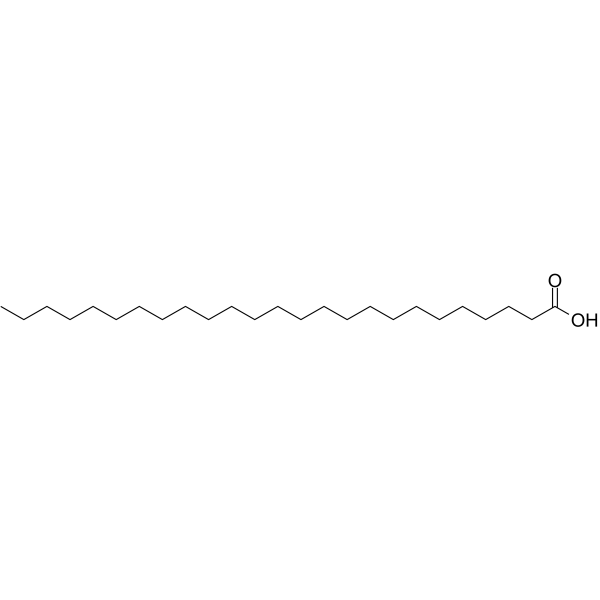
Physicochemical Properties
| Molecular Formula | C25H50O2 |
| Molecular Weight | 382.66 |
| Exact Mass | 382.381 |
| CAS # | 506-38-7 |
| PubChem CID | 10468 |
| Appearance | White to off-white solid powder |
| Density | 0.9±0.1 g/cm3 |
| Boiling Point | 412.4±8.0 °C at 760 mmHg |
| Melting Point | 83 °C |
| Flash Point | 185.0±13.3 °C |
| Vapour Pressure | 0.0±1.0 mmHg at 25°C |
| Index of Refraction | 1.460 |
| LogP | 11.94 |
| Hydrogen Bond Donor Count | 1 |
| Hydrogen Bond Acceptor Count | 2 |
| Rotatable Bond Count | 23 |
| Heavy Atom Count | 27 |
| Complexity | 288 |
| Defined Atom Stereocenter Count | 0 |
| InChi Key | MWMPEAHGUXCSMY-UHFFFAOYSA-N |
| InChi Code | InChI=1S/C25H50O2/c1-2-3-4-5-6-7-8-9-10-11-12-13-14-15-16-17-18-19-20-21-22-23-24-25(26)27/h2-24H2,1H3,(H,26,27) |
| Chemical Name | pentacosanoic acid |
| HS Tariff Code | 2934.99.9001 |
| Storage |
Powder-20°C 3 years 4°C 2 years In solvent -80°C 6 months -20°C 1 month |
| Shipping Condition | Room temperature (This product is stable at ambient temperature for a few days during ordinary shipping and time spent in Customs) |
Biological Activity
| Targets | Human Endogenous Metabolite |
| ln Vivo | Adrenoleukodystrophy's degree of demyelination is correlated with the behenic acid to behenic acid ratios (C25:0/C22:0 and C26:0/C22:0). The parts that are most affected, where the active process is finished, are mostly home to the intermediate fraction's saturated fatty acids (C24:0, C25:0, and C26:0). The identification of a region with a high concentration of long-chain fatty acids was the cause of the absence of histopathological alterations [1]. The frontal lobe margins are often where areas of myelin loss but axonal retention are most noticeable. lesions. Pentacosanoic acid (C25:0) and hexacanoic acid (C26:0) represent the midpoint of a bell-shaped distribution of very long-chain fatty acids esterified to cholesterol [1]. |
| References |
[1]. The correlation between biochemical and histopathological findings in adrenoleukodystrophy. J Neurol Sci. 1985 Aug;70(1):21-38. |
| Additional Infomation |
Pentacosanoic acid is a straight-chain saturated fatty acid and a very long-chain fatty acid. It is a conjugate acid of a pentacosanoate. Pentacosanoic acid has been reported in Senecio scandens, Sabia parviflora, and other organisms with data available. |
Solubility Data
| Solubility (In Vitro) |
DMSO: 5 mg/mL (13.07 mM) Ethanol: < 1 mg/mL |
| Solubility (In Vivo) |
Solubility in Formulation 1: ≥ 0.5 mg/mL (1.31 mM) (saturation unknown) in 10% DMSO + 40% PEG300 + 5% Tween80 + 45% Saline (add these co-solvents sequentially from left to right, and one by one), clear solution. For example, if 1 mL of working solution is to be prepared, you can add 100 μL of 5.0 mg/mL clear DMSO stock solution to 400 μL PEG300 and mix evenly; then add 50 μL Tween-80 to the above solution and mix evenly; then add 450 μL normal saline to adjust the volume to 1 mL. Preparation of saline: Dissolve 0.9 g of sodium chloride in 100 mL ddH₂ O to obtain a clear solution. Solubility in Formulation 2: ≥ 0.5 mg/mL (1.31 mM) (saturation unknown) in 10% DMSO + 90% Corn Oil (add these co-solvents sequentially from left to right, and one by one), clear solution. For example, if 1 mL of working solution is to be prepared, you can add 100 μL of 5.0 mg/mL clear DMSO stock solution to 900 μL of corn oil and mix evenly. (Please use freshly prepared in vivo formulations for optimal results.) |
| Preparing Stock Solutions | 1 mg | 5 mg | 10 mg | |
| 1 mM | 2.6133 mL | 13.0664 mL | 26.1329 mL | |
| 5 mM | 0.5227 mL | 2.6133 mL | 5.2266 mL | |
| 10 mM | 0.2613 mL | 1.3066 mL | 2.6133 mL |