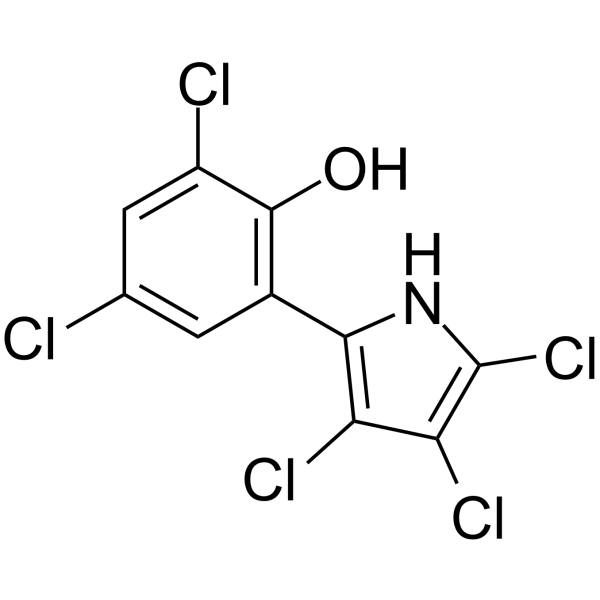
Pentachloropseudilin (Antibiotic A-15104 Y; PClP) is a novel, potent and allosteric Myosin-1 (Myo1) inhibitor. Also inhibits transforming growth factor-β activity by accelerating cell-surface type II TGF-β receptor turnover.
Physicochemical Properties
| Molecular Formula | C10H4CL5NO |
| Molecular Weight | 331.39 |
| Exact Mass | 328.874 |
| CAS # | 69640-38-6 |
| PubChem CID | 3053233 |
| Appearance | Off-white to gray solid powder |
| Density | 1.733g/cm3 |
| Boiling Point | 445.9ºC at 760 mmHg |
| Flash Point | 223.5ºC |
| Index of Refraction | 1.672 |
| LogP | 5.654 |
| Hydrogen Bond Donor Count | 2 |
| Hydrogen Bond Acceptor Count | 1 |
| Rotatable Bond Count | 1 |
| Heavy Atom Count | 17 |
| Complexity | 281 |
| Defined Atom Stereocenter Count | 0 |
| InChi Key | FBRLLYYPGGXCKT-UHFFFAOYSA-N |
| InChi Code | InChI=1S/C10H4Cl5NO/c11-3-1-4(9(17)5(12)2-3)8-6(13)7(14)10(15)16-8/h1-2,16-17H |
| Chemical Name | 2,4-dichloro-6-(3,4,5-trichloro-1H-pyrrol-2-yl)phenol |
| Synonyms | PClP Pentachloropseudilin |
| HS Tariff Code | 2934.99.9001 |
| Storage |
Powder-20°C 3 years 4°C 2 years In solvent -80°C 6 months -20°C 1 month |
| Shipping Condition | Room temperature (This product is stable at ambient temperature for a few days during ordinary shipping and time spent in Customs) |
Biological Activity
| ln Vitro | In target cells (A549, HepG2, and Mv1Lu cells), pentachloropsin (PClP) inhibits TGF-β-stimulated Smad2/3 phosphorylation and plasminogen activator inhibitor-1 (PAI-1) promoter activation; the IC50 value is 0.1 μM [1]. Pentachloropseudoprotein inhibited vimentin, N-cadherin, and fibronectin expression in response to TGF-β, preventing TGF-β-induced epithelial-mesenchymal transition (EMT) in these cells. The TGF-β-mediated (50 or 100 pM) increase in p-Smad2/3 expression was inhibited by pretreatment with pentachloropsin (0.05 to 1 μM; 0–6 hours) by 47% (Mv1Lu) and 79% (A549)[1]. By reducing the expression of type II TGF-β receptors on the cell surface and speeding up caveolae-mediated internalization, which is mainly followed by lysosome-dependent receptor degradation, pentachloropsin (0.2 μM) inhibits TGF-β. Sucrose density gradient analysis and immunofluorescence staining were used to examine cellular responses to stimulation [1]. In HUVEC, pentachloropsin (200 μM; 24 hours) shows and modifies cell viability [2]. |
| References |
[1]. Mechanism and specificity of pentachloropseudilin-mediated inhibition of myosin motor activity. J Biol Chem. 2011;286(34):29700-29708. [2]. Pentachloropseudilin Inhibits Transforming Growth Factor-β (TGF-β) Activity by Accelerating Cell-Surface Type II TGF-β Receptor Turnover in Target Cells. Chembiochem. 2018;19(8):851-864. [3]. Pentachloropseudilin Impairs Angiogenesis by Disrupting the Actin Cytoskeleton, Integrin Trafficking and the Cell Cycle. Chembiochem. 2019;20(18):2390-2401. |
Solubility Data
| Solubility (In Vitro) | DMSO : ~100 mg/mL (~301.74 mM) |
| Solubility (In Vivo) |
Solubility in Formulation 1: ≥ 2.5 mg/mL (7.54 mM) (saturation unknown) in 10% DMSO + 90% Corn Oil (add these co-solvents sequentially from left to right, and one by one), clear solution. For example, if 1 mL of working solution is to be prepared, you can add 100 μL of 25.0 mg/mL clear DMSO stock solution to 900 μL of corn oil and mix evenly. (Please use freshly prepared in vivo formulations for optimal results.) |
| Preparing Stock Solutions | 1 mg | 5 mg | 10 mg | |
| 1 mM | 3.0176 mL | 15.0880 mL | 30.1759 mL | |
| 5 mM | 0.6035 mL | 3.0176 mL | 6.0352 mL | |
| 10 mM | 0.3018 mL | 1.5088 mL | 3.0176 mL |