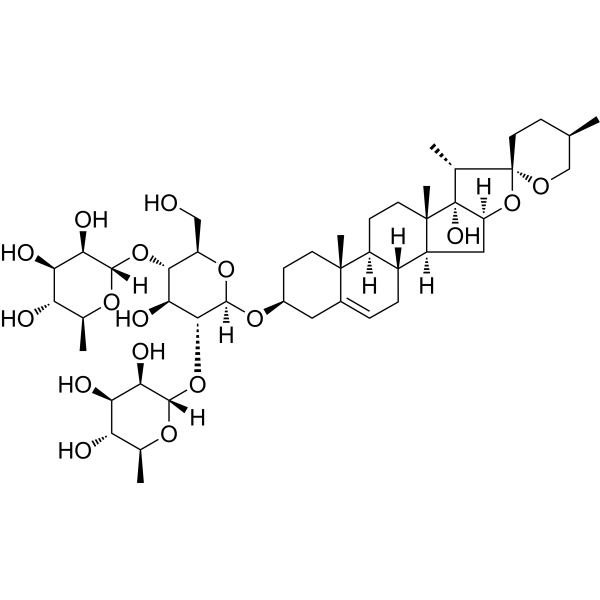
Physicochemical Properties
| Molecular Formula | C45H72O17 |
| Molecular Weight | 885.0430 |
| Exact Mass | 884.477 |
| CAS # | 55916-52-4 |
| PubChem CID | 21626520 |
| Appearance | White to off-white solid powder |
| LogP | 0.356 |
| Hydrogen Bond Donor Count | 9 |
| Hydrogen Bond Acceptor Count | 17 |
| Rotatable Bond Count | 7 |
| Heavy Atom Count | 62 |
| Complexity | 1650 |
| Defined Atom Stereocenter Count | 26 |
| SMILES | C[C@@H]1CC[C@@]2([C@H]([C@]3([C@@H](O2)C[C@@H]4[C@@]3(CC[C@H]5[C@H]4CC=C6[C@@]5(CC[C@@H](C6)O[C@H]7[C@@H]([C@H]([C@@H]([C@H](O7)CO)O[C@H]8[C@@H]([C@@H]([C@H]([C@@H](O8)C)O)O)O)O)O[C@H]9[C@@H]([C@@H]([C@H]([C@@H](O9)C)O)O)O)C)C)O)C)OC1 |
| InChi Key | NABPSKKFOWENEB-KUYDPMQHSA-N |
| InChi Code | InChI=1S/C45H72O17/c1-19-9-14-44(55-18-19)22(4)45(54)29(62-44)16-27-25-8-7-23-15-24(10-12-42(23,5)26(25)11-13-43(27,45)6)58-41-38(61-40-35(52)33(50)31(48)21(3)57-40)36(53)37(28(17-46)59-41)60-39-34(51)32(49)30(47)20(2)56-39/h7,19-22,24-41,46-54H,8-18H2,1-6H3/t19-,20+,21+,22-,24+,25-,26+,27+,28-,29+,30+,31+,32-,33-,34-,35-,36+,37-,38-,39+,40+,41-,42+,43+,44-,45-/m1/s1 |
| Chemical Name | (2S,3R,4R,5R,6S)-2-[(2R,3S,4S,5R,6R)-4-hydroxy-2-(hydroxymethyl)-6-[(1R,2S,4S,5'R,6R,7S,8S,9S,12S,13R,16S)-8-hydroxy-5',7,9,13-tetramethylspiro[5-oxapentacyclo[10.8.0.02,9.04,8.013,18]icos-18-ene-6,2'-oxane]-16-yl]oxy-5-[(2S,3R,4R,5R,6S)-3,4,5-trihydroxy-6-methyloxan-2-yl]oxyoxan-3-yl]oxy-6-methyloxane-3,4,5-triol |
| HS Tariff Code | 2934.99.9001 |
| Storage |
Powder-20°C 3 years 4°C 2 years In solvent -80°C 6 months -20°C 1 month |
| Shipping Condition | Room temperature (This product is stable at ambient temperature for a few days during ordinary shipping and time spent in Customs) |
Biological Activity
| Targets |
- Pennogenin 3-O-beta-chacotrioside regulates autophagy-related targets, including Beclin-1 and LC3 (microtubule-associated protein 1 light chain 3) [1] |
| ln Vitro |
- Pennogenin 3-O-beta-chacotrioside inhibited the proliferation of colorectal cancer cells, and cell viability decreased in a concentration-dependent manner [1] - Pennogenin 3-O-beta-chacotrioside induced autophagy in colorectal cancer cells, as shown by increased formation of LC3 puncta (observed via fluorescence microscopy) and upregulated expression of autophagy-related proteins (Beclin-1, LC3-II/LC3-I ratio) detected by western blot [1] - Pennogenin 3-O-beta-chacotrioside enhanced the efficacy of the chemotherapeutic drug doxorubicin in colorectal cancer cells; the combination treatment significantly reduced cell viability compared to doxorubicin monotherapy, and the combination index (CI) indicated a synergistic effect [1] |
| ln Vivo |
- In a nude mouse xenograft model of colorectal cancer, Pennogenin 3-O-beta-chacotrioside administration significantly inhibited tumor growth, as evidenced by reduced tumor volume and tumor weight compared to the control group [1] - Pennogenin 3-O-beta-chacotrioside combined with doxorubicin in the xenograft model showed a more significant tumor-inhibiting effect than either agent alone; immunohistochemical staining of tumor tissues revealed increased expression of autophagy markers (Beclin-1, LC3) in the combination group [1] |
| Cell Assay |
- Cell viability assay: Colorectal cancer cells were seeded in 96-well plates and cultured overnight. Different concentrations of Pennogenin 3-O-beta-chacotrioside were added, and the cells were incubated for a specified duration. A cell viability detection reagent was added, and the absorbance was measured at a specific wavelength to calculate the inhibition rate [1] - Autophagy detection via fluorescence microscopy: Colorectal cancer cells stably expressing GFP-LC3 were treated with Pennogenin 3-O-beta-chacotrioside for a specified time. The cells were fixed, and the number of GFP-LC3 puncta per cell was counted under a fluorescence microscope [1] - Western blot for autophagy markers: Colorectal cancer cells were treated with Pennogenin 3-O-beta-chacotrioside, and total protein was extracted. The protein samples were separated by SDS-PAGE, transferred to a membrane, and incubated with primary antibodies against Beclin-1, LC3, and GAPDH (internal reference). After incubation with secondary antibodies, the bands were visualized and quantified [1] - Combination efficacy assay: Colorectal cancer cells were treated with Pennogenin 3-O-beta-chacotrioside (different concentrations) combined with doxorubicin. Cell viability was detected as described above, and the combination index (CI) was calculated using appropriate software to evaluate synergism [1] |
| Animal Protocol |
- Animal model establishment: Nude mice were subcutaneously injected with colorectal cancer cells into the right flank. When tumors reached a specific volume, the mice were randomly divided into four groups: control group, Pennogenin 3-O-beta-chacotrioside group, doxorubicin group, and combination group [1] - Drug administration: Pennogenin 3-O-beta-chacotrioside was dissolved in an appropriate solvent and administered via intraperitoneal injection or gavage at a specific dose once every 2–3 days for a total of 2–4 weeks. Doxorubicin was administered at a specific dose via intraperitoneal injection once a week [1] - Sample collection and detection: During the treatment period, mouse body weight and tumor volume were measured every 2–3 days. At the end of treatment, the mice were euthanized, and tumors were excised, weighed, and fixed in formalin. Paraffin-embedded tumor sections were used for immunohistochemical staining to detect autophagy markers [1] |
| References |
[1]. Paris Polyphylla Inhibits Colorectal Cancer Cells via Inducing Autophagy and Enhancing the Efficacy of Chemotherapeutic Drug Doxorubicin. Molecules. 2019 Jun 3;24(11). |
| Additional Infomation |
Pennogenin 3-O-beta-chacotrioside has been reported in Ypsilandra thibetica, Dioscorea bulbifera, and other organisms with data available. - Pennogenin 3-O-beta-chacotrioside is a major bioactive steroidal saponin isolated from Paris Polyphylla, and its anti-colorectal cancer effect is mainly mediated by inducing autophagy [1] - The enhancement of doxorubicin efficacy by Pennogenin 3-O-beta-chacotrioside may be related to the promotion of autophagic cell death in colorectal cancer cells, which overcomes drug resistance to doxorubicin [1] |
Solubility Data
| Solubility (In Vitro) | DMSO : ~100 mg/mL (~112.99 mM) |
| Solubility (In Vivo) |
Solubility in Formulation 1: ≥ 2.5 mg/mL (2.82 mM) (saturation unknown) in 10% DMSO + 40% PEG300 + 5% Tween80 + 45% Saline (add these co-solvents sequentially from left to right, and one by one), clear solution. For example, if 1 mL of working solution is to be prepared, you can add 100 μL of 25.0 mg/mL clear DMSO stock solution to 400 μL PEG300 and mix evenly; then add 50 μL Tween-80 to the above solution and mix evenly; then add 450 μL normal saline to adjust the volume to 1 mL. Preparation of saline: Dissolve 0.9 g of sodium chloride in 100 mL ddH₂ O to obtain a clear solution. Solubility in Formulation 2: ≥ 2.5 mg/mL (2.82 mM) (saturation unknown) in 10% DMSO + 90% (20% SBE-β-CD in Saline) (add these co-solvents sequentially from left to right, and one by one), clear solution. For example, if 1 mL of working solution is to be prepared, you can add 100 μL of 25.0 mg/mL clear DMSO stock solution to 900 μL of 20% SBE-β-CD physiological saline solution and mix evenly. Preparation of 20% SBE-β-CD in Saline (4°C,1 week): Dissolve 2 g SBE-β-CD in 10 mL saline to obtain a clear solution. Solubility in Formulation 3: ≥ 2.5 mg/mL (2.82 mM) (saturation unknown) in 10% DMSO + 90% Corn Oil (add these co-solvents sequentially from left to right, and one by one), clear solution. For example, if 1 mL of working solution is to be prepared, you can add 100 μL of 25.0 mg/mL clear DMSO stock solution to 900 μL of corn oil and mix evenly. (Please use freshly prepared in vivo formulations for optimal results.) |
| Preparing Stock Solutions | 1 mg | 5 mg | 10 mg | |
| 1 mM | 1.1299 mL | 5.6495 mL | 11.2989 mL | |
| 5 mM | 0.2260 mL | 1.1299 mL | 2.2598 mL | |
| 10 mM | 0.1130 mL | 0.5649 mL | 1.1299 mL |